A Sword from the Sky: Li Bai Beyond the Canyon
Honor of Kings turns the Tang poet Li Bai into a sword immortal. From Suyab to Dangtu, the official histories and his own poems tell a life wilder than the game.
Updated
Two Li Bais
Third year of Tianbao, Chang’an: a fresh sword-gash has appeared on the Vermilion Gate, cut with half a line of verse — “I would rise and pluck the bright moon from the sky.”1 The stroke is wild, like something thrown off drunk. No one knows who cut it, but Chang’an liked the legend it suggested: a swordsman in white, drunk past the Daming Palace in the dark, carving a poem into the gate, and gone.
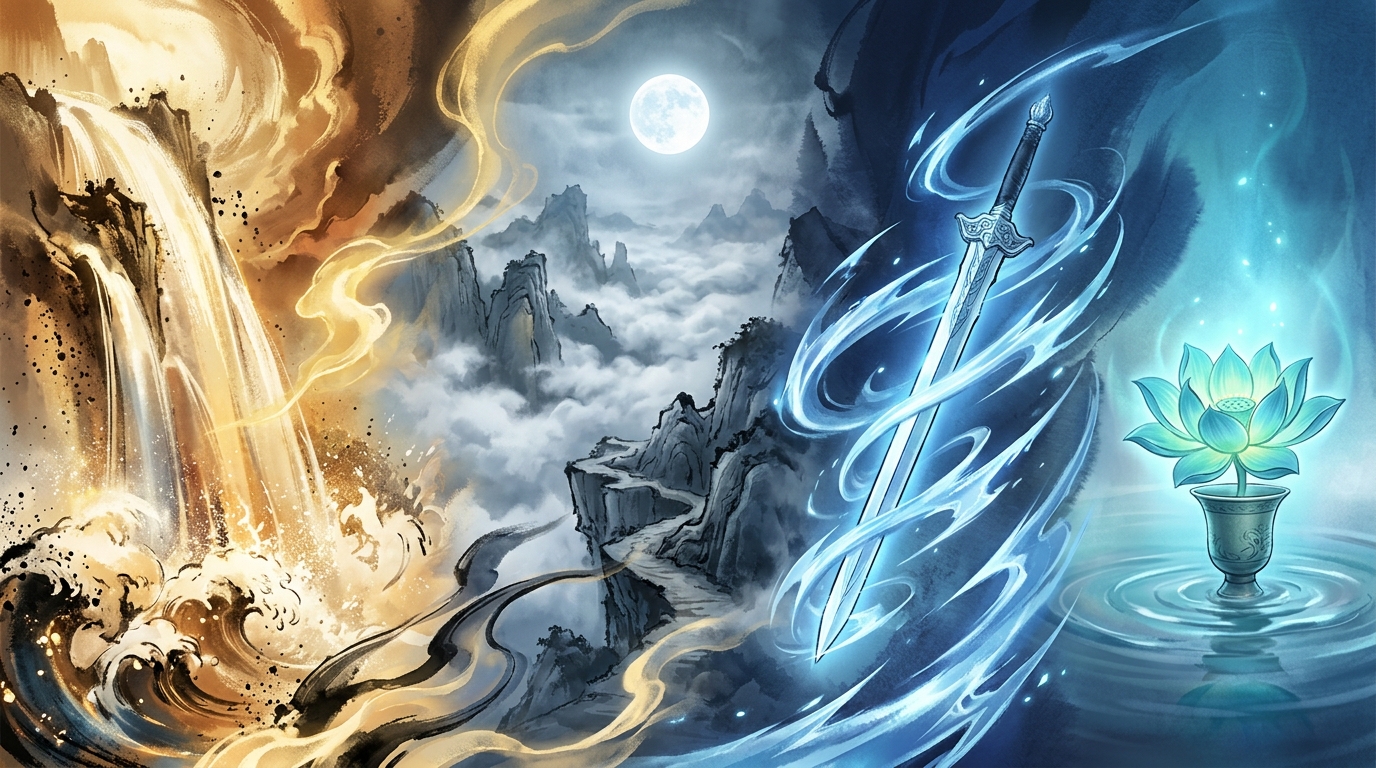
A thousand years later the legend has a new version. In Honor of Kings he is the Green Lotus Sword Immortal, class: assassin, shouting “the river’s sword comes down from the sky” as his blades come out —
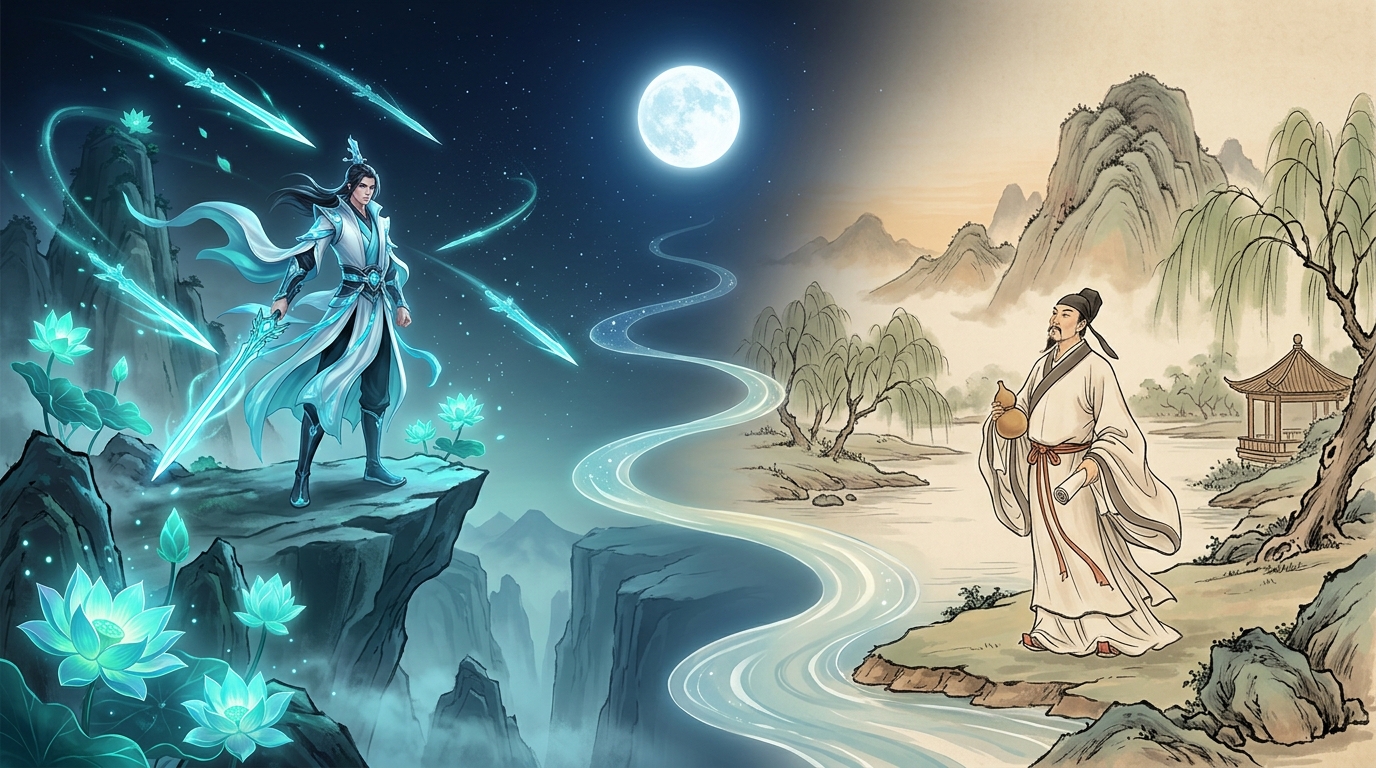
That “from the sky” is the Yellow River —
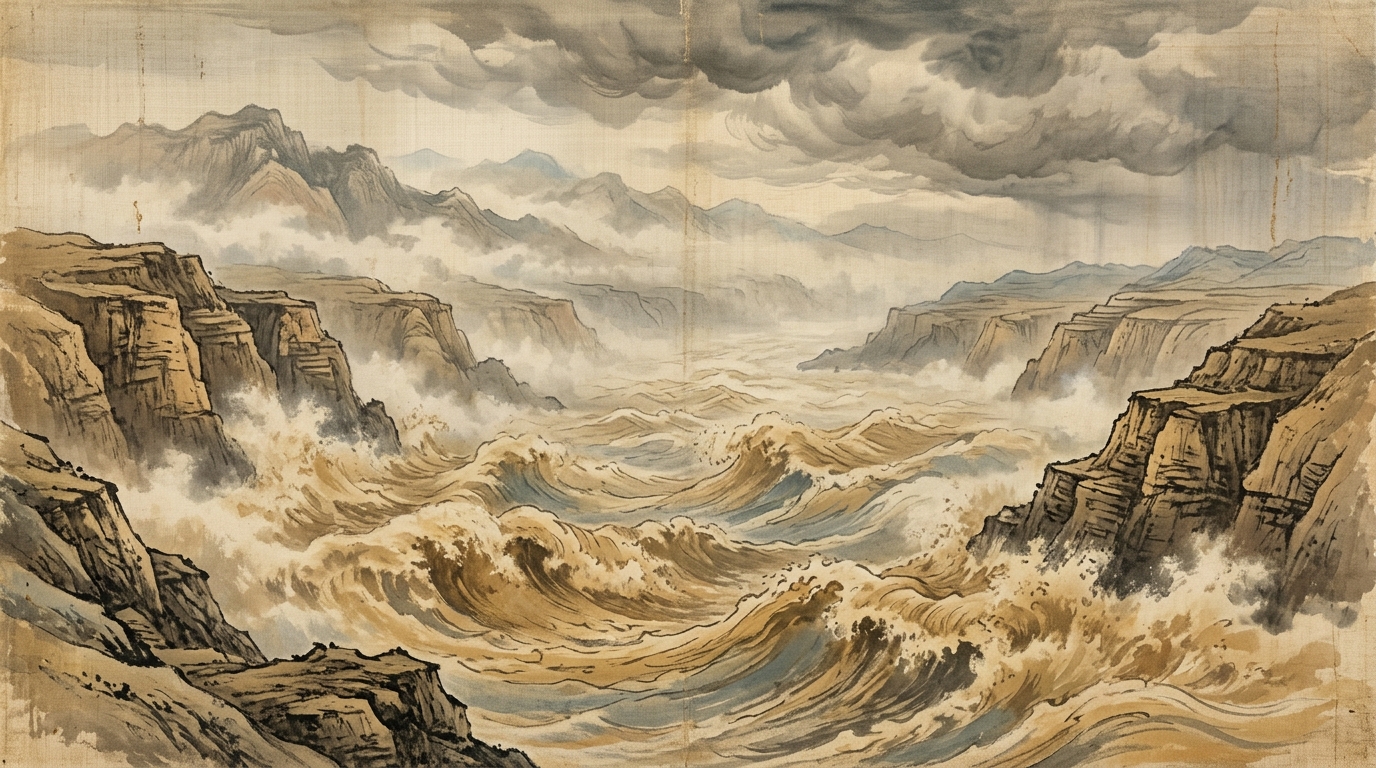
Nearly every element has a source. The cry reworks “You have not seen — the Yellow River’s water comes down from heaven,”2 the opening of “Bring In the Wine”; the sword-gash verse comes from “Dreaming of a Journey to Tianmu”; “Green Lotus” is his own signature, Green Lotus Hermit. The game made a classic adaptation — a poet’s lines, recast as a glowing sword.
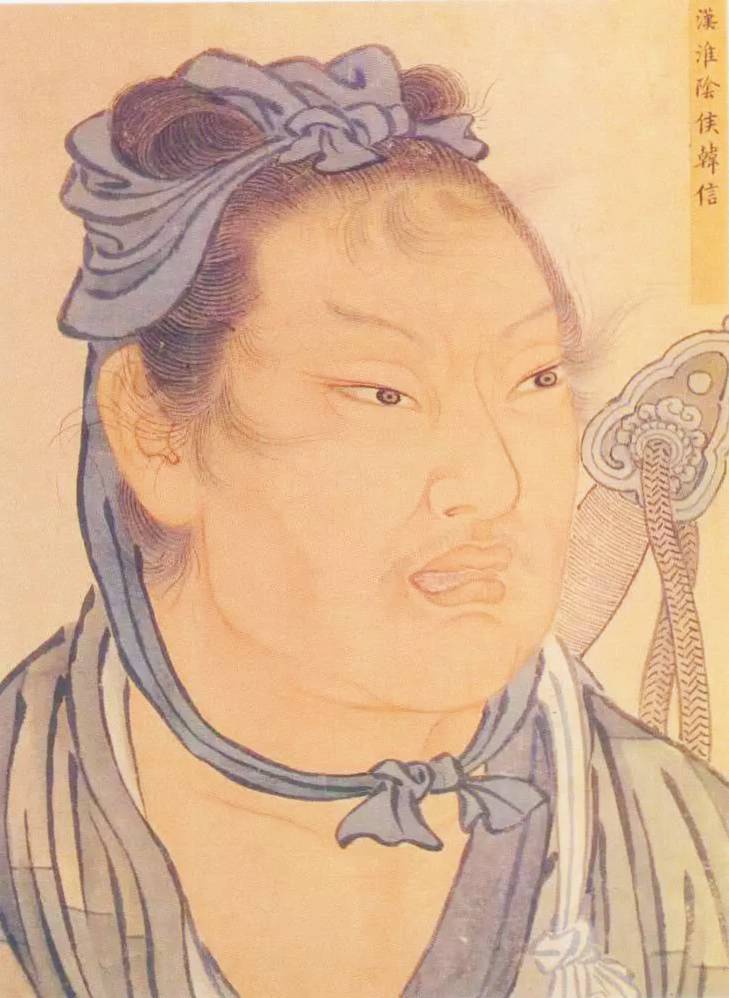
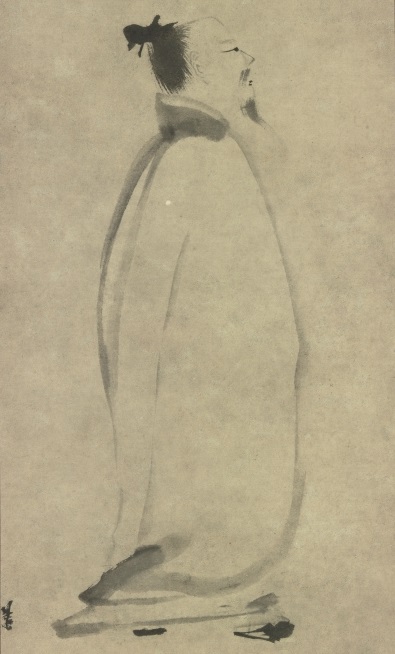
The Li Bai on paper never carried a sword. Eight hundred years ago the Southern Song painter Liang Kai left this portrait in reduced brushwork: no background, no props, one figure striding head-high, robes in the wind, the page otherwise empty.
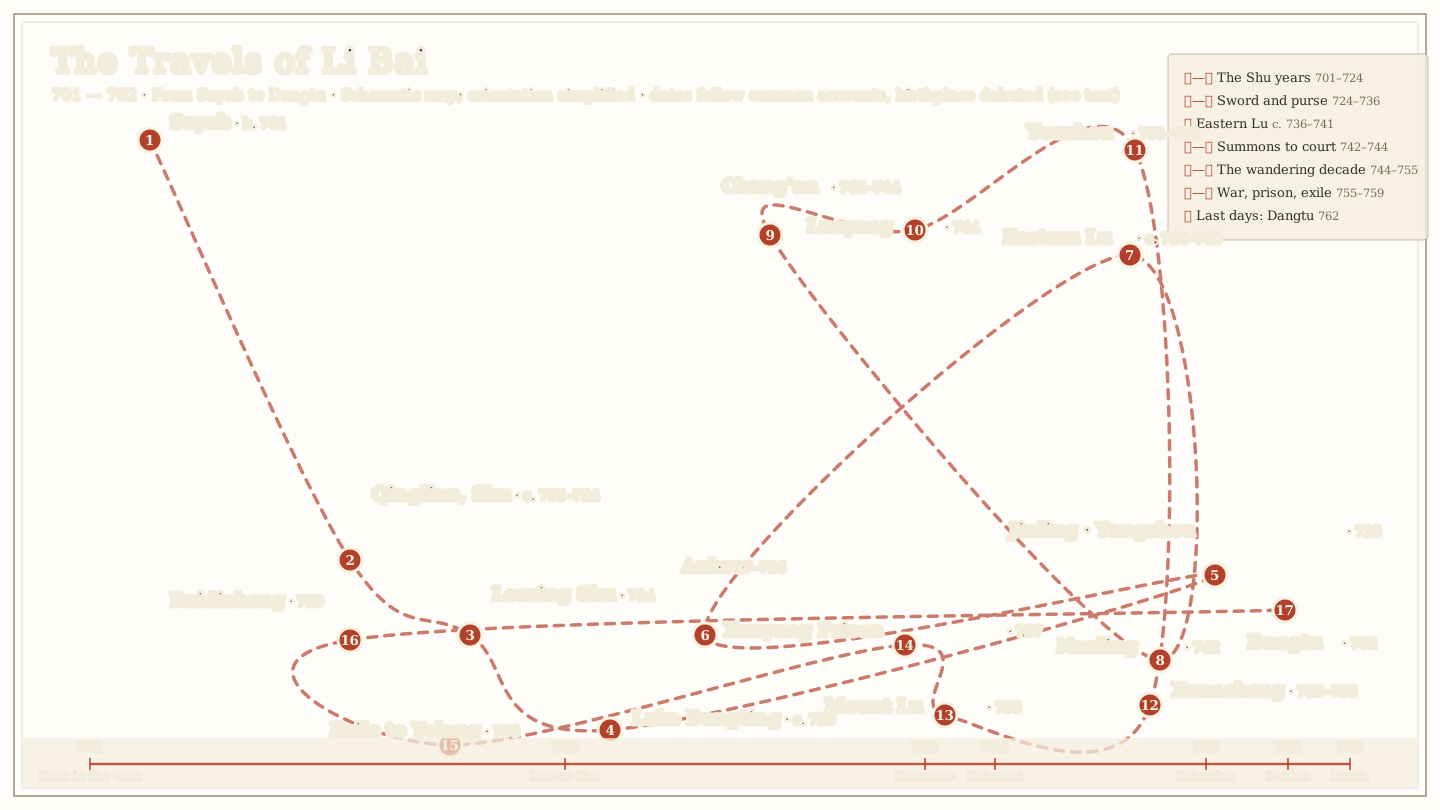
Legends can be retold any number of ways; the real Li Bai lived his life once. The map below follows him the whole way — every stop is a place he actually went. Start at the beginning, in a place called Suyab.
An Uncertain Origin: From Suyab to Qinglian
About where he came from, Li Bai left unusually few clues. Three accounts survive — his clan uncle Li Yangbing, who edited his collected works; Fan Chuanzheng, who moved his tomb decades later; and two of the official histories. The New Tang History says his ancestors “in the last years of Sui were exiled to Suyab for a crime.” Li Yangbing’s preface has the family “settled blameless in Tiaozhi,” then “at the start of the Shenlong era, fleeing back to Shu.” Fan’s epitaph reads “in the troubles of late Sui, one branch was driven out to Suyab.”3
The ruins of Suyab lie near today’s Tokmok in Kyrgyzstan — the farthest of the Tang’s four garrisons of Anxi. Li Bai was born in 701, the first year of the Chang’an era. If the family only reached Shu around 705, he was born in the Western Regions; Chen Yinke made that argument in the 1930s, and it has been argued ever since without a verdict. What is certain is the childhood: Qinglian township in Mianzhou (today’s Jiangyou, Sichuan), and a self-chosen name, Green Lotus Hermit (Qīnglián jūshì 青莲居士) — the first half of the game’s “Green Lotus Sword Immortal” comes from that small Sichuan town.
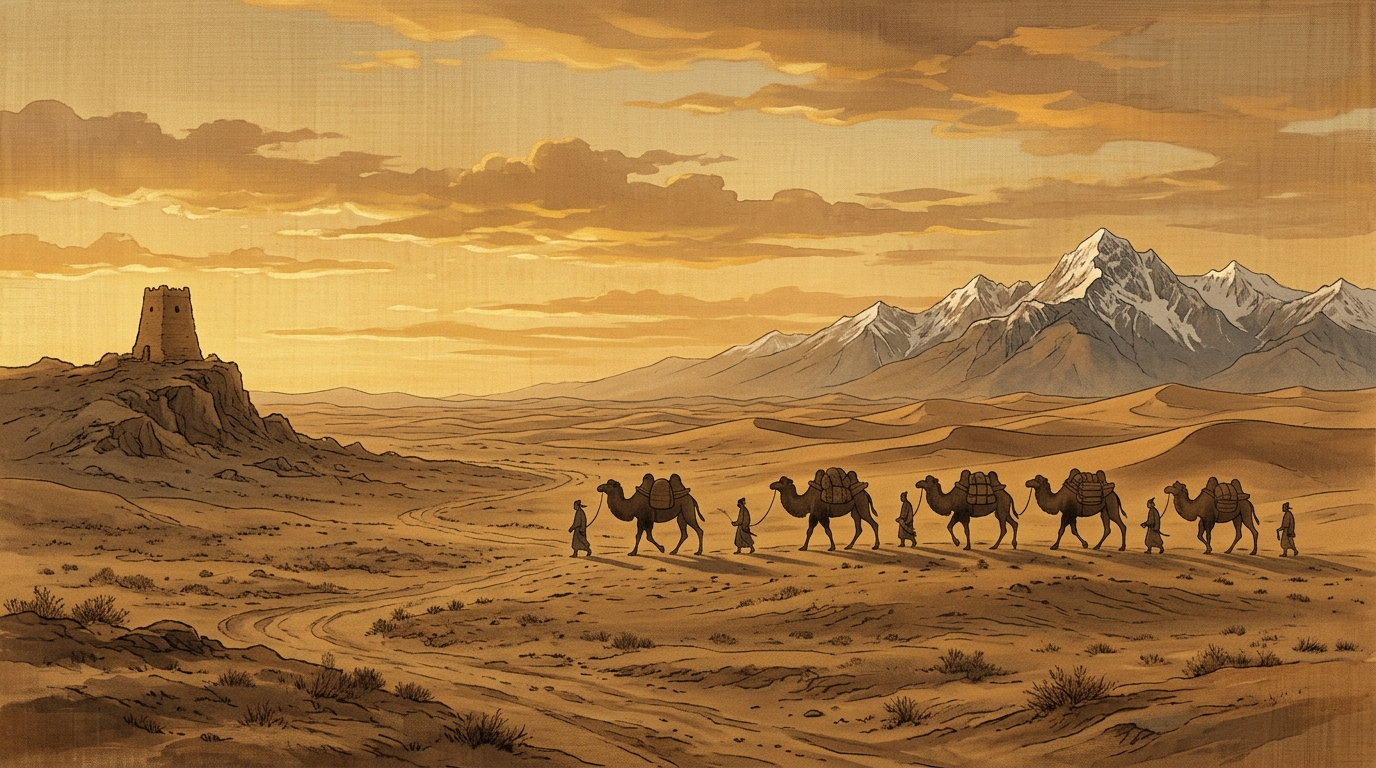
If he was born in Suyab, the world of his childhood was the Silk Road. In this mural from a Western Regions cave, Sogdian merchants — the road’s great traders — move with their camels. Camel bells, wine shops and foreign merchants are the backdrop of a “Suyab” childhood.
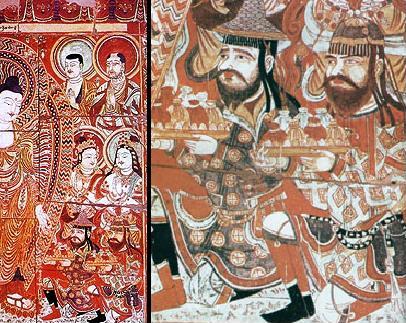
Gobi, beacon towers, snow peaks, camel trains: goods moved stage by stage from Samarkand to Chang’an, and Suyab sits at the road’s midpoint — garrison, post stations, markets, all of it. A childhood there began not with Chang’an’s temple bells but with the sound of these camels.
The Banished Immortal: Two Years in Chang’an
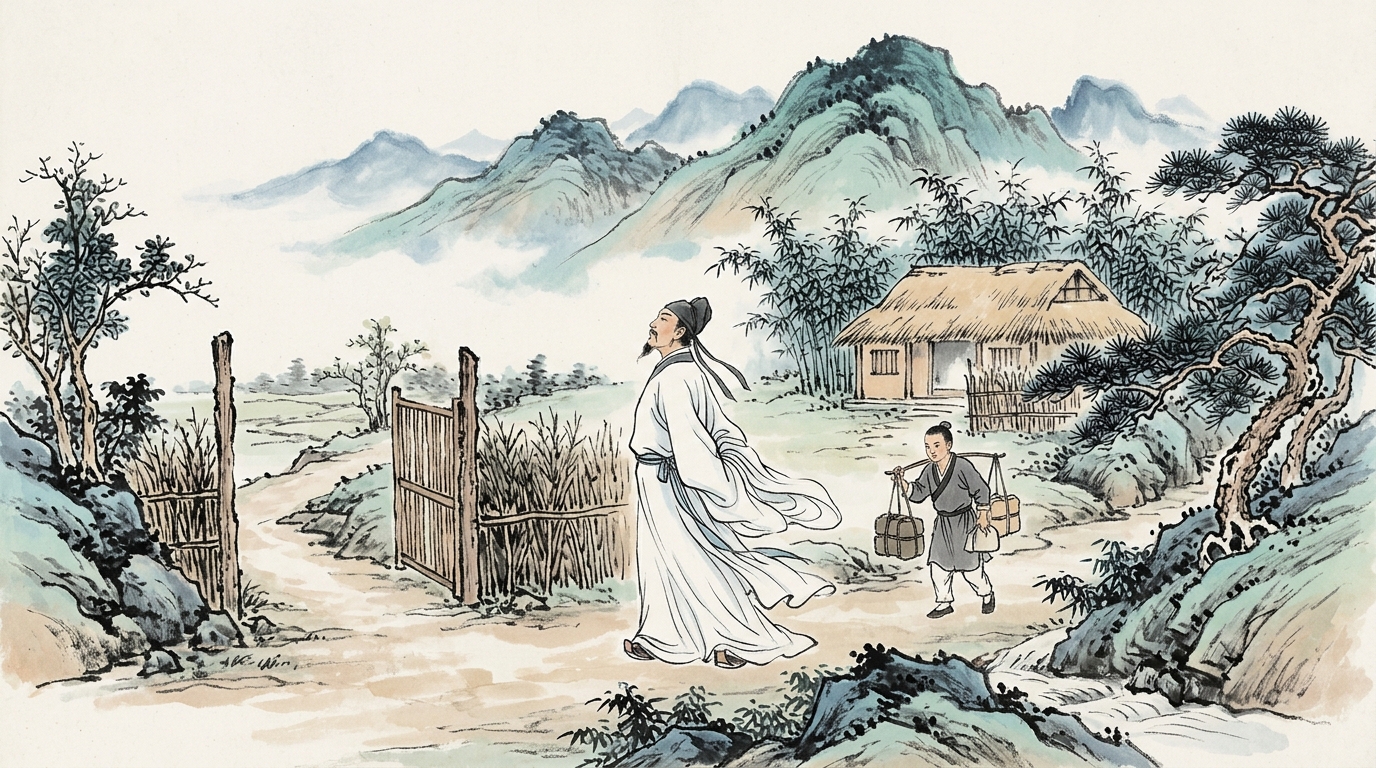
In 742, the first year of the Tianbao era, the summons arrived. Li Bai was forty-two.
Laughing at the sky, I stride out the gate —
was I ever born to fade among the weeds?
Li Bai, 'Farewell to My Children at Nanling'
The court’s title for him was Hanlin Attendant — awaiting the imperial summons — not Hanlin Academician. No office, no policy; the work was poems for royal amusement. The difference gets missed: he never stood inside real power, and when Fan Chuanzheng’s epitaph styles him “Hanlin Academician,” that is posterity being generous.
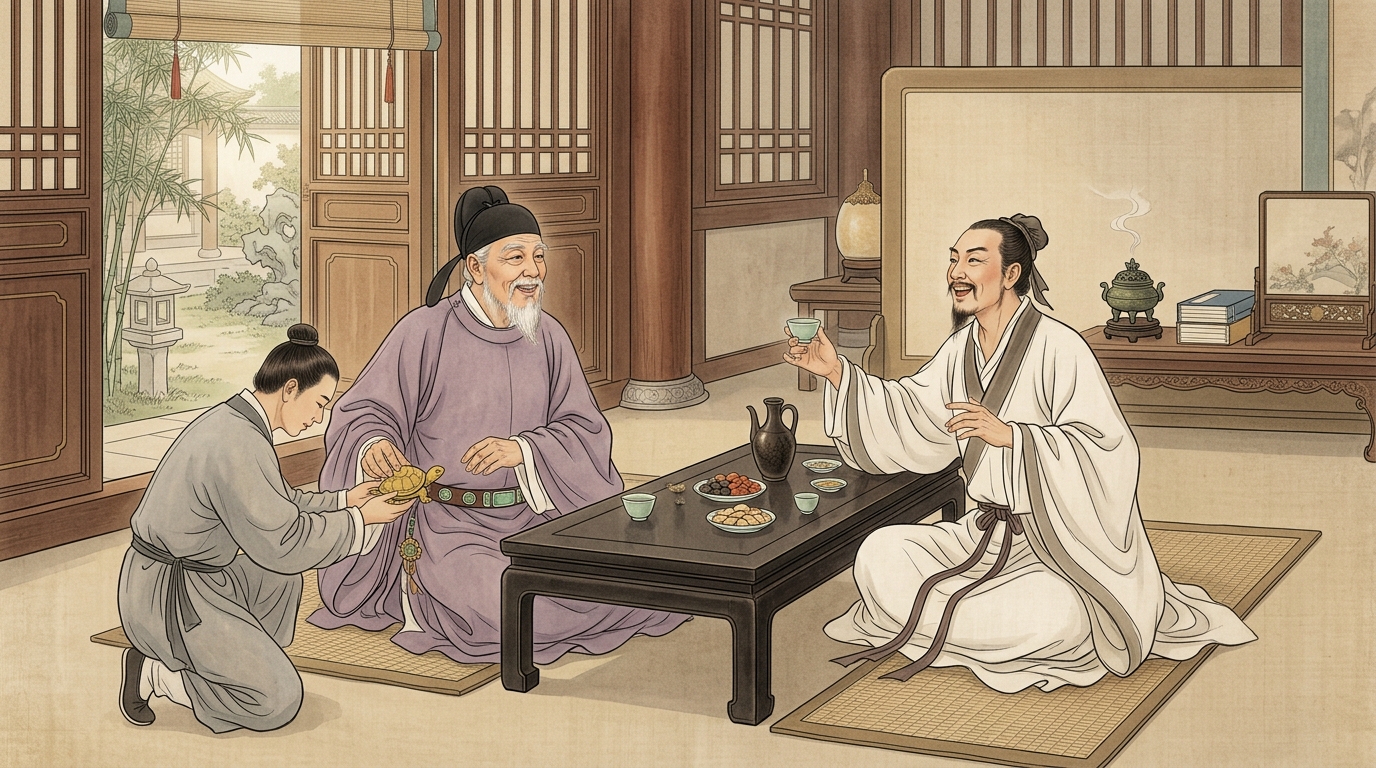
He Zhizhang read his poems at the Purple Polar Palace and cried “a banished immortal!” (zhé xiān rén 谪仙人) — then unclasped the golden turtle at his belt to pay for wine. The story comes from Li Bai himself; the New Tang History says He Zhizhang had been reading “The Road to Shu Is Hard.”
Master He, Grand Tutor to the Crown Prince, met me once in the Purple Polar Palace at Chang’an,
called me a banished immortal, and traded the golden turtle at his belt for wine — we had a marvelous time.
Li Bai, preface to ‘Remembering He Zhizhang over Wine’
- jīn guī 金龟
- A gilded turtle belt-badge worn by very high Tang officials, the metal marking rank. Trading it for wine was court dignity put on the table.
As for drafting edicts drunk, and the boot pulled off by Gao Lishi, the emperor’s favorite eunuch, the Old Tang History keeps to one line: “Bai once waited on the emperor; drunk, he had Gao Lishi pull off his boots.” The fuller scenes come from Tang anecdote collections — fact and embellishment were already blurring while he lived.
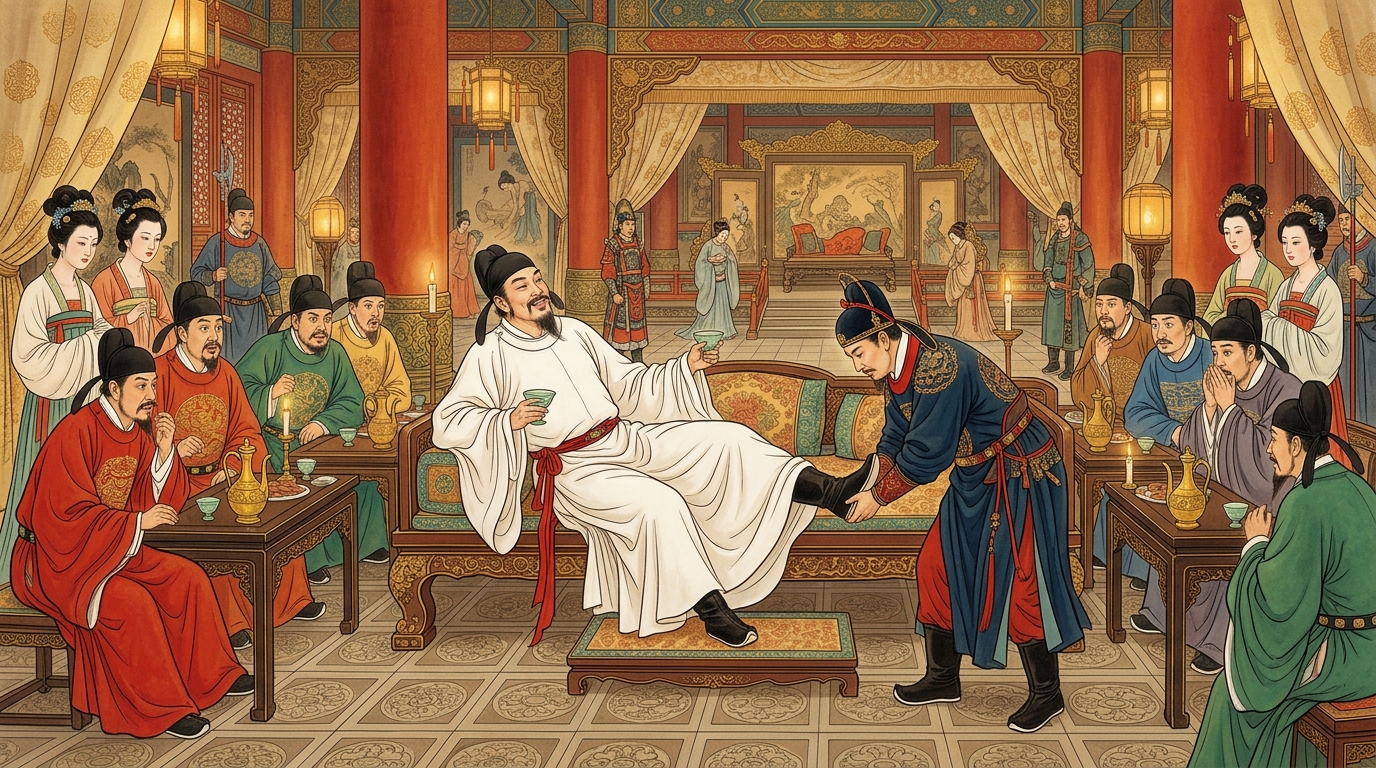
A little over two years in, Xuanzong “dismissed him with gold” — a gracious phrase for an expulsion, recorded plainly in both histories.
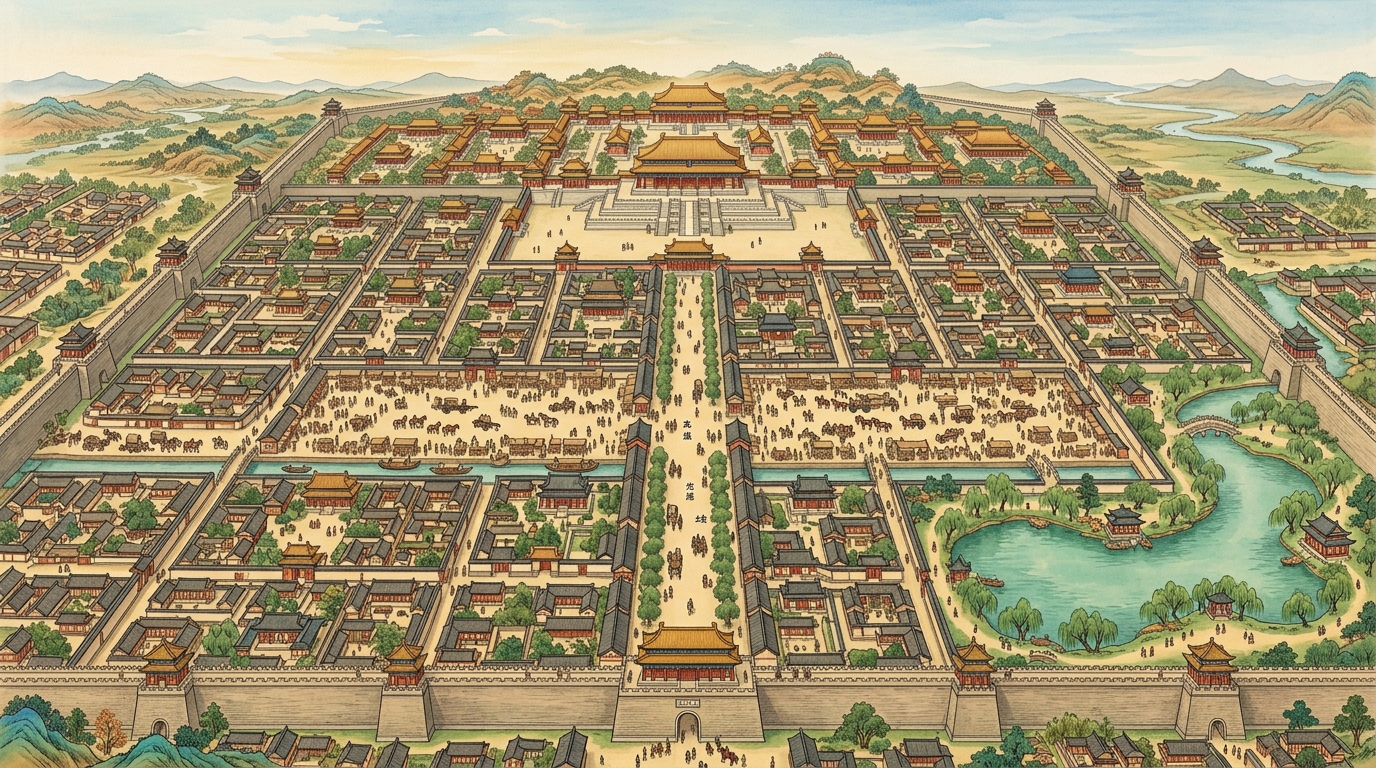
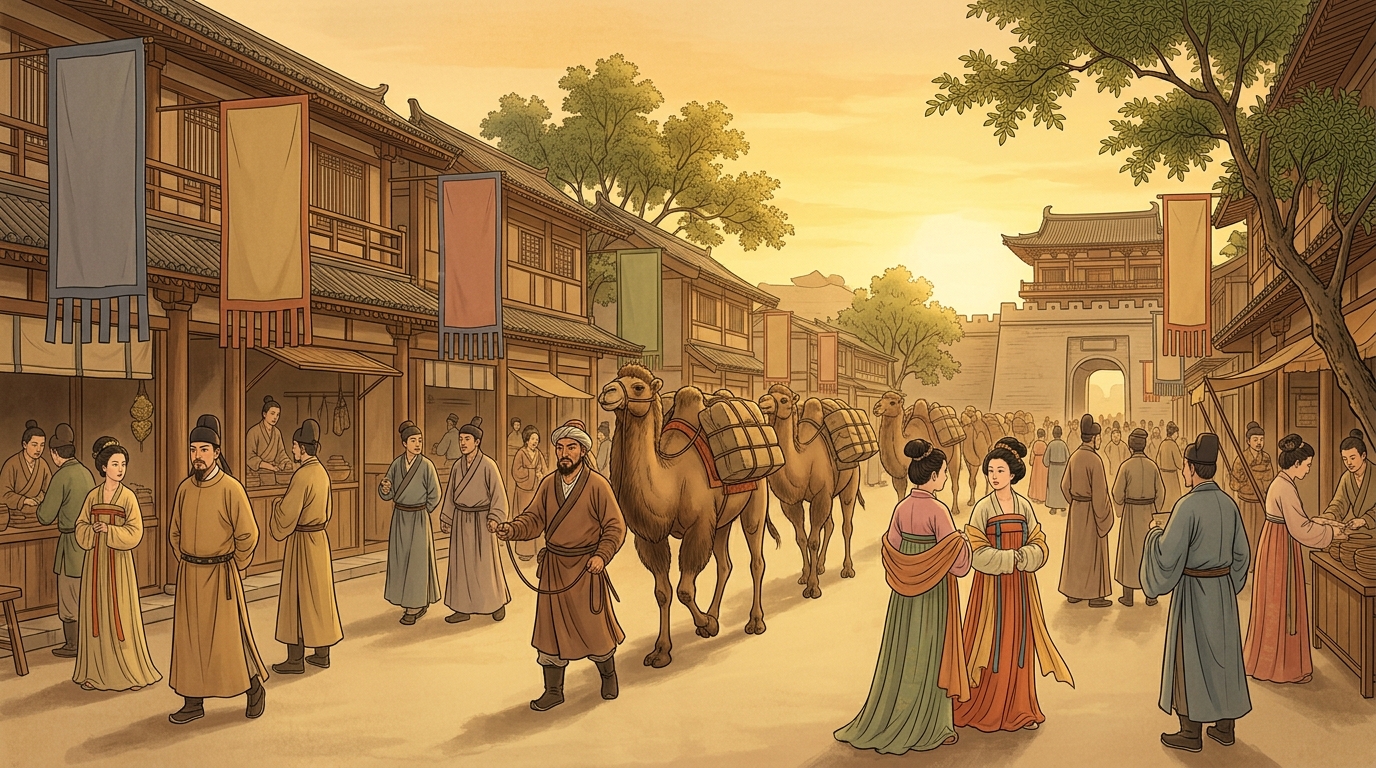
At street level the wine shops hung their banners, Sogdian traders walked camels through the ward gates, and a dozen languages mixed on the avenues. Chang’an held a million people, one of the largest cities on earth — and his two years there were steeped in that street life.
Wine, Swords, and Verse
The decade of wandering after Chang’an was his most productive stretch: “Bring In the Wine,” “Dreaming of a Journey to Tianmu” and “Hard Is the Road” all come from these years. Close to a thousand of his poems survive.
He did talk about swords. In “A Letter to Governor Han of Jingzhou” he claims he was “fond of the sword at fifteen”; in “The Ballad of the Knight-Errant” he writes “Ten steps, one man slain; a thousand li and no one can stop him.”4 That is most of why the game cast him as an assassin. But sword-talk among Tang literati was largely a knight-errant posture — few of them were planning to kill anyone.
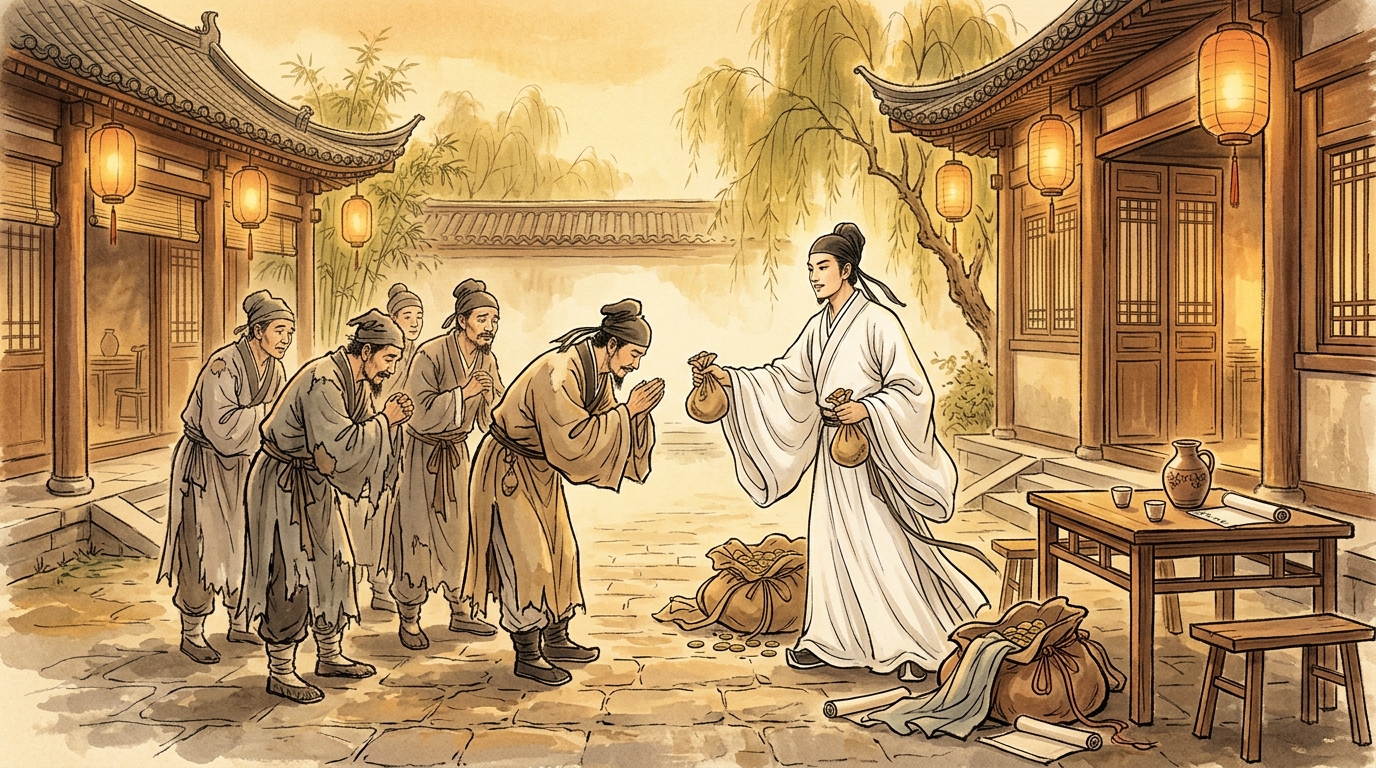
The wandering was not all talk, either. In “A Letter to Pei, Chief Minister of Anzhou,” he records two episodes from his younger years: on a long stay in Yangzhou he gave away more than 300,000 cash in under a year, supporting stranded young gentlemen; and when his travel companion Wu Zhinan died on the shore of Lake Dongting, he buried him where he fell, returned years later to reborrow money for a proper burial, cleaned the bones with his own hands and carried them wrapped on his back. One episode shows the open hand, the other the loyal one — startling to read, but both are his.
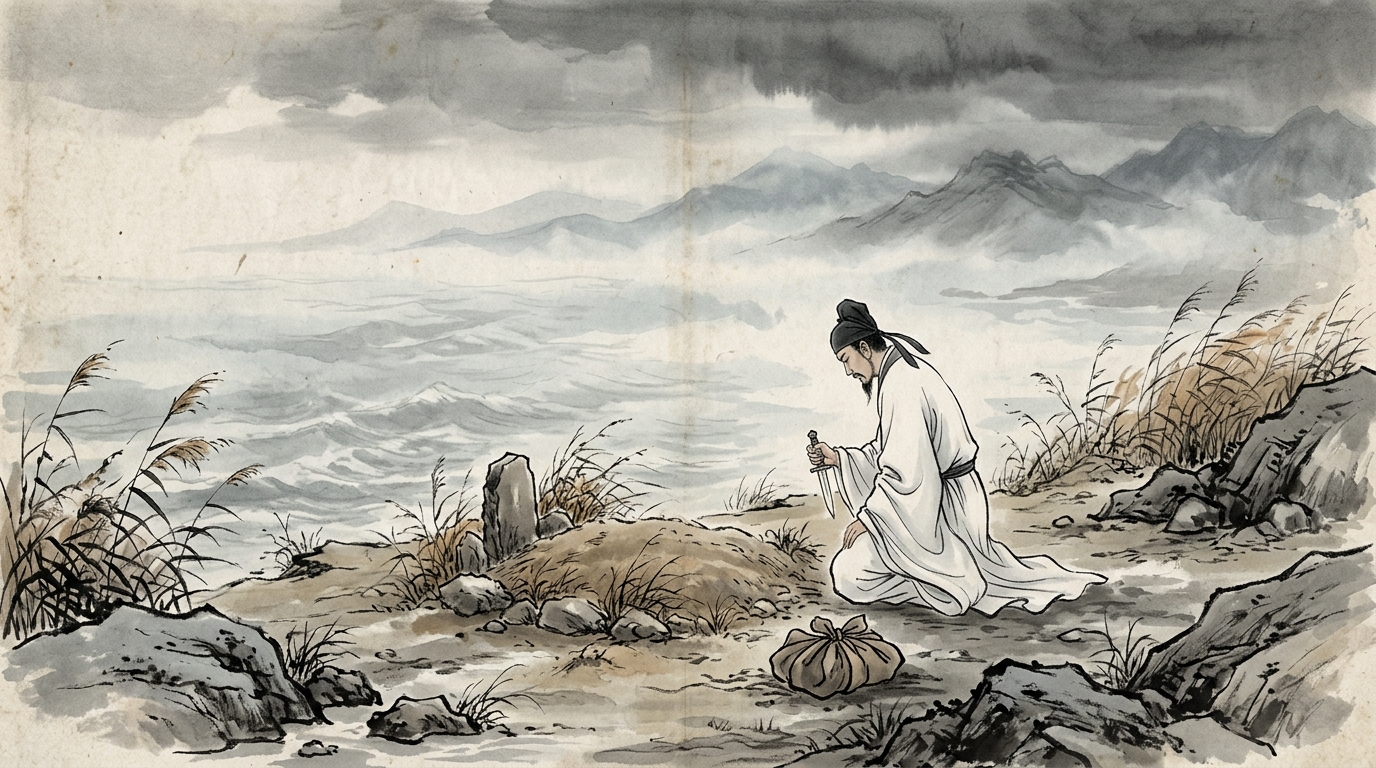
And the wine goes without saying. Du Fu sings him in “Song of the Eight Immortals of the Wine Cup”:
Li Bai: a dou of wine, a hundred poems;
asleep in a wineshop on Chang’an’s market street.
Summoned by the Son of Heaven, he wouldn’t board the boat —
“Your subject,” he said, “is an immortal of wine.”
Du Fu, ‘Song of the Eight Immortals of the Wine Cup’
- dǒu jiǔ 斗酒
- A dou, roughly ten liters — poetic scale for heroic drinking.
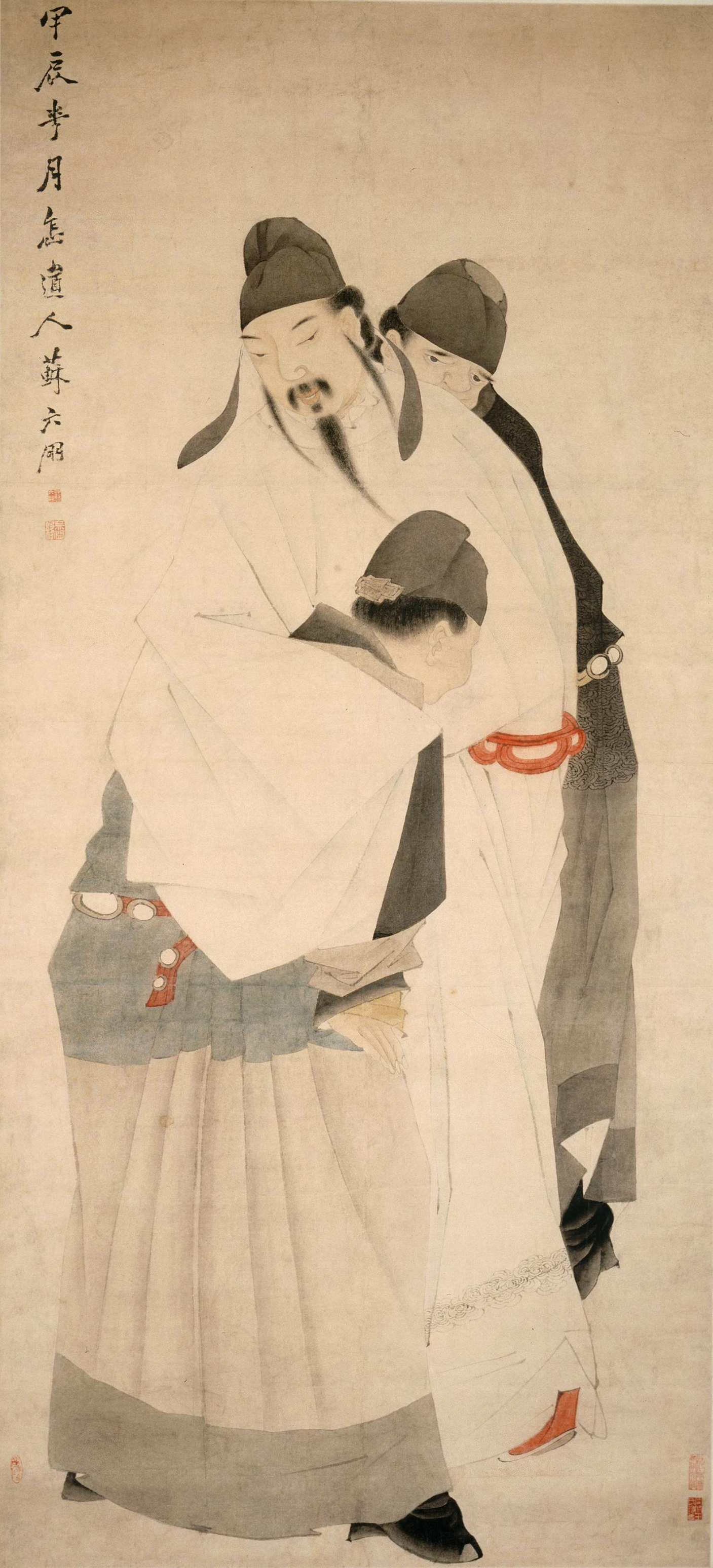
The Qing painter Su Liupeng’s “Li Bai Drunk” shows the poet exactly as later ages imagined him after drinking. The game’s story says that after his dismissal he “gained wine alongside the sword” — and half of that image was already in the poems.
His handwriting survives, too. The “Shangyang Tower Scroll” is the only generally accepted Li Bai manuscript in existence, with a label by Emperor Huizong of Song; it is usually read as a memorial to his Daoist friend Sima Chengzhen, written on a visit to the Shangyang Temple on Mount Wangwu.
Mountains high, rivers running long, ten thousand things in view —
without the old master’s brush, where would such freshness and force end?
Li Bai, inscription on the Shangyang Tower Scroll (Shàng yáng tái tiè)
- lǎo bǐ 老笔
- An "aged brush" — calligraphy of weathered, deliberate strength.
Chinese original
山高水长,物象千万,非有老笔,清壮何穷。

The Yellow River in his lines, the sword-gash on the Vermilion Gate, the assassin’s role, the name Green Lotus — all of it is already in the poems:
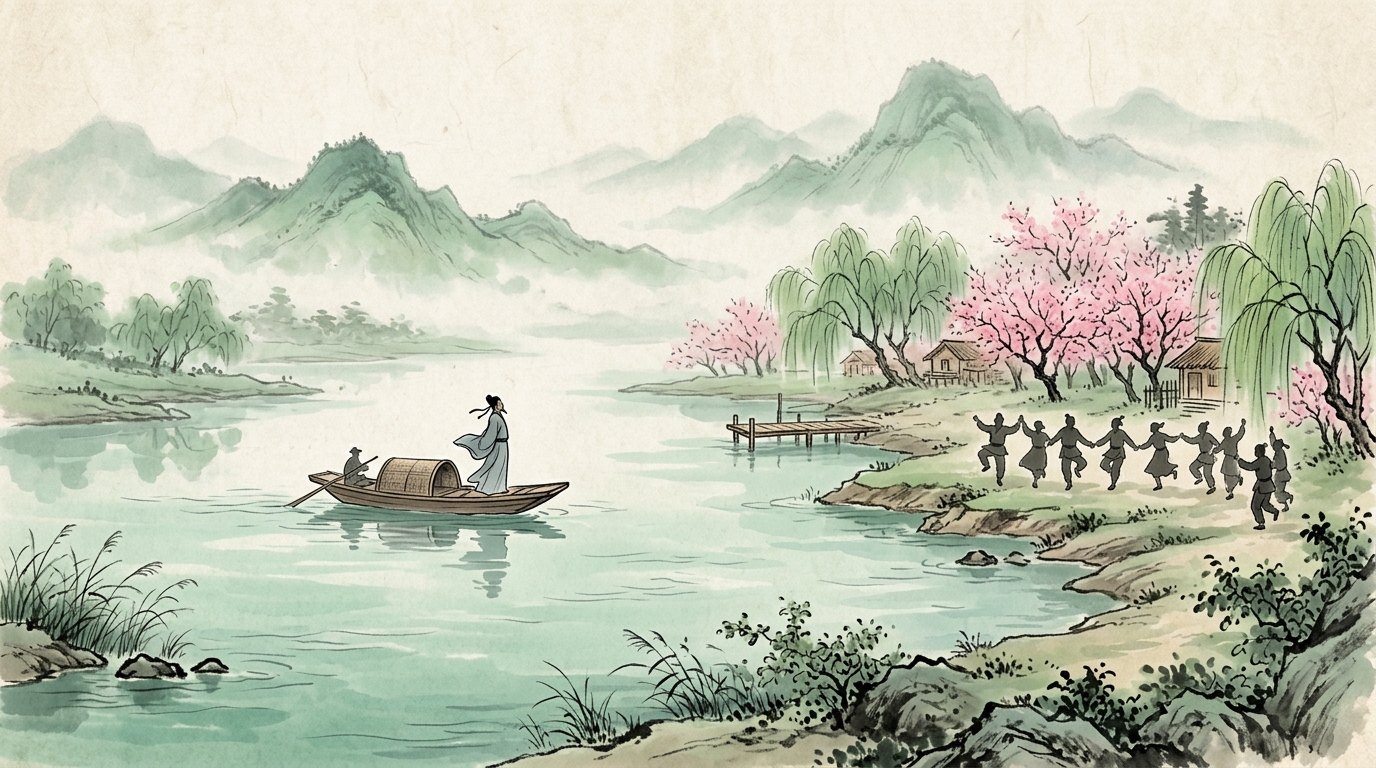
He made friends without checking their rank, too. Late in life, the story goes, he was passing through Jing County when a local admirer, Wang Lun, sent him a letter: “Sir, do you love travel? We have ten li of peach blossoms here. Do you love wine? We have ten thousand wine shops.” He went, and found that Peach Blossom was the name of a pool and Ten Thousand Families the family name behind one shop. Far from taking offense, as he boarded his boat he heard singing on the bank, and wrote on the spot: “The peach-blossom pool may be a thousand feet deep — it cannot match the feeling Wang Lun sends me off with.”5
The Prince Yong Disaster
In the winter of 755, An Lushan rose in revolt. Li Bai took refuge on Mount Lu — and then made the decision that would shadow the rest of his life: the road down the mountain led to the river fleet of Prince Yong, Li Lin. Eleven poems “Written on Prince Yong’s Eastern Tour” document the enlistment — “Give me the Xie An of Eastern Mountain, and I will sweep the barbarian dust away in talk”6 — with Li Bai casting himself as Xie An, sure that the moment he had waited half a lifetime for had finally come.
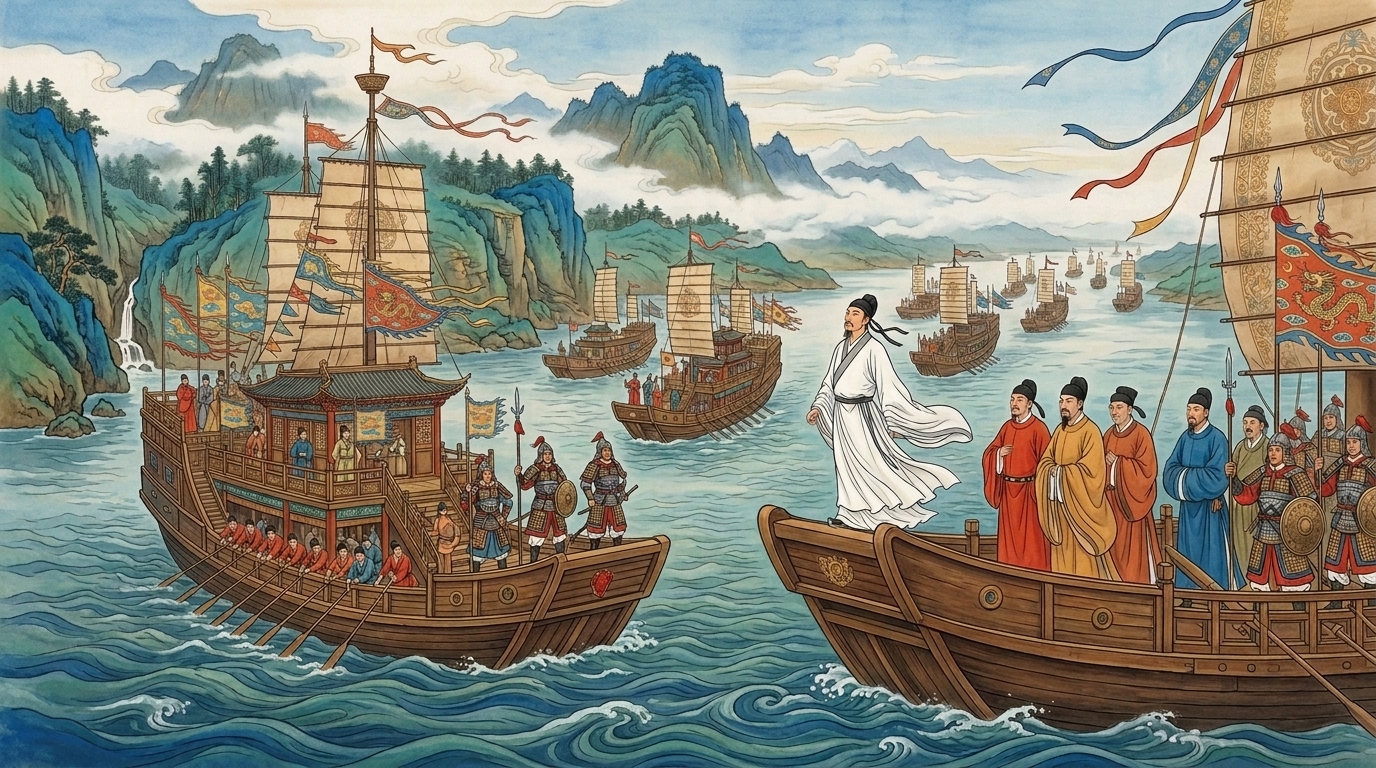
The prince was beaten and killed, and Li Bai became a convicted rebel, jailed at Xunyang. The histories also keep one dramatic tale: that Guo Ziyi, whom Li Bai had once shielded from prosecution, offered his own rank to ransom him — but the dates hardly line up, and scholars mostly read it as legend. It is repeated here as repeated there, doubts included.
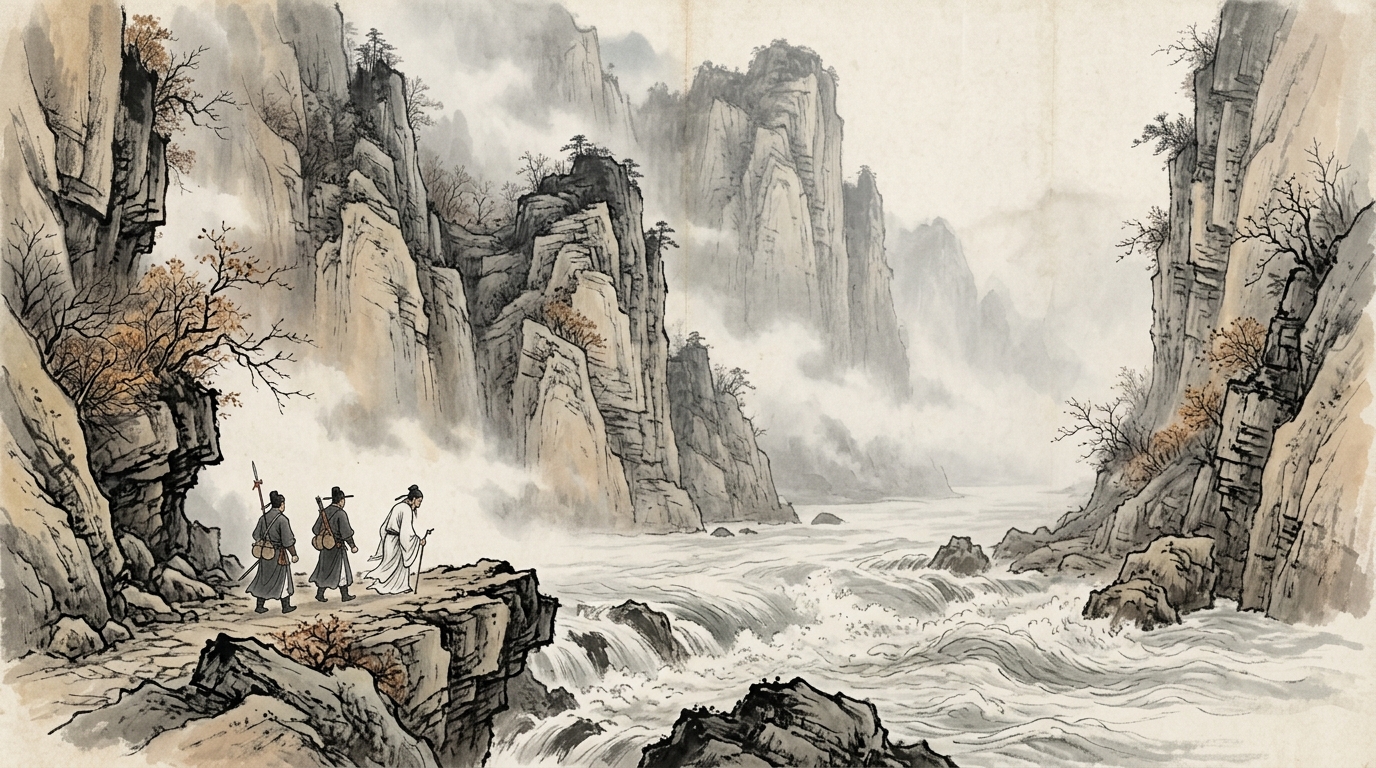
At fifty-nine he was sentenced to exile in Yelang. In the spring of 759, reaching Baidicheng, an amnesty caught up with him and he turned for home — writing, on the way, the poem every Chinese schoolchild can recite:
At dawn I leave Baidi crowned in colored cloud —
a thousand li to Jiangling, done in a day.
Li Bai, ‘Setting Out at Dawn from Baidicheng’ (早发白帝城)
- Jiānglíng 江陵
- A city in modern Hubei, roughly 1,200 li downstream from Baidicheng.
Chinese original
朝辞白帝彩云间,千里江陵一日还。
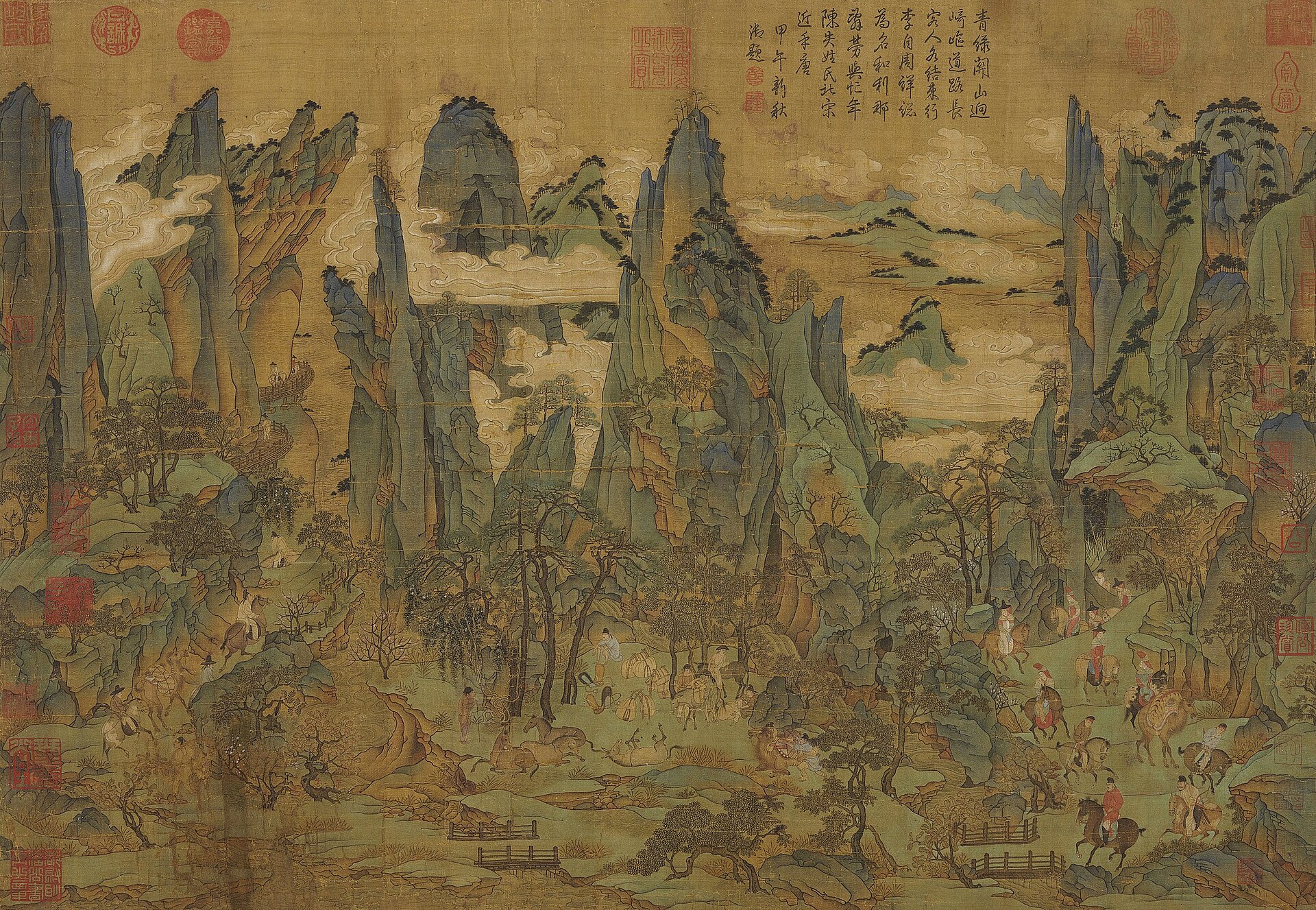
The same war sent Emperor Xuanzong fleeing to Shu. “Emperor Minghuang’s Journey to Shu,” attributed to Li Zhaodao, paints the imperial train: a green-and-gold landscape that cannot quite hide the panic. The emperor into Shu, the poet back east — two halves of one exposure.
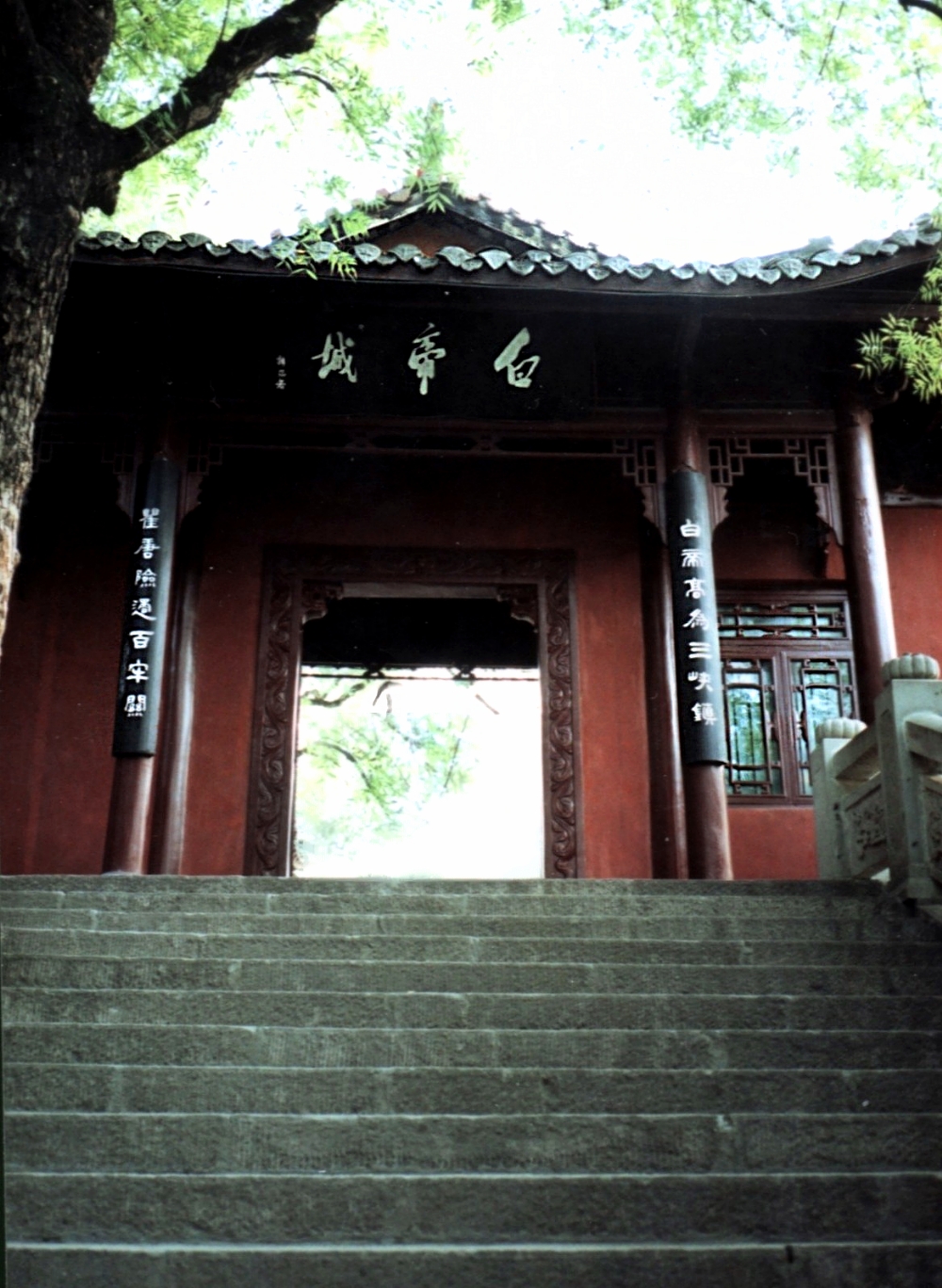
Baidicheng still stands at the mouth of the Qutang Gorge.
On the map, Xunyang, Yelang and Baidicheng light up in sequence. Not an adventure map: a real road of exile, and a road home from the edge of death.
The End at Dangtu
In the winter of 762 Li Bai died at Dangtu, staying with his clan uncle Li Yangbing, the county magistrate. Before the end he handed over his life’s manuscripts — “gravely ill; ten thousand pages of draft, unedited, passed to me from his pillow.”
So how did he die? At least three records survive — three documents, three endings:
Old Tang History, Literary Biographies (Liu Xu, Later Jin)
“He drank to excess, dying drunk in Xuancheng.”
The official biography names the cause — drink — and the place, Xuancheng.
New Tang History, Arts Letters & Li Yangbing, preface to the collection
“In his last years he favored the Huang-Lao way… he loved the Green Mountain of the Xie family and wished to end his days there.” / “Gravely ill; ten thousand pages of draft, unedited, passed to me from his pillow.”
Death by illness at Dangtu, manuscripts entrusted to Li Yangbing; Fan Chuanzheng later moved the tomb to Green Mountain, honoring his wish.
Tang Zhizhiyan (Wang Dingbao, Five Dynasties)
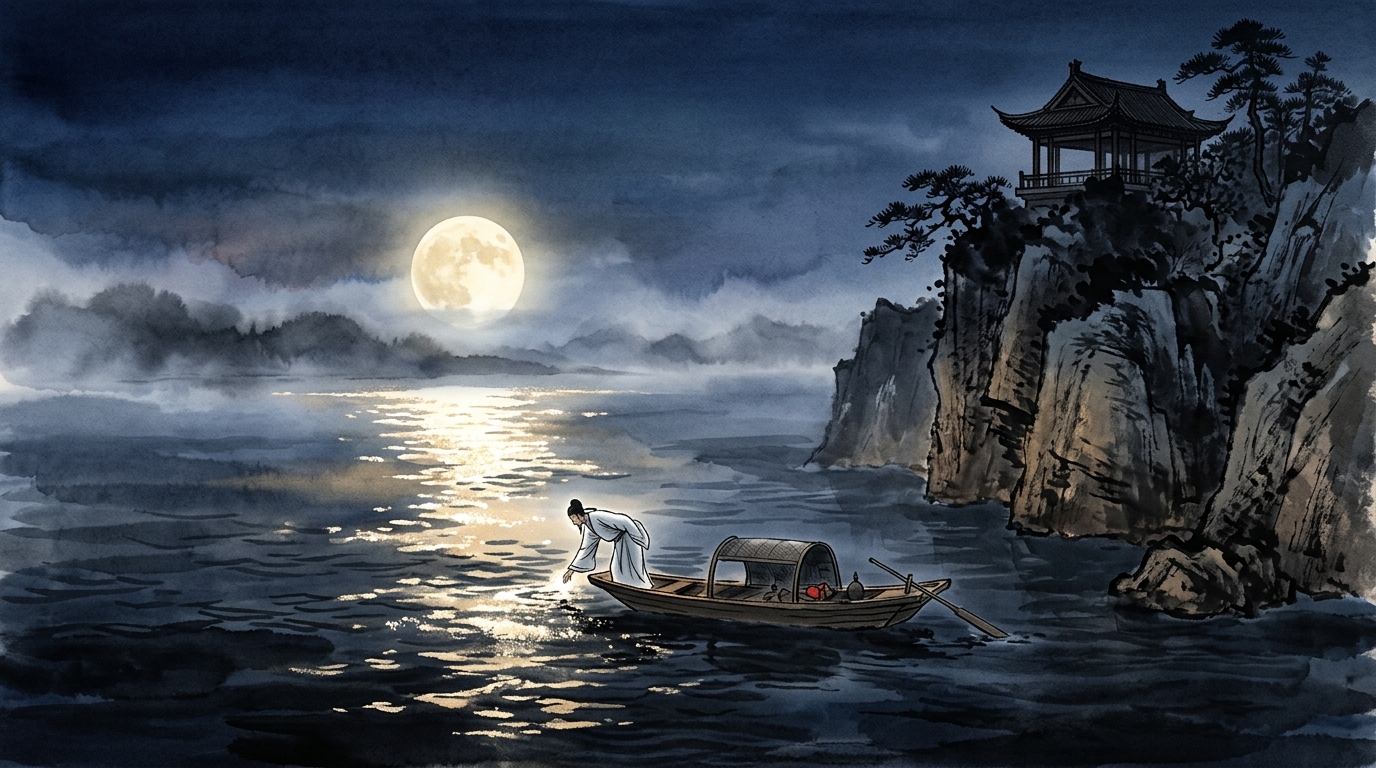
“In a palace brocade robe he drifted on the river at Caishi, proud and self-possessed, as if no one else were there; drunk, he leaned into the water to seize the moon, and drowned.”
A legend from two centuries after his death, and the origin of the moon-grasping image — the version that spread the widest.
People chose the poetry over the sickbed.
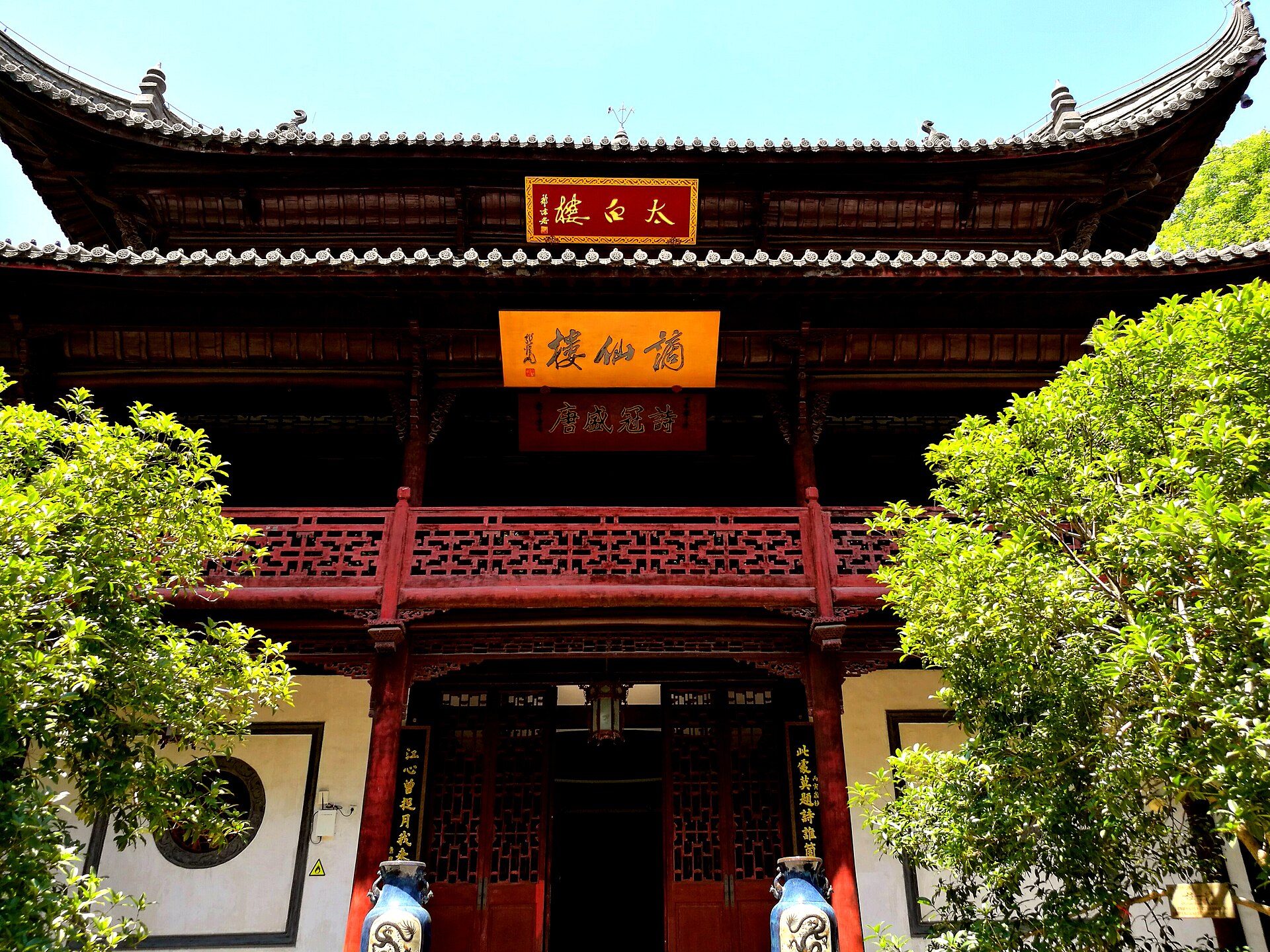
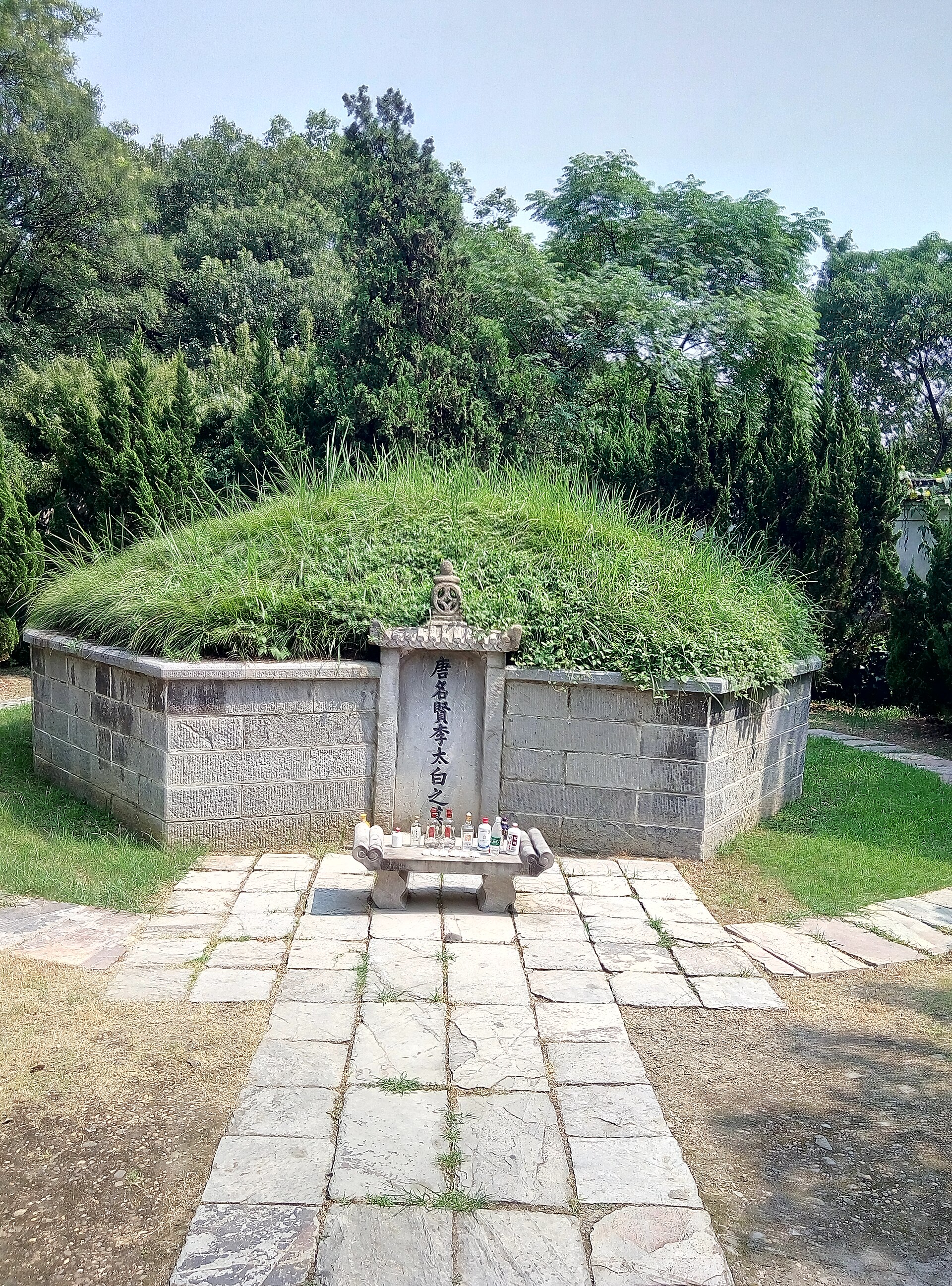
Dangtu built him the Taibai Tower and buried him at Green Mountain, near the old home of Xie Tiao, the Southern Dynasties poet he idolized. Fan Chuanzheng, who moved the grave, put the wish on stone: “his heart was on Green Mountain.”
Why the Canyon Chose Him
Li Bai is likely the most rewritten poet in Chinese history. The game’s character — sword, wine, verse, freedom — is rooted at every point: the sword at fifteen is his own line; the hundred poems per peck of wine is Du Fu’s song; Green Lotus Hermit is his own signature; banished immortal was He Zhizhang’s shout. The real parts are already legendary, and the legendary parts are already real — which is why every generation rewrites him.
The game tells an openly invented story — empresses, detectives, desert kingdoms — and still closes its hero page with a “Li Bai in history” panel. Even inside the game, people want the real one.
The real Li Bai had no equipment slots and no cooldown timers, only a brush and a rough, eventful life. He wrote his truest self into the poems — that is where the sword from the sky actually comes from.

Notes
-
The line is from “Dreaming of a Journey to Tianmu.” ↩
-
The opening of “Bring In the Wine.” ↩
-
Suyab’s ruins lie near today’s Tokmok in Kyrgyzstan; where Tiaozhi was has never been pinned down. The New Tang History makes the move punitive; Li Yangbing’s preface insists the family was blameless — the disagreement has never been settled. ↩
-
The sword claims come from “A Letter to Governor Han of Jingzhou” and “The Ballad of the Knight-Errant.” ↩
-
The poem is “To Wang Lun.” ↩
-
Eastern Mountain (Dongshan) was where Xie An withdrew from public life before returning to lead the state to victory — Li Bai is asking to be that comeback. ↩
Sources & further reading
- Old Tang History, vol. 190B — Literary Biographies (Li Bai annex biography)
- New Tang History, vol. 202 — Arts Letters (Li Bai biography)
- Li Yangbing, preface to the Cao Tang Collection
- Honor of Kings official site — Li Bai hero page (backstory and In History panel)
- Honor of Kings official hero data, herolist.json (accessed 2026-10-12)
About the media
Cultural-relic images are public domain via Wikimedia Commons (Liang Kai, Su Liupeng, Li Bai's Shangyang Tie, Ming Huang's Journey to Shu, Bezeklik Sogdian merchants). Photos via Wikimedia Commons with credits: Baidicheng (Tang Ge, CC BY 2.5), Taibai Tower (Virgil Guo, CC BY-SA 4.0), Li Bai tomb (Sancho Zheng, CC BY-SA 4.0). Maps, quote cards and interactive components are original work by this project. Some illustrations were generated for this article as artistic interpretations.