Sun and Moon Over the Sky: Wu Zetian Beyond the Canyon
In Honor of Kings, the Empress strikes every corner of the map from her fountain. In the histories, Wu Zetian walked sixty-eight years of a life more astonishing than any skill description.
Updated
The Empress in the Canyon
In Honor of Kings, Wu Zetian is less a character than a presence. Title: Empress. Class: mage. From her fountain she can strike any corner of the map — no other hero’s ultimate reaches that far, and her skins arrive with full imperial ceremony.1 Her signature line is among the most quoted in the game: “Don’t look down, or the crown will fall. Don’t cry, or the queen is smiling.”2
What is interesting is how the official backstory was written. Most heroes in the canyon get a fantasy origin invented from scratch. Hers tracks the histories almost beat for beat: presented to the palace at fourteen by a local official; confined in a convent; visited there by the new Emperor, who had seen her at an incense ceremony and brought her back; and after his death, Empress of the empire in her own right. All four beats trace to the Two Tang Histories and the Comprehensive Mirror — the game copied the skeleton and left out everything between the bones.
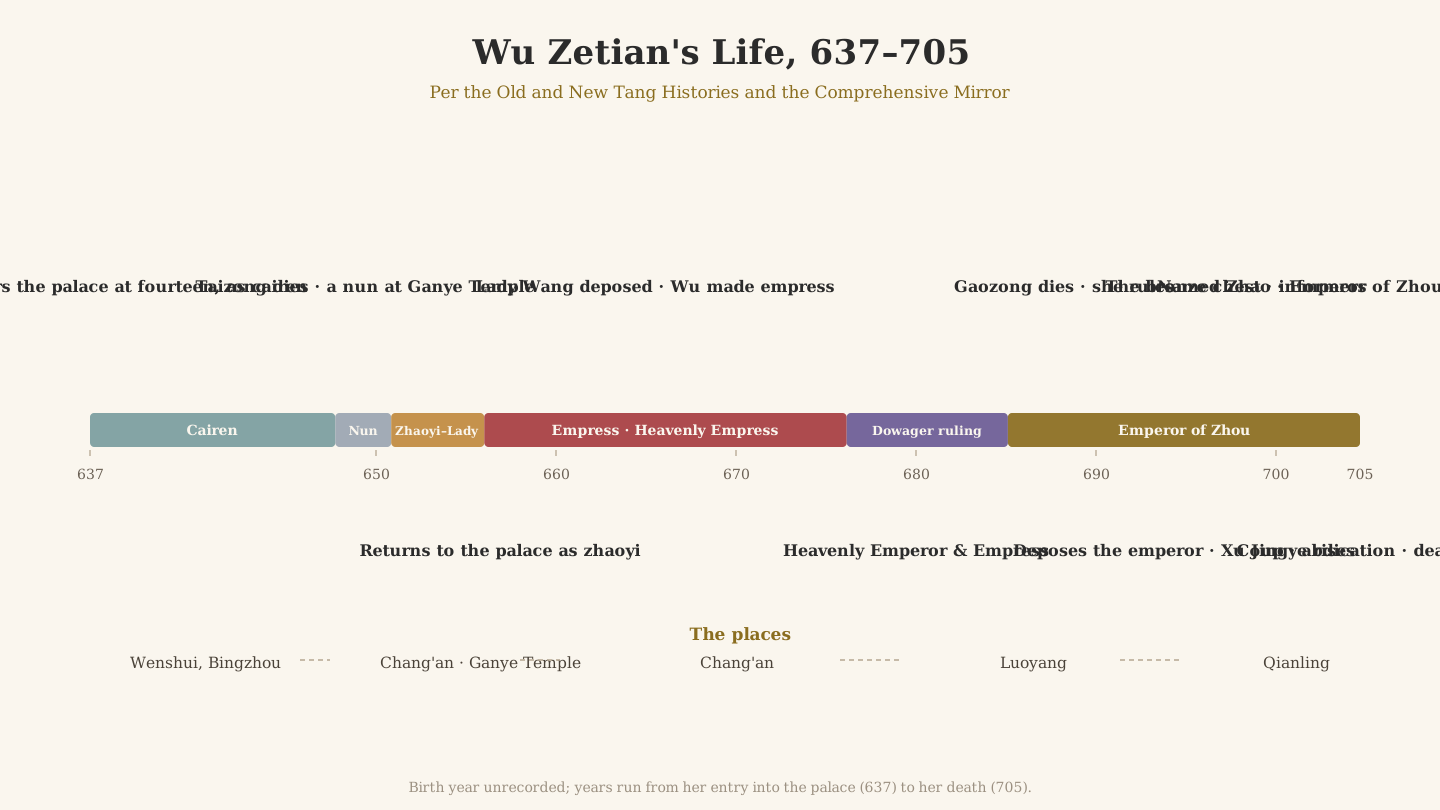
The version on paper has no prophecy and no magic. It has a woman who spent sixty-eight years walking from the edge of an inner palace to the throne itself, and then, by her own testament, stepped back down. This article walks the whole road — from a boast about a horse, through the lamp of Ganye Temple, the edge of a succession war, a new examination in the Luocheng Hall, secret letters dropped into a bronze box, and a character she invented for her own name — to a stele at Qianling with not one word carved on it.
A Boast and a Lamp
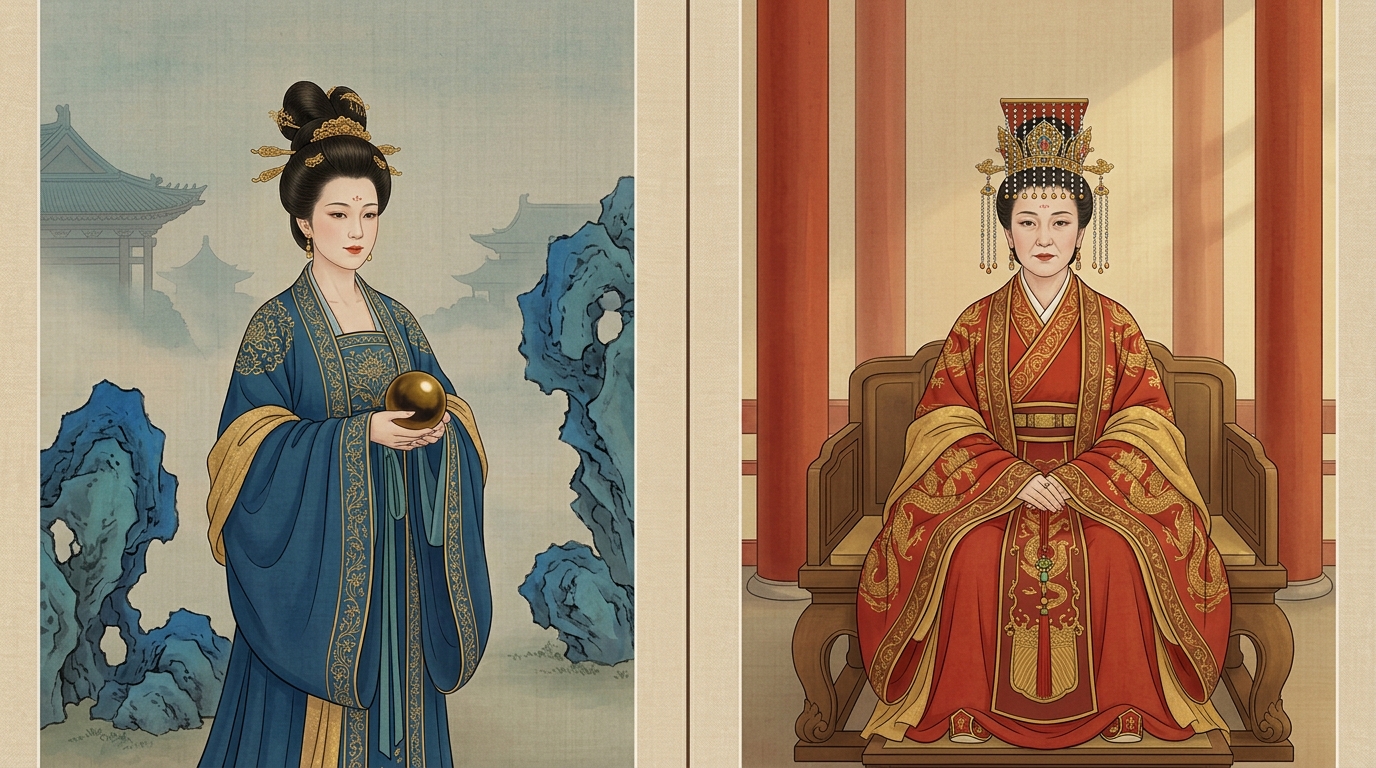
Wu Zetian was from Wenshui in Bingzhou. Her father Wu Shihuo had been a low company officer in Sui’s last years; Li Yuan’s army quartered at his house on the march through Fen and Jin, and when the uprising began he followed it into Chang’an, rising to Minister of Works and Governor of Jingzhou, enfeoffed Duke of Ying. The family had bet correctly.3
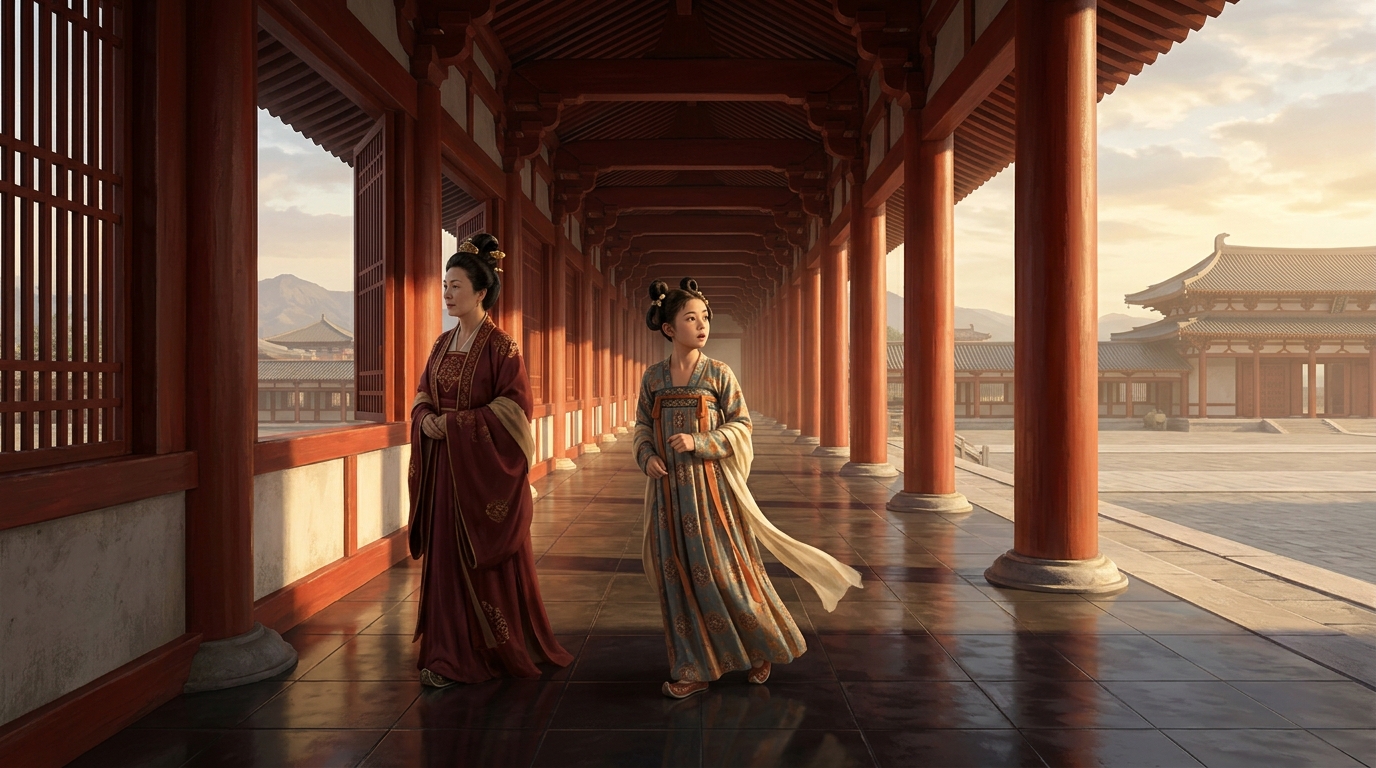
In the eleventh year of Zhenguan (637), Taizong heard of Wu Shihuo’s daughter:
At fourteen she was heard of by Taizong for her bearing and beauty,
and was summoned into the palace, made a cairen.
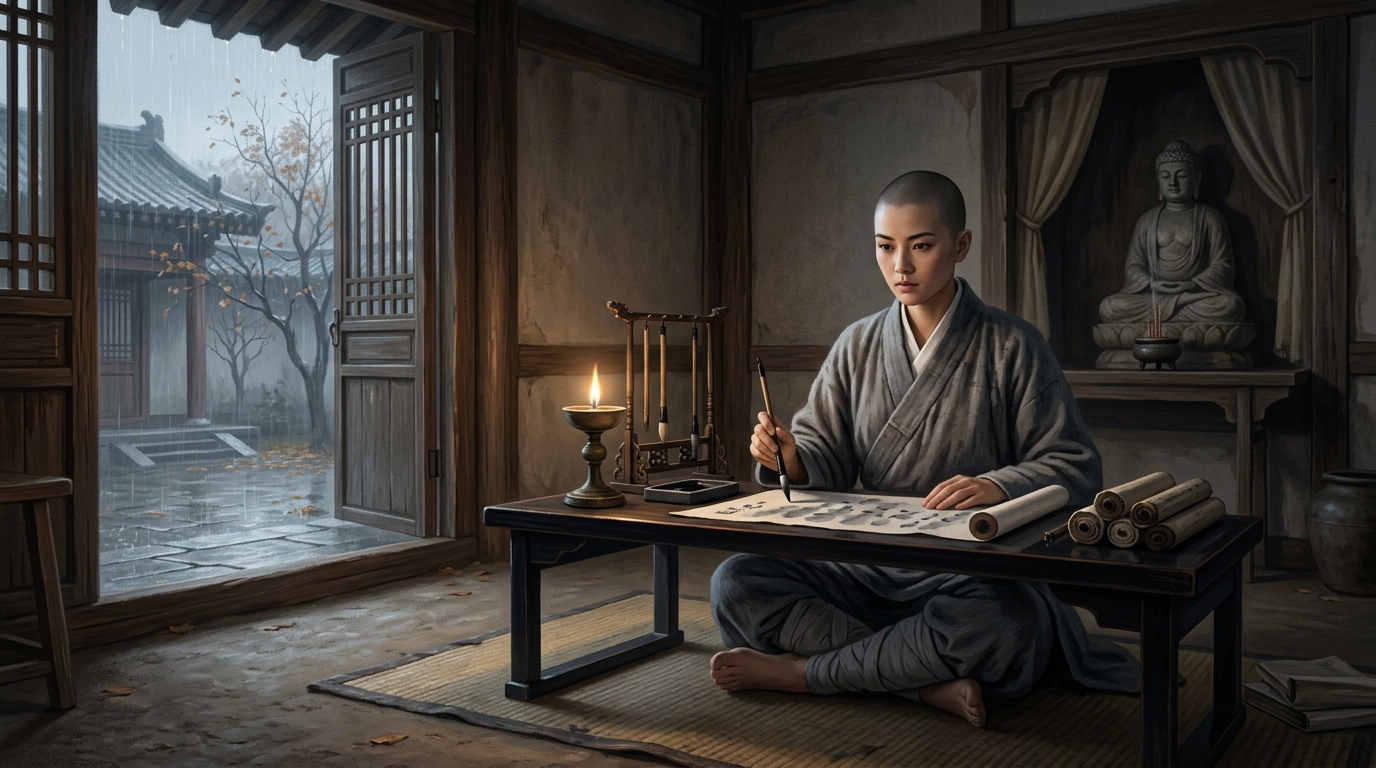
When Taizong died, she became a nun, and lodged at Ganye Temple.
Old Tang History, vol. 6, Basic Annals of Empress Wu
- cairen 才人
- A palace consort of the fifth rank, low in the hierarchy of nine ranks.
Fourteen, and a fifth-rank cairen. For the next twelve years the histories record almost nothing about her in Taizong’s court — no promotion, no children. The one episode that survives is a boast, and it survives only because she retold it herself, decades later, as Empress. Taizong, she said, had a horse named the Lion — sleek, violent, impossible to break. Standing at his side as a palace girl, she said she could tame it with three things: an iron whip, an iron mace, and a dagger. If the whip failed, the mace to its head. If that failed, the dagger to its throat. Taizong, she said, praised her spirit.4 Whether the scene happened as told, no one can verify — the telling is hers alone. But it says something that this was the story she chose to keep: the fourteen-year-old in her memory was not a girl fading in the rear palace, but one who made threats to anything untamable.
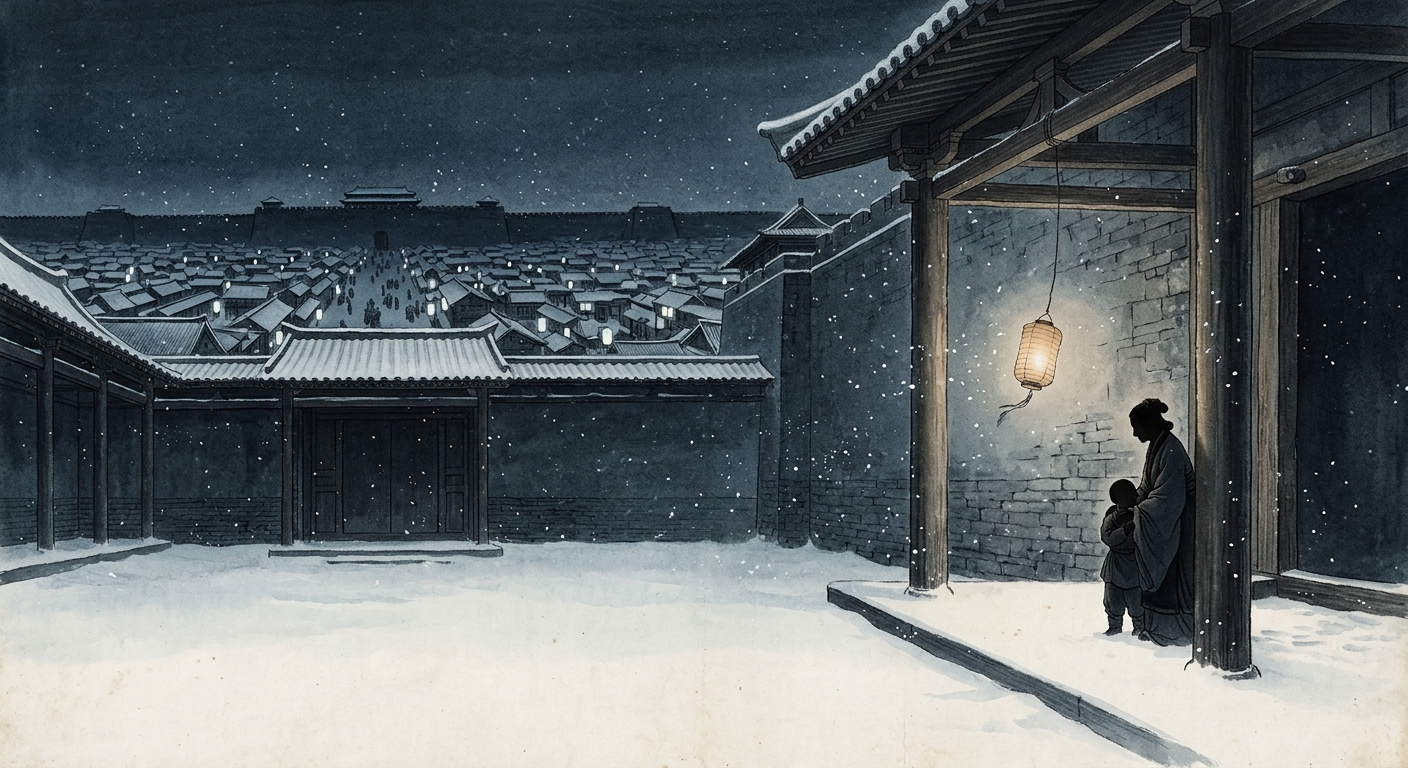
Then the first fall. In 649 Taizong died, and in her twenties she left the palace by rule, took vows, and moved into Ganye Temple as a nun.
The Pomegranate Skirt
The turning point came at an incense ceremony. The Comprehensive Mirror is blunt:
On the death-day of Taizong, the Emperor visited the temple to offer incense, and saw her —
Wu wept, and the Emperor wept.
Zizhi Tongjian, vol. 199
And outside the histories, one poem survives in her name. The Quan Tangshi anthology prints “Ruyi Niang” under Wu Zetian, and tradition reads it as written for the Emperor:
Seeing red as green, my thoughts tangle and fray —
haggard and undone, all from missing you.
If you doubt I have wept of late,
open the chest and check the pomegranate skirt.
'Ruyi Niang,' Quan Tangshi vol. 5, under Wu Zetian
Meaning看朱成碧思紛紛,憔悴支離爲憶君。不信比來長下淚,開箱驗取石榴裙。
- seeing red as green 看朱成碧
- Grief so strong it scrambles the eyes — the image goes back to a sixth-century line by Wang Sengru.
Under the lamp of Ganye Temple, the woman who once boasted about a dagger wrote this — a poem with its head bowed. Love, strategy, or both at once: no one can say, and the histories record nothing of when it was written or to whom.5 But it catches the other line the chronicle preserves — Wu wept, and the Emperor wept.
Lady Wang, the Empress consort, heard of it and made the decision that would undo her: she had Wu’s hair quietly allowed to grow again, and urged the Emperor to take her into the rear palace — not out of kindness, but to split the favor enjoyed by Consort Xiao. “Wu was clever and resourceful. On entering the palace she humbled herself and served the Empress,” who praised her again and again to the Emperor. Before long she was greatly favored and made a zhaoyi: now both Lady Wang and Consort Xiao had lost ground, and together they slandered her before the Emperor — who paid them no heed.6
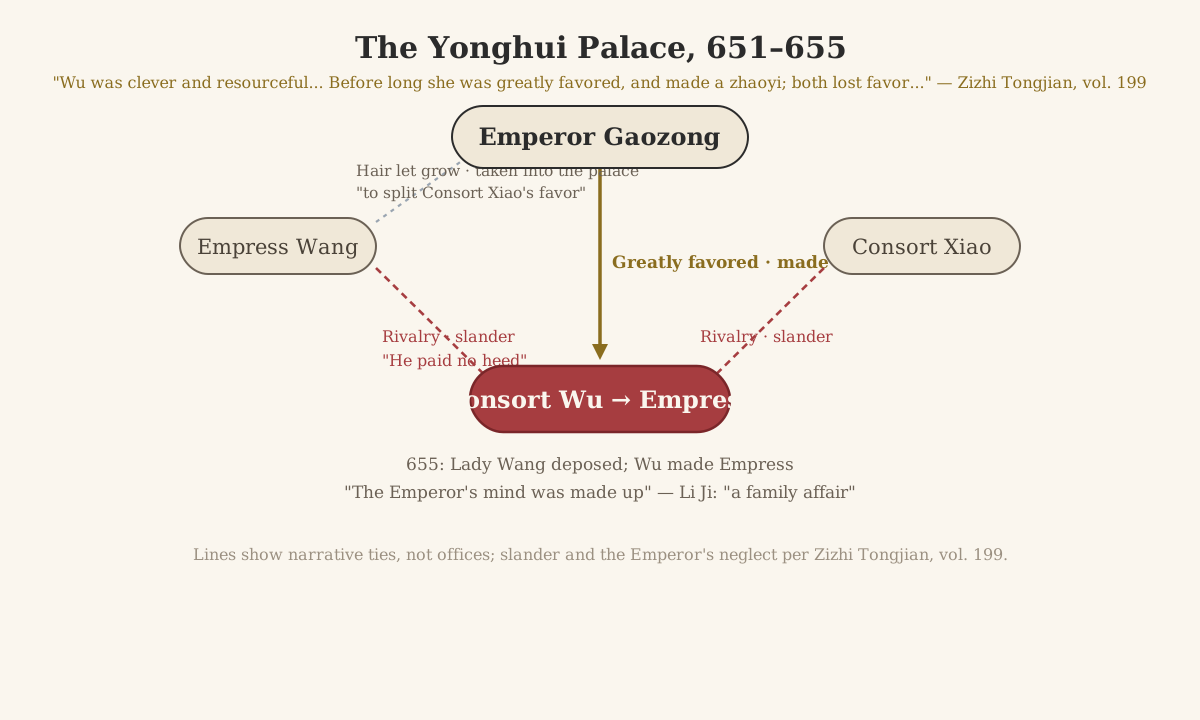
The chessboard then moved to the court. In the sixth year of Yonghui (655), Gaozong wanted to depose Lady Wang and make Wu his empress. The elder ministers erupted: the regent minister Chu Suiliang argued to his death, and others invoked the warning of Zhou and Han — “Emperor Cheng, in his desire, raised a slave-girl to empress, and the imperial line died out.” The deadlock broke when Gaozong asked another regent minister, the founding general Li Ji:
The Emperor asked him: "I wish to make Consort Wu empress; Suiliang insists it cannot be done.
He is a regent minister — shall the matter end here?"
Li Ji replied: "This is Your Majesty’s family affair. Why ask outsiders!" And the Emperor’s mind was made up.
Zizhi Tongjian, vol. 199
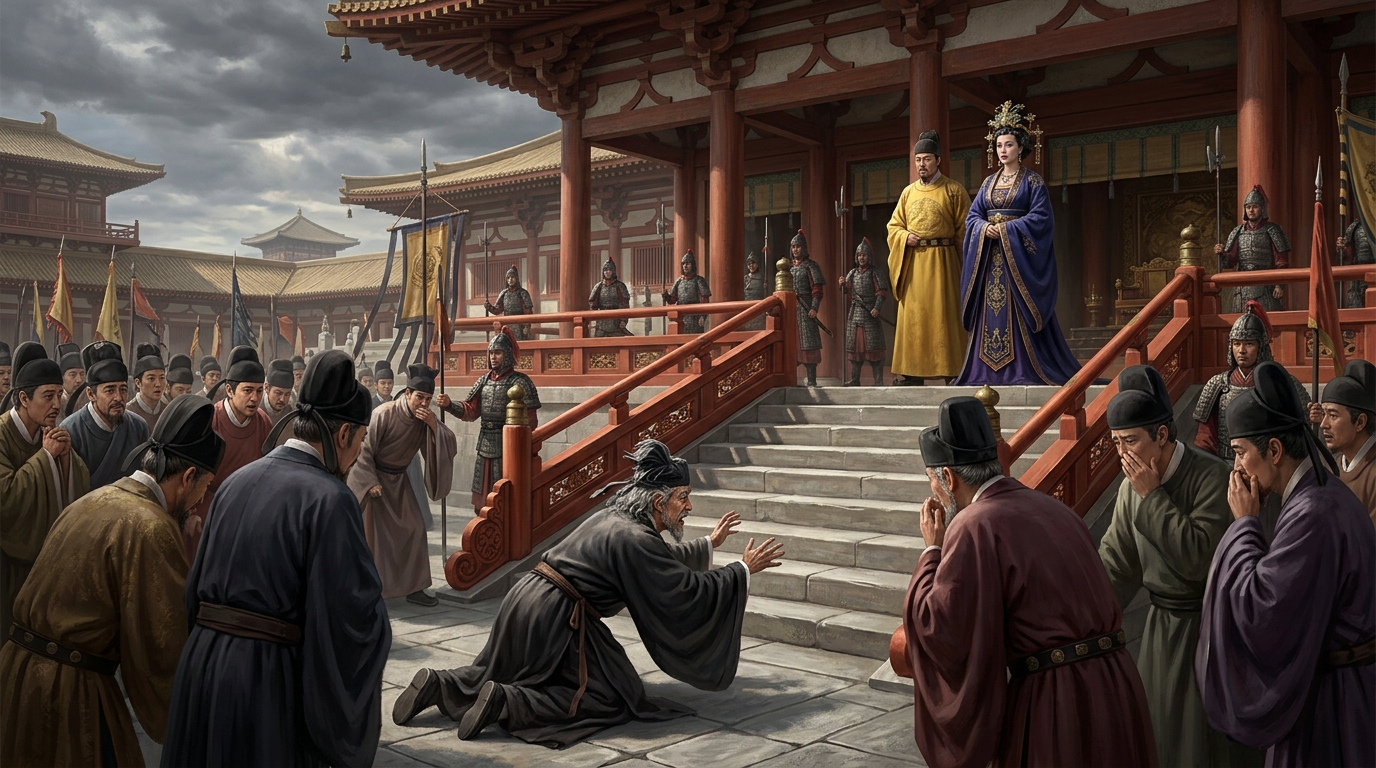
One phrase — “a family affair” — shut the old alliance out of the room. That same year Lady Wang was deposed and Wu made Empress; Chu Suiliang was demoted within the month; Xu Jingzong campaigned for the new empress in open court: “A farmer with ten bushels of surplus wheat will trade up his wife. How much more the Son of Heaven, taking an empress!”7 From the lamp of Ganye Temple to the phoenix seat, she had walked the narrowest stretch of road in her life.
Behind the Curtain
The Old Tang History sums up the new empress in eight characters: “by nature resourceful, well read in history and letters.”
Her opportunity came from Gaozong’s worsening health. From the Xianqing years on he “suffered often from wind-illness” — a chronic disorder of dizziness and failing sight — and “all memorials from the hundred offices were referred to the Empress for decision.” The Old Tang History sums up the stretch: “From then on she directed state affairs from within for decades, her power no less than the Emperor’s. The court called them the Two Holies.”8
But the title was nearly taken away. In 664 a Daoist priest was caught performing sorcery inside the palace, and the furious Emperor summoned chancellor Shangguan Yi. Yi turned the meeting into a case for deposition:
"The Empress is domineering; the realm will not accept her. Depose her."
The Emperor agreed, and ordered Yi to draft the edict.
Someone ran to warn her; she went straight to the throne to plead.
The draft still lay before him. He could not do it — and, afraid of her anger, said:
"I never wanted this. Shangguan Yi talked me into it."
Zizhi Tongjian, vol. 201
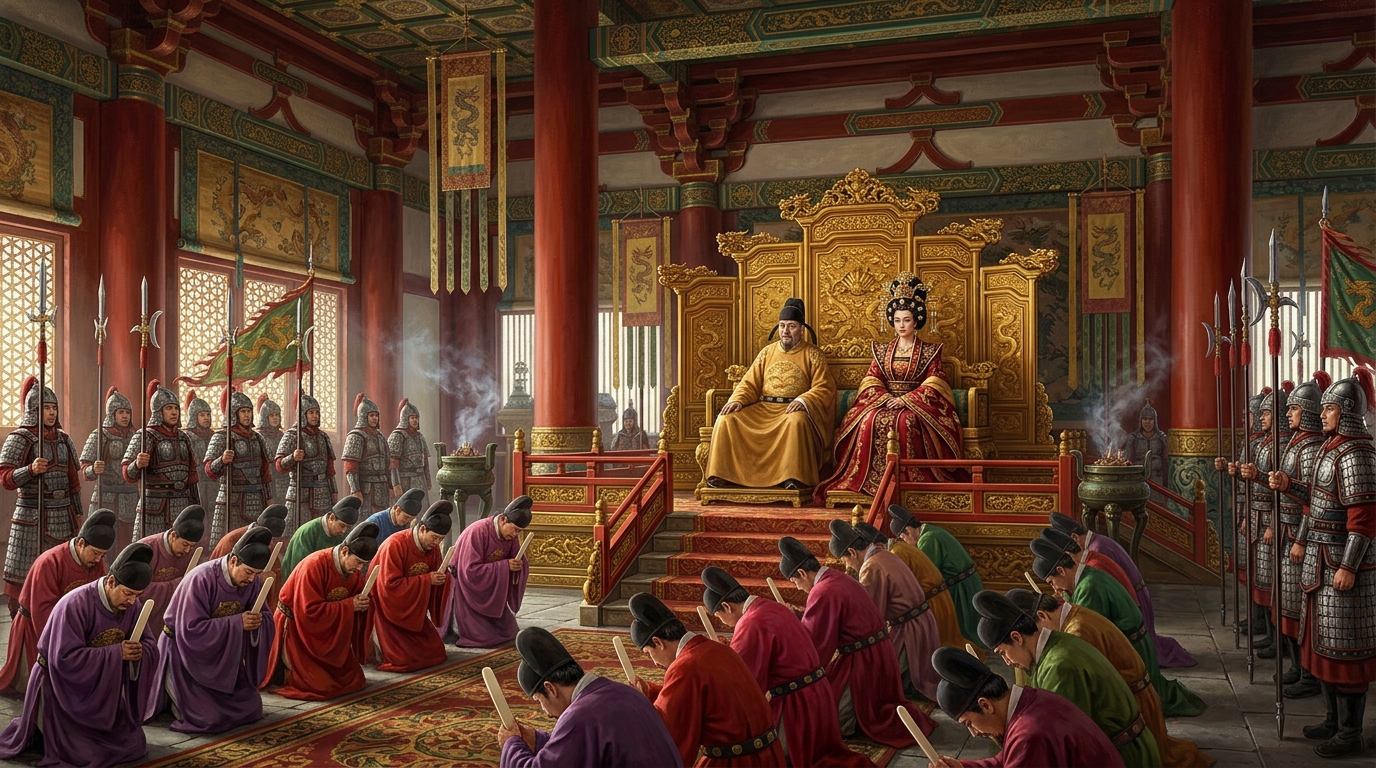
Shangguan Yi died for it. And the crisis inverted itself: from that day, whenever the Emperor held court she sat behind a screen at his side. “From then on the government, great and small, was heard by her. All power under heaven returned to the inner palace; promotion, dismissal, life and death were decided at her lips, and the Son of Heaven sat with folded hands. Within and without, they called them the Two Holies.”[^ershou2]
In 674 the court conferred new titles: Heavenly Emperor and Heavenly Empress. Under one sky, two suns.
A Character of Her Own
In 683 Gaozong died. The heir Li Xian took the throne, and Wu became Empress Dowager — and that very day she took the court and ruled in her own name. In 684 she deposed the young Emperor and set another son on the throne as a placeholder. In September Xu Jingye raised a rebellion in Yangzhou and put the finest brush of early Tang, Luo Binwang, at his service. The call to arms he wrote survives, and it tears into her: “She murdered her sister, crushed her brothers, poisoned the empress dowager — hated by spirits and men, unforgiven by heaven and earth.”9
The Empress read the proclamation and asked who had written it. Told it was Luo Binwang, she said: “That is the chancellor’s failure. A man of such talent, and he was left to drift!” She sent Li Xiaoyi south with three hundred thousand men; the rising collapsed within weeks, and Luo Binwang died in the defeat.10
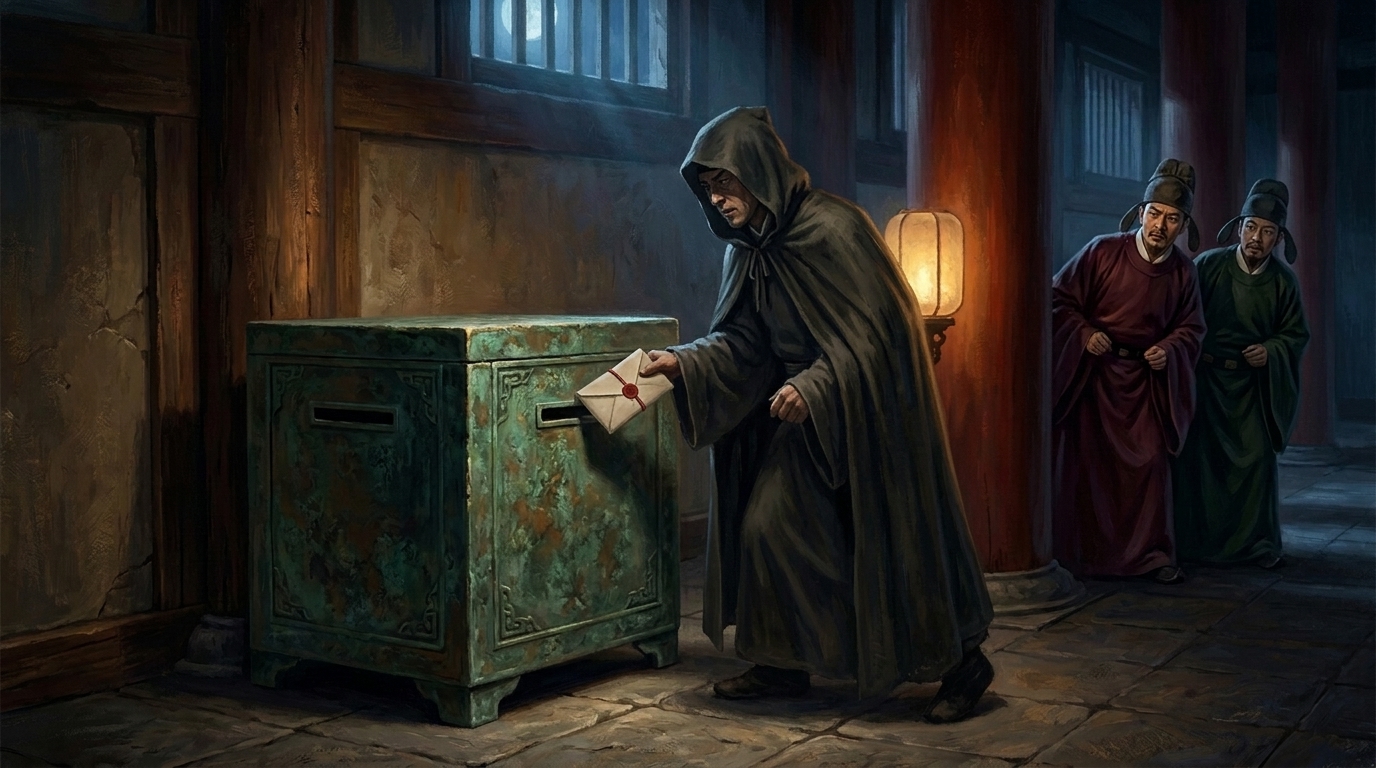
The revolt taught her how much of the court still opposed her, and she began building machinery of her own. In 686 she had a bronze chest cast and set up at the court, with four openings for four kinds of letters: essays and job-seeking in the east, remonstrance in the south, grievances in the west, omens and military secrets in the north.11 The chest’s designer was Yu Baojia — and within months an enemy dropped a letter into it accusing Yu of forging weapons for Xu Jingye. Yu was executed. The man who built the box died first by the box.
Then the machinery of denunciation: “those who came to inform were questioned by no one, given post-horses and food at the fifth-rank rate, and brought before her. Farmers and woodcutters alike were received in audience.”12 A profession of informers grew up around the chest, and out of their interrogations came an idiom every Chinese speaker still knows:
"Easy — take a great jar, bank coals around it, and put the prisoner inside.
What will he refuse to confess?"
So Junchen fetched the jar, banked the fire as Xing had described, then rose and said:
"There is an indictment against you, brother. Please step into the jar."
Xing, terrified, knocked his head to the floor and confessed.
Zizhi Tongjian, vol. 204
The idiom is “qing jun ru weng” — “invite you into the jar.” Xing himself was spared the jar and exiled instead, and died at the hands of an enemy on the road. And the ledger ran on: “Xing and Su Yuanli and Lai Junchen competed in cruelty. Xing and Yuanli killed several thousand each; Junchen ruined more than a thousand households.”13
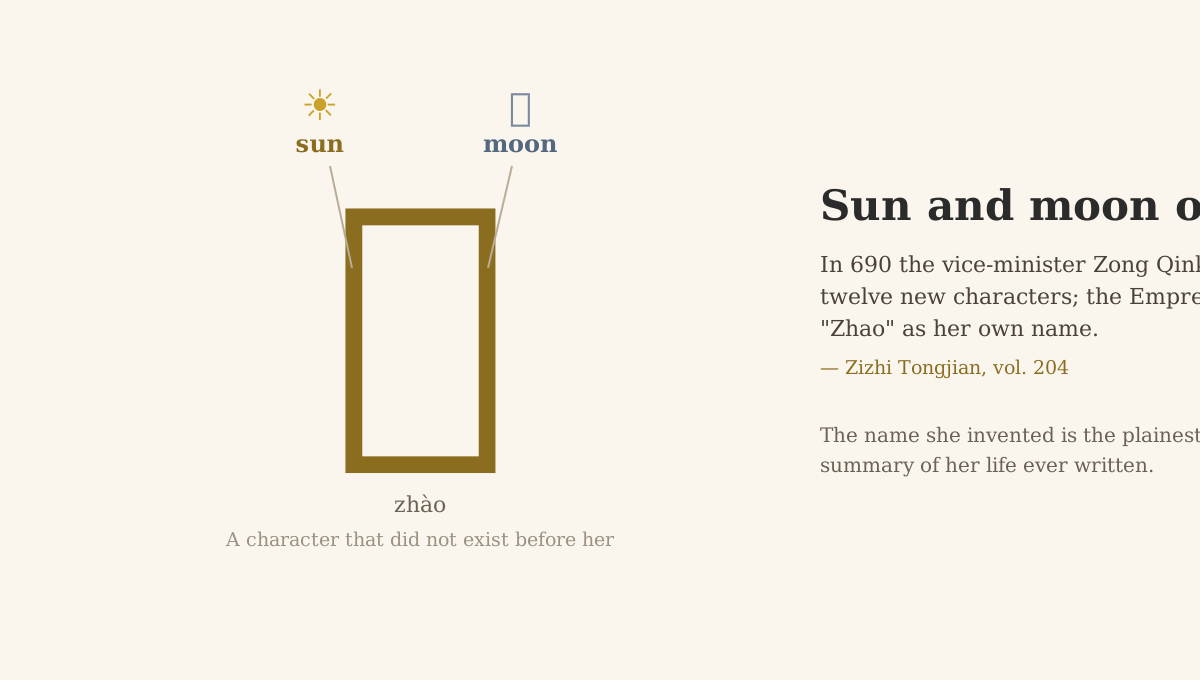
In 690 the road reached its end. The vice-minister Zong Qinke presented twelve characters of her own invention, and the Empress took one of them as her name:
Zong Qinke, vice-minister of the Phoenix Pavilion, presented twelve new characters,
including new forms of "heaven" and "earth."
The Empress took the name Zhao for herself, and renamed edicts "decrees."
Zizhi Tongjian, vol. 204
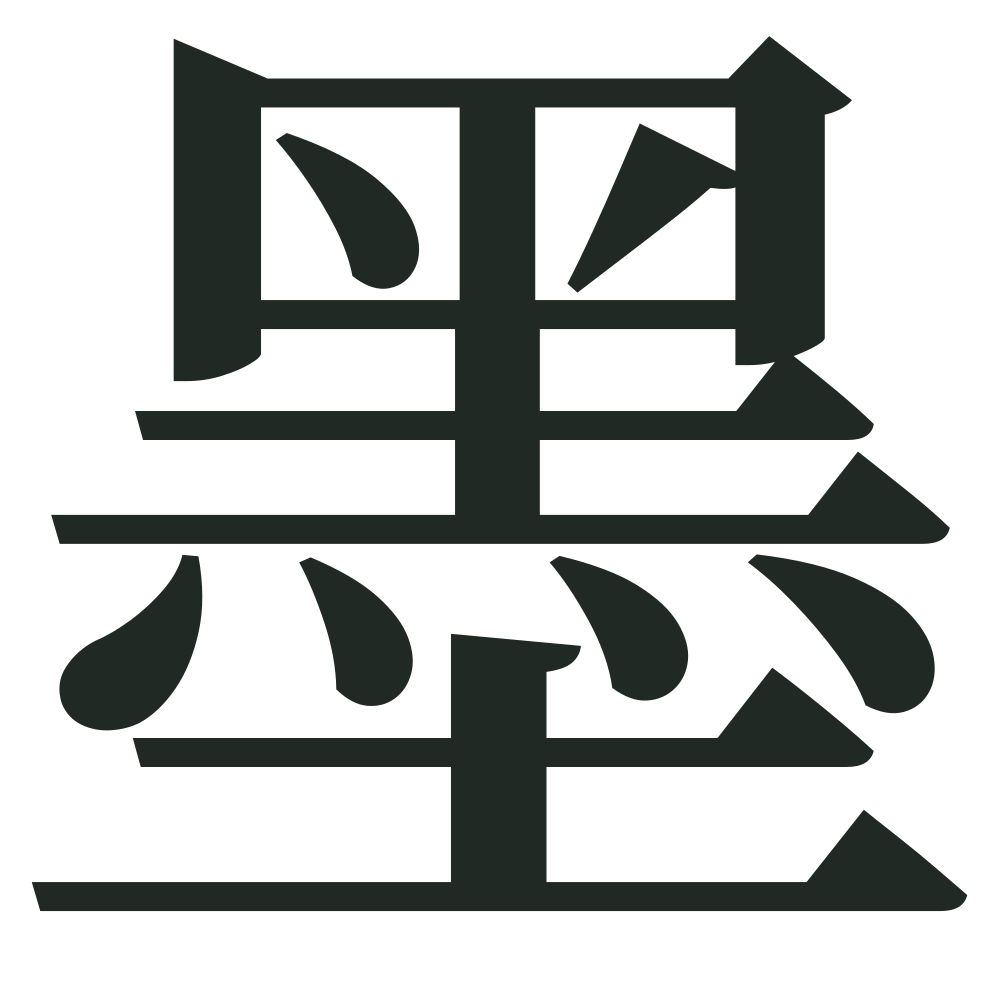
Zhao: a character compiled from sun, moon and sky, written to mean “everything lit from above.” It had not existed before her and has hardly been used since. That same year the Emperor and all the ministers petitioned her to take the throne, and she assented:
The Empress assented to the petition of the Emperor and the ministers.
A general amnesty was declared; Tang became Zhou, and the era name was changed.
The honorific Sage Divine Emperor was conferred;
the emperor was demoted to heir of the Wu line.
Zizhi Tongjian, vol. 204
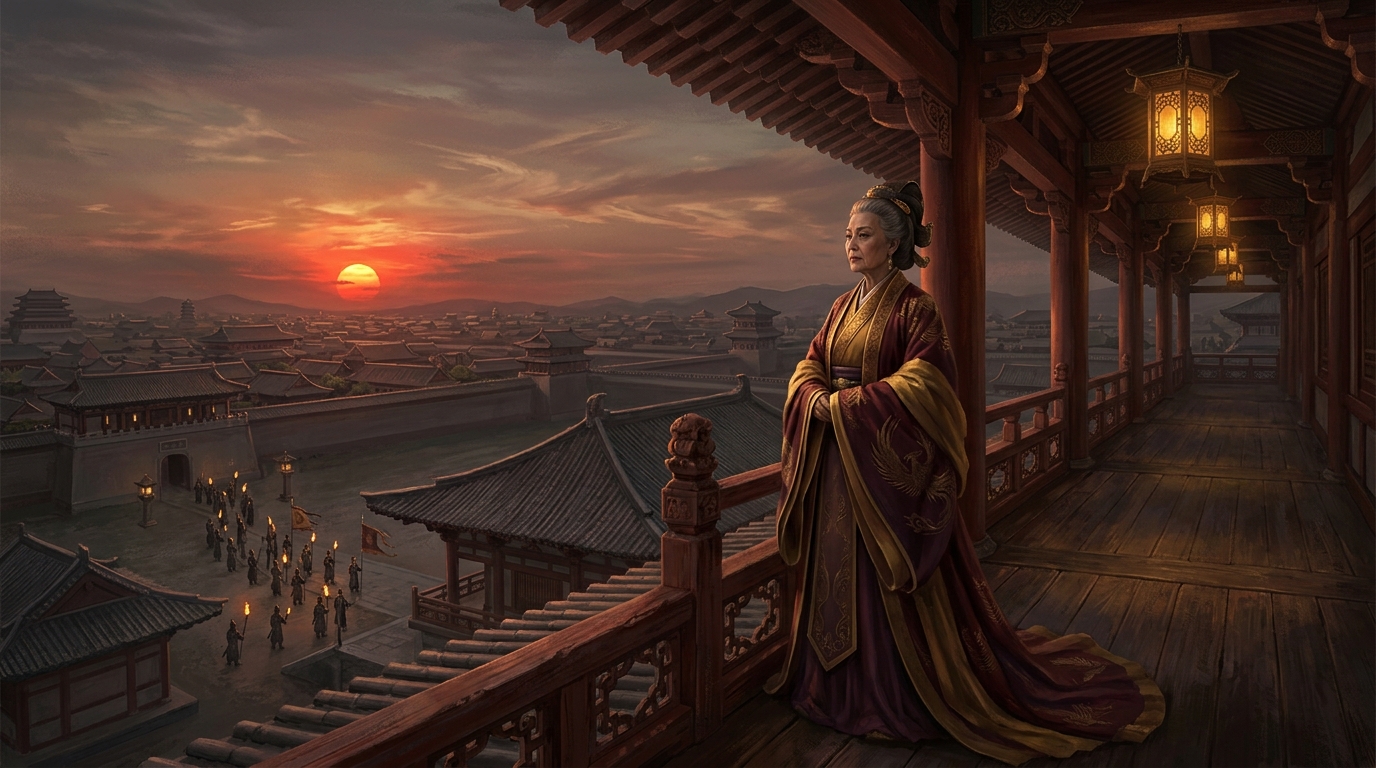
At sixty-six, having entered the palace at fourteen, she was Emperor. The dynasty was Zhou; the capital was Luoyang, which she built into a true second capital; and on the city walls rose a character she had invented for her own name.

Peaches and Plums
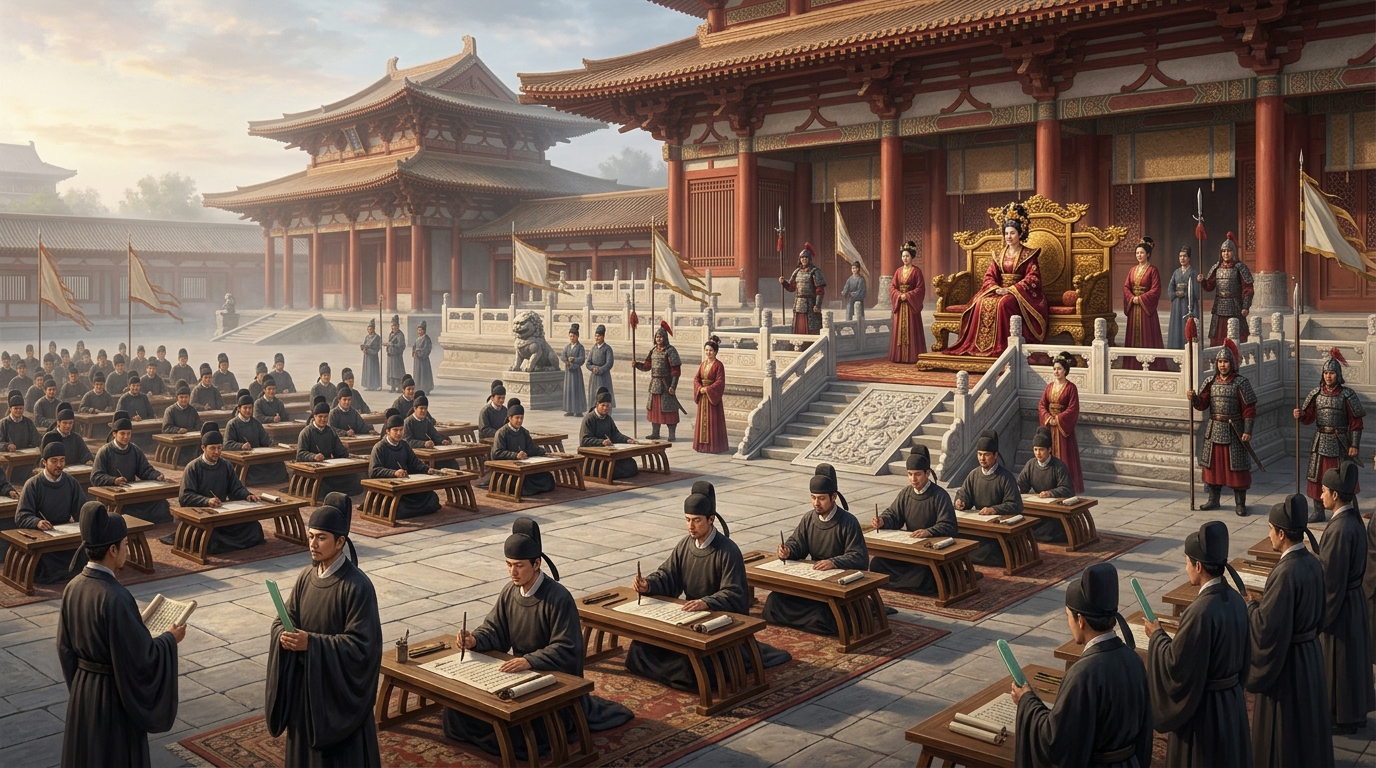
In the second month of 690, months before the dynasty changed, she did something no Chinese ruler had done: she examined candidates herself.
The Empress examined the tribute scholars in the Luocheng Hall.
Palace examinations of tribute scholars began here.
Zizhi Tongjian, vol. 204
A ruler personally questioning candidates — the palace examination, which lasted into the twentieth century, begins with her. The old aristocracy could block her, so she went around it and made the scholars of the empire her own examinees.
The Comprehensive Mirror gives a verdict on how she used people, with praise and blame in the same sentence:
Though the Empress lavished rank and salary to buy the hearts of the realm,
those unfit for office were soon dismissed — or executed.
Wielding reward and punishment to drive the empire, governing from her own hand,
clear-sighted and decisive, she made the best men of the age compete to serve her.
Zizhi Tongjian, vol. 205
And the roster under that verdict is real. Di Renjie became her chancellor; as a circuit inspector he had petitioned away more than seventeen hundred shrines across Wu and Chu.14 When the informers came for him too — accused of treason, thrown into prison — he left the famous line of self-preservation: “The Zhou revolution renews all things; we ministers of the old Tang are content to be executed. Yes — I rebelled.” Confess first, live, and overturn the case later. He did, and returned to power.
And in 700, she asked Di Renjie for one fine talent. The exchange is recorded word for word:
"I want one fine talent to employ. Who is there?"
"If you want an outstanding genius, there is Zhang Jianzhi, governor of Jingzhou —
old, but with a chancellor’s gifts."
She made him prefect of Luozhou. Asked again days later, Renjie said:
"The man I named was meant for chancellor, not prefect." And in time Zhang became chancellor.
He named dozens more — Yao Chong, Huan Yanfan, Jing Hui — and nearly all became famous ministers.
Someone said: "All the peaches and plums of the realm grow at your gate."
He answered: "Recommending the worthy is for the state, not for myself."
Zizhi Tongjian, vol. 207
The men on that list ran the empire for a generation — and Zhang Jianzhi, the chancellor Di Renjie named, led the coup that ended her reign.15
The arms kept pace. In the tenth month of 692, Wang Xiaojie crushed the Tibetans and “recovered the Four Garrisons, setting the Protectors General of Anxi at Kucha, with garrisons to hold them” — the road to the Western Regions back inside the map.16
The Reckoning
The other side of the ledger was written in the same ink.
For the imperial clan, one line in the Comprehensive Mirror: “The Empress worked quietly toward revolution and pruned the imperial clan.” Princes Yuanjia, Lingkui, Zhen and Chong died one after another — the old Tang house nearly uprooted.17 Her own son’s household was not spared: in 693 a palace slave accused the two consorts of the heir — Liu, and Dou, mother of the future Emperor Xuanzong — of sorcery. They came to court to pay their respects and were killed as they withdrew, “buried inside the palace, no one knowing where.” The deposed emperor “dared not speak, and went about before her as if nothing had happened.”18
For the officials, the terror had a machinery, and the machinery has a name every Chinese speaker knows. When the officer Zhou Xing was accused of treason, Lai Junchen was set to interrogate him — and asked over dinner how to make a prisoner talk:
"Easy — take a great jar, bank coals around it, and put the prisoner inside.
What will he refuse to confess?"
So Junchen fetched the jar, banked the fire as Xing had described, then rose and said:
"There is an indictment against you, brother. Please step into the jar."
Xing, terrified, knocked his head to the floor and confessed.
Zizhi Tongjian, vol. 204
“Qing jun ru weng” — “invite you into the jar.” The idiom entered the language, and Zhou Xing himself was spared the jar: exiled, and killed by an enemy on the road. The ledger reads:
Xing and Su Yuanli and Lai Junchen competed in cruelty.
Xing and Yuanli killed several thousand each; Junchen ruined over a thousand households.
Zizhi Tongjian, vol. 204
And the spending: the monk Huaiyi built a Buddha image “one of whose fingers could hold several dozen men,” with a Heaven Hall north of it to house the statue. Blown down by the wind, it was rebuilt — “ten thousand laborers a day; timber rafted from the gorges; in a few years the cost ran to the trillions, and the treasury was drained.”19
The last account closed itself. In 697 Lai Junchen reached for the Wu princes and Princess Taiping, and this time no one saved him. On the day of his execution “his enemies fought to eat his flesh, finishing it in moments; his eyes gouged, his face flayed, his heart torn out,” and people congratulated each other on the roads: “From tonight, we can sleep with our backs flat on the bed.”20 The terror ended when its own master died. The innocents “framed and driven to execution” stayed in the ledger — every name of them.
The Wordless Stele
In the first month of 705, with Wu Zetian gravely ill, Zhang Jianzhi — the chancellor Di Renjie had named — led the palace guards into the hall, killed the Zhang brothers, and forced her to yield. The Old Tang History records it in one line: “that day the Emperor passed the throne to the crown prince and moved to the Shangyang Palace.”21 The history calls the Zhang brothers traitors and the coup an execution — the winners held the pen, as they always do.
Her last act of state was her own funeral:
As she neared her end, her testament ordered: return to the temple, return to the tomb,
lay down the imperial title, and be called Empress Zetian the Great.
The families of Lady Wang and Lady Xiao, and the kin of Chu Suiliang and Han Yuan
punished in their wake, were all restored to their lives.
That day she died in the Xianju Hall of the Shangyang Palace, aged eighty-three.
Old Tang History, vol. 6
Lay down the title. Return to the tomb. Pardon the families of Lady Wang and Lady Xiao and of Chu Suiliang — the people she had broken. In the fifth month of 706 she was buried beside Gaozong at Qianling.22
Two stelae stand at Qianling. The one for Gaozong carries eight thousand carved characters, every space filled. Hers carries none.23
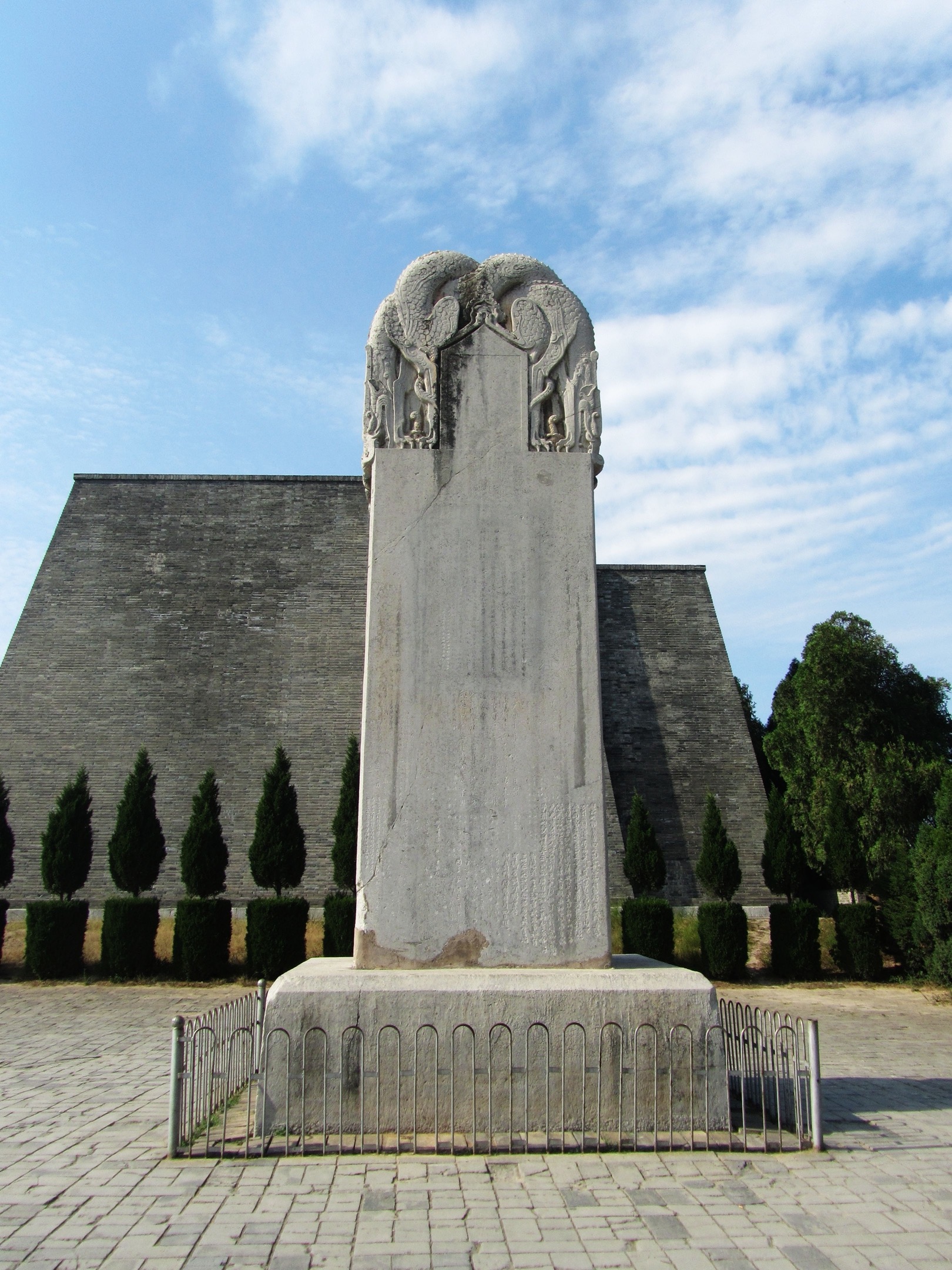
Why blank? Readers have argued for thirteen centuries: her deeds were too great for words; her guilt too heavy for words; or she knew no verdict could hold her and left the page open for whoever came next. All three are guesses. She wrote nothing — and the blankness is all the stone says.
The stele is wordless; the histories are not, and the words fight. The Old Tang History’s historian wrote cruelly: “let a cowardly woman seize the moment and she can hold the lives of all creatures in her seat, wielding the might of injustice”;24 the Comprehensive Mirror records, plainly, that she was “clear-sighted and decisive, so the best men of the age competed to serve her.” Those who denounce her cannot forget the secret police and the framed cases; those who record her cannot delete the examinations and the ministers. The canyon subtracted her down to one line — “don’t look down, or the crown will fall” — and the paper added her back up, sixty-eight years of merits and crimes.
Her name was Zhao, sun and moon over the sky; her stele, not one word. The two characters of her final title — ze tian, after heaven — she wrote into her own testament. The name she raised into the sky; the verdict she left on the ground. And perhaps the two acts hid the same thought.
Notes
-
Skins per official Honor of Kings hero data, herolist.json (accessed 2026-10-14): Nüdi (Empress), Dongfang Bubai, Haiyang zhi Xin, Nikesi Shenyu, Shenqi Minghuiyi. ↩
-
From the official Honor of Kings hero page story (accessed 2026-10-14). ↩
-
“His father Shihuo was a company officer in late Sui… followed the uprising into the capital… Minister of Works, Governor of Jingzhou, Duke of Ying.” Old Tang History, vol. 6. ↩
-
The horse-taming episode appears only in Wu Zetian’s own late-life retelling, recorded in Zizhi Tongjian, vol. 206; it is absent from both Tang annals. ↩
-
“Ruyi Niang,” Quan Tangshi vol. 5, under Wu Zetian. Traditional reading: written at Ganye Temple for Gaozong; date and circumstance unrecorded. ↩
-
“Wu was clever and resourceful…” Zizhi Tongjian, vol. 199. Zhaoyi, second-rank consort of nine. ↩
-
“Xu Jingzong declared at court…” Zizhi Tongjian, vol. 199; Chu Suiliang demoted the same day. ↩
-
“By nature resourceful…” and “From then on she directed state affairs from within…” Old Tang History, vol. 6. Titles conferred 674. ↩
-
Luo Binwang’s proclamation, quoted in Zizhi Tongjian, vol. 203. Later editions read “where is the six-foot orphan” and “behold today’s realm.” ↩
-
“Li Xiaoyi… three hundred thousand men, to punish Li Jingye.” Zizhi Tongjian, vol. 203. Luo Binwang died in the defeat. ↩
-
Zizhi Tongjian, vol. 203. The four slots: “Yan’en” (east), “Zhaojian” (south), “Shenyuan” (west), “Tongxuan” (north). ↩
-
Zizhi Tongjian, vol. 203. ↩
-
“Xing and Su Yuanli and Lai Junchen competed in cruelty…” Zizhi Tongjian, vol. 204. ↩
-
Di Renjie “petitioned to burn more than 1,700 unregistered shrines in Wu and Chu.” Zizhi Tongjian, vol. 204. His arrest and confession, vol. 205. ↩
-
The exchange per Zizhi Tongjian, vol. 207: she made Zhang Jianzhi prefect of Luozhou, and when Di Renjie pressed again — “the man I named was meant for chancellor, not prefect” — he became chancellor. He named dozens more, nearly all famous ministers. Zhang Jianzhi later led the Shenlong coup of 705. ↩
-
Zizhi Tongjian, vol. 205, Changshou first year (692). ↩
-
“The Empress worked quietly toward revolution and pruned the imperial clan.” Zizhi Tongjian, vol. 204, around 688. ↩
-
Zizhi Tongjian, vol. 205 (693): a palace slave “slandered Princess-consort Liu and Consort Dou of the heir for sorcery.” They paid their respects to the Empress and were killed on the way out, “buried inside the palace, no one knowing where.” Consort Dou was mother of the future Emperor Xuanzong. ↩
-
Old Tang History, vol. 6, and Zizhi Tongjian, vol. 205: the monk Huaiyi’s Buddha image, “one finger of which could hold several dozen men”; the Heaven Hall blown down and rebuilt, “10,000 laborers a day… the cost ran to the trillions, and the treasury was drained.” ↩
-
Zizhi Tongjian, vol. 206 (697): Lai Junchen executed; “his enemies fought to eat his flesh, finishing it in moments”; people congratulated each other on the roads — “from tonight, we can sleep with our backs flat on the bed.” ↩
-
Old Tang History, vol. 6, Shenlong first year (705). ↩
-
“In the fifth month of the second year, buried at Qianling.” Old Tang History, vol. 6 (706). ↩
-
The Wordless Stele stands outside the Zhuque Gate of Qianling. The reason for its blankness is nowhere recorded; every explanation is later speculation. ↩
-
Old Tang History, vol. 6, historian’s verdict at chapter’s end. ↩
Sources & further reading
About the media
Photo of the Wordless Stele at Qianling Mausoleum: 猫猫的日记本 (CC BY-SA 3.0) via Wikimedia Commons. Some scene illustrations, diagrams and the timeline are original to, or generated for, this project as artistic interpretations. Game imagery is described in text only; no official game art is reproduced.