The First Emperor: Ying Zheng Beyond the Canyon
In the canyon, Ying Zheng commands from the throne of Peerless Among Kings. In history, he spent thirty-seven years traveling from a hostage's son in Handan to the traveling palace at Shaqiu — and invented the word "emperor."
Updated
Peerless Among Kings
In Honor of Kings, Ying Zheng is one of the few heroes who cannot be bought with gold. His official title is four characters: Wangzhe Duzun — Peerless Among Kings. His abilities carry the same vocabulary: his passive is “Judgment of the King,” his basic attacks pierce their targets; a shield skill raises the “Shield of the King”; his ultimate drops artillery from beyond extreme range. 1
The official backstory the game gives him is longer than most heroes’, and a good deal grimmer. It unfolds in a kingdom called Xuanyong — the game’s fantasy reconstruction of Qin. As a boy in the palace, Ying Zheng keeps a “monster” from the southern wilds. His grandmother tells him: some things should only be done when ten thousand come to pay court; the royal house does not need to solve problems — it only needs to harvest credit. He does not believe her. On the road to study at Jixia, the blood-clan armies close in, and his companion tears a weapon from an attacker’s hand to cut them a way out — “If an emperor is protected, he is worth less than a common man.” 1
In that moment, some power awakens. Every metal blade in the blood-clan army is torn into the sky and falls back to earth like rain. The sages of Jixia later tell him: human power is boundless, and only when a person’s consciousness awakens does he truly become human; forging blades to serve you proves only the strength of blades — the man who walks into the world empty-handed finds that wherever he goes, weapons submit to him. 1
That “monster” of a companion is Bai Qi, the general to come. After one massacre of a city, he never removes his mask again. People heard him crying out in his fever — “Don’t look at me,” “It wasn’t me” — saying the ground is covered in eyes, and the sky, and his dreams. The strange physician offers two roads: exchange blood for blood, and from then on have no wounds, no memory, no pain — become a blood-clansman who no longer bleeds; or bare the face to the light for three days — the cursed blood will recede, the wounds will not kill, but neither will they ever heal, and he will live out an endless nightmare wearing a monster’s face. Ying Zheng remembers the parable of the two princes the sage once told. He reaches toward the mask. Light will fall on that tormented face. 1
All of this, of course, is the game’s worldview, and has nothing to do with history. What is interesting is its premise, and the real echoes buried inside it: the Ying Zheng of the story pursues “law,” so that all may live together as equals; the one who teaches him to read is Jixia; the grandmother in the palace who warns him; the Meng general who leads his armies. None of these echoes is casual — each can be found in the histories. 2
The true story has less legend in it, and far more hardship. It begins not in Xianyang, but in the capital of an enemy state.
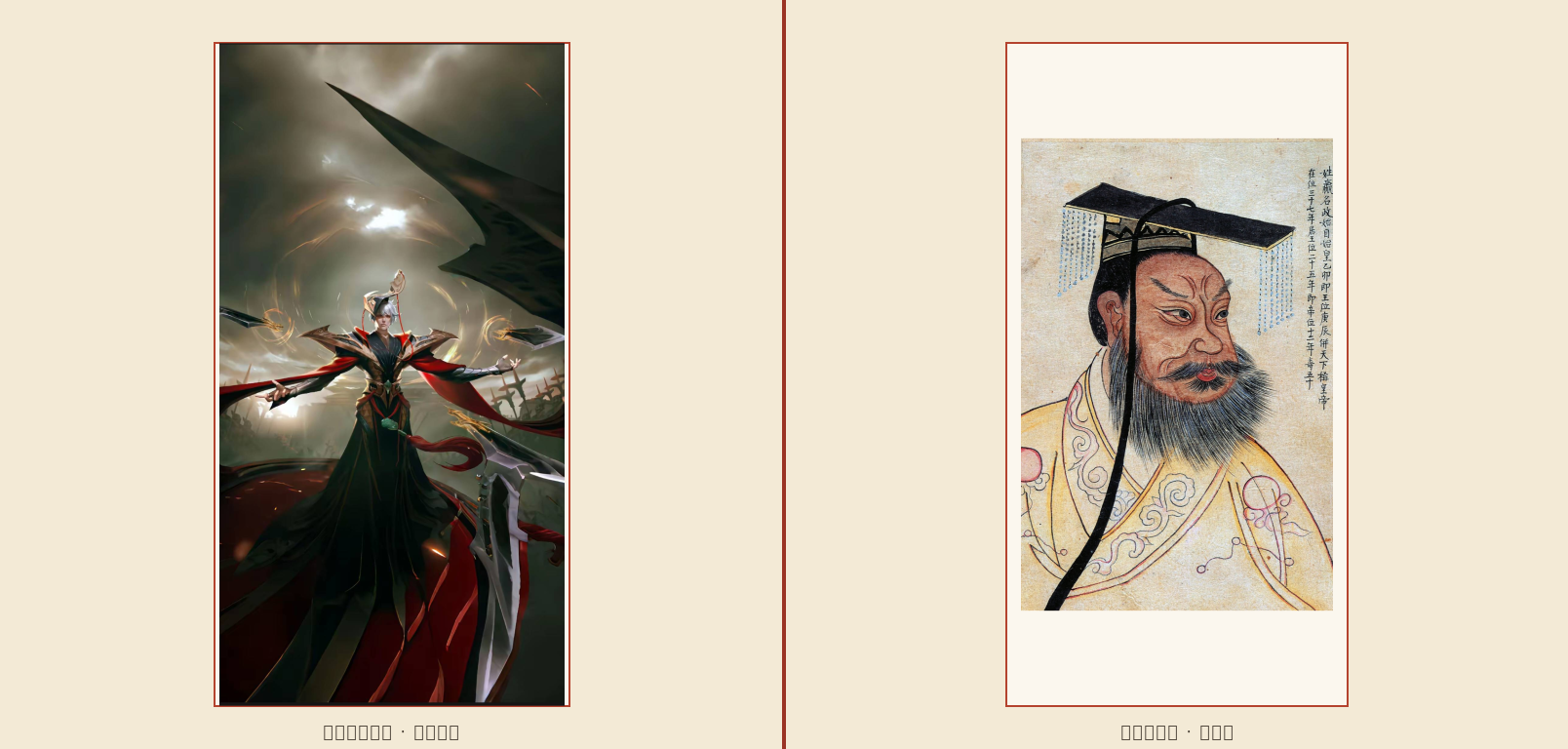
Born in Handan
About Ying Zheng’s origins, the Records of the Grand Historian opens like this:
秦始皇帝者,秦庄襄王子也。
庄襄王为秦质子于赵,见吕不韦姬,悦而取之,生始皇。
以秦昭王四十八年正月生于邯郸。
及生,名为政,姓赵氏。
年十三岁,庄襄王死,政代立为秦王。
《史记·秦始皇本纪》 (Records of the Grand Historian, Annal of the First Emperor)
MeaningThe First Emperor of Qin was the son of King Zhuangxiang of Qin. King Zhuangxiang served as a hostage in Zhao, saw Lü Buwei’s concubine, pleased with her took her, and she bore the First Emperor. He was born in Handan in the first month of the forty-eighth year of King Zhaoxiang. At birth he was named Zheng, with the clan name Zhao. At thirteen, King Zhuangxiang died, and Zheng succeeded as King of Qin.
- 质子
- In the Warring States, allied states exchanged princes as hostages of good faith.
- 吕不韦
- A great merchant of Yangzhai who staked everything on this father and son, later chancellor of Qin, enfeoffed as Lord Wenxin.
Ying Zheng was born in Handan, the capital of Zhao. A few months before his birth, the Qin army had buried alive the surrendered soldiers of Zhao at Changping — the Records put the number at more than four hundred thousand; 3 when the news of mourning reached Handan, the whole city was steeped in grief. A child of the Qin royal house was born into a city that hated Qin.
The first man to change his fate was the merchant Lü Buwei. Trading in Handan, he saw this struggling Qin hostage and gave him the verdict that has echoed for two thousand years: “This is a rare commodity worth hoarding.” He went to Zichu and said, “I can magnify your gate.” Zichu laughed: “Magnify your own gate first — then magnify mine.” Lü Buwei answered without a beat: “You don’t understand. My gate awaits the greatness of yours.” 4 The merchant staked everything he had: a thousand gold sent west to Xianyang to win over Lady Huayang, King Xiaowen’s favorite; and a dancing girl from his own household, already carrying his child, given to Zichu. The Records preserve the line that has been argued over for two thousand years — “The girl concealed her pregnancy, and when her full time came, she bore a son named Zheng.” Whose blood was in the child, Sima Qian left on the page exactly as he found it. 4
In 257 BC, the Qin army besieged Handan. The situation grew desperate, and an enraged Zhao resolved to execute this Qin hostage. The Records preserve the escape:
秦昭王五十年,使王齮围邯郸,急,赵欲杀子楚。
子楚与吕不韦谋,行金六百斤予守者吏,
得脱,亡赴秦军,遂以得归。
赵欲杀子楚妻子。子楚夫人赵豪家女也,
得匿,以故母子竟得活。
《史记·吕不韦列传》 (Records, Biography of Lü Buwei)
MeaningIn the fiftieth year of King Zhaoxiang, the king sent Wang Yi to besiege Handan. The danger grew, and Zhao wanted to kill Zichu. Zichu plotted with Lü Buwei, offered six hundred catties of gold to the gatekeepers, escaped, and fled to the Qin army, thus returning home. Zhao then wanted to kill Zichu’’s wife and children. Zichu’’s wife was a daughter of Zhao’’s old nobility; she found a place to hide, and so mother and son survived.
His father traded six hundred catties of gold for a way out, and fled back to Qin alone; the two-year-old Ying Zheng and his mother stayed behind in Handan. The mother was a daughter of Zhao’s old nobility; the city that wanted them dead was the city where her family could shelter them. Mother and son hid under the blade for six years, until 251 BC, when King Zhaoxiang died and Qin–Zhao relations eased — “Zhao then sent Lady Zichu and the child Zheng back to Qin” — and at eight, Ying Zheng set foot on Qin soil for the first time. 5
Four years later, his father was gone too.
The succession reads like a relay race that keeps accelerating, each leg shorter than the last. His grandfather King Zhaoxiang had reigned fifty-six years and broken all six rivals; when he died, the crown prince Xiaowen was already past fifty. After a year of mourning, he formally ascended on the day yi-hai of the tenth month — “three days later, on xinchou, he died” — the shortest reign in Qin history. 6 The throne passed to King Zhuangxiang.
King Zhuangxiang reigned three years, like a true king of Qin: he honored Lü Buwei as chancellor and let him destroy the token Eastern Zhou, taking “all its lands”; Meng Ao attacked Han, Han ceded Chenggao and Gong, Qin’s border reached the walls of Daliang, and the Sanchuan commandery was created; in his second year he attacked Zhao and settled Taiyuan, creating the Taiyuan commandery; in his third he took Gaodu and Ji from Wei, then Yuci, Xincheng and Langmeng from Zhao — thirty-seven cities in all. He also absorbed one heavy blow: Lord Xinling of Wei led a five-state coalition against Qin, “and Qin was pushed back beyond the River,” Meng Ao retreating. In the fifth month, on the day bing-wu of 247 BC:
五月丙午,庄襄王卒,子政立,
是为秦始皇帝。
《史记·秦本纪》 (Records, Basic Annals of Qin)
MeaningIn the fifth month, on the day bing-wu, King Zhuangxiang died, and his son Zheng succeeded — he who would later be known as the First Emperor of Qin.
- 五月丙午
- 247 BC. At this point Ying Zheng was King of Qin; "First Emperor" is the later name, adopted when the empire was proclaimed twenty-six years on.
How did he die? The histories record not one word. King Zhuangxiang was in his thirties, in his prime, on the throne exactly three years — and from the Records to every Han text, the cause of his death is met with silence. There is no shortage of speculation: in these three short years the greatest beneficiary was Lü Buwei, whose entire wager entered its harvest the day after the king died, and the rumor that “Lü Buwei poisoned him” grew louder and louder. But rumor never reaches the page — all that can be confirmed is one line, “In the fifth month, on bing-wu, King Zhuangxiang died,” and the thirteen-year-old who came after it.
The Records describe the state he inherited:
当是之时,秦地已并巴、蜀、汉中,越宛有郢,置南郡矣;
北收上郡以东,有河东、太原、上党郡;东至荥阳,灭二周,置三川郡。
吕不韦为相,封十万户,号曰文信侯。
招致宾客游士,欲以并天下。李斯为舍人。
蒙骜、王齮、麃公等为将军。
王年少,初即位,委国事大臣。
《史记·秦始皇本纪》 (Records, Annal of the First Emperor)
MeaningBy this time Qin had absorbed Ba, Shu and Hanzhong, crossed Wan to hold Ying, and set up the Nan commandery; in the north it had taken Shangjun and the lands east, with the Hedong, Taiyuan and Shangdang commanderies; in the east it reached Xingyang, destroyed the two Zhou, and set up the Sanchuan commandery. Lü Buwei was chancellor, enfeoffed with a hundred thousand households, styled Lord Wenxin. He gathered guests and wandering scholars, intending to swallow all-under-Heaven. Li Si was among his retainers. Meng Ao, Wang Yi and Lord Piao were his generals. The king was young, newly enthroned, and entrusted state affairs to the ministers.
Thirteen years old. By the time he took the throne, Qin’s dominance over the six states was already decided — and the one sitting on the throne was merely a child monarch. Power was not in his hands — it lay with the chancellor Lü Buwei, and with the queen dowager’s favorite.
He would wait nine years. By ritual, a king takes personal rule only after the capping ceremony; his was held only when he turned twenty-two.
The Second Father and the Marquis of Changxin
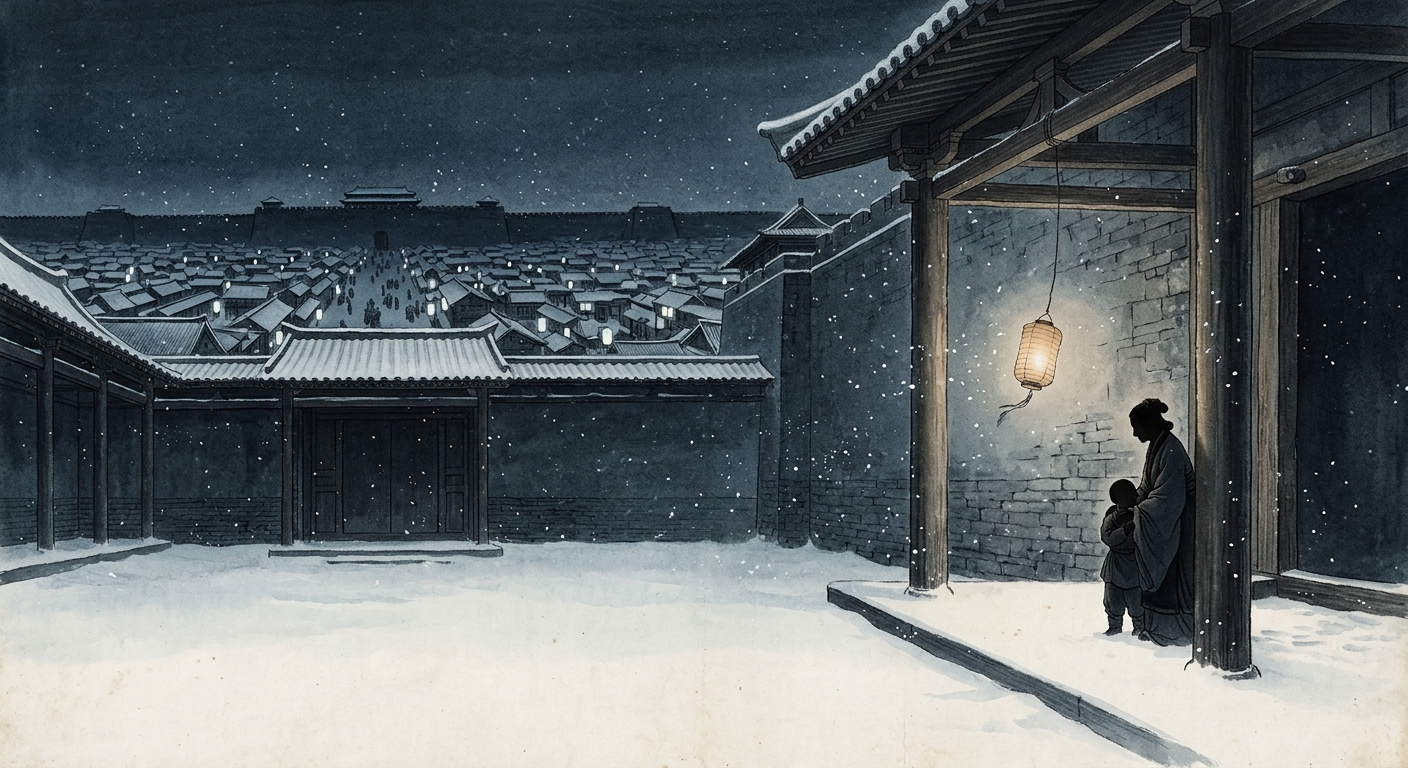
Through those nine years, Ying Zheng grew up underneath other people’s power: Lü Buwei honored as chancellor, styled “Second Father”; the king young, with “state affairs entrusted to the ministers”; and the Biography of Lü Buwei adds one palace secret — “the queen dowager secretly carried on with Lü Buwei,” whose household slaves numbered ten thousand. 5 The “Second Father” came to feel the danger: the future First Emperor grew daily, the dowager’s appetite did not cease, and the old affair might cost him his life at any moment. His solution was a stand-in — Lao Ai, the man of prodigious endowment. He took Lao Ai into his service, had him perform at feasts the trick of spinning a wooden wheel, and made sure the dowager heard of it; the dowager wanted the man. So a false castration was arranged, the executioner quietly bribed, and at the ceremony only his beard and brows were plucked — thus a fake eunuch entered the dowager’s apartments. She took him as a lover, loved him utterly, and soon was pregnant; afraid of discovery, she claimed an unlucky divination and moved to Yong. Lao Ai attended her, lavishly rewarded, “and all matters great and small were decided by Lao Ai”; his household slaves numbered in the thousands, and more than a thousand petitioners sought to become his retainers. 5 In 239 BC, Lao Ai was enfeoffed Marquis of Changxin with the lands of Shanyang — palace, carriages, clothes, parks, hunts, all without limit; then “the Hexi Taiyuan commandery was made his fief” — an entire commandery renamed for him. 7
In 238 BC, Ying Zheng turned twenty-two and went to Yong for the capping ceremony. In that year the Records record a revolt:
四月,上宿雍。己酉,王冠,带剑。
长信侯毐作乱而觉,矫王御玺及太后玺
以发县卒及卫卒、官骑、戎翟君公、舍人,
将欲攻蕲年宫为乱。王知之,
令相国昌平君、昌文君发卒攻毐。战咸阳,斩首数百,皆拜爵。
毐等败走。即令国中:有生得毐,赐钱百万;杀之,五十万。
尽得毐等。
《史记·秦始皇本纪》 (Records, Annal of the First Emperor)
MeaningIn the fourth month the king stayed at Yong. On the day ji-you the king was capped and girded with a sword. The Marquis of Changxin, Lao Ai, raised a revolt and was discovered. Forging the royal seal and the seal of the dowager, he mustered the county soldiers, the palace guards, the cavalry, the lords of the Rong and Di tribes and his retainers, intending to attack the Qinian Palace. The king knew of it, and ordered the chancellors Lord Changping and Lord Wenwen to lead troops against him. They fought at Xianyang; hundreds were beheaded, and all who took part were rewarded with rank. Lao Ai and his faction fled. An order went out to the whole state: whoever took Lao Ai alive would be rewarded with a million cash; whoever killed him, five hundred thousand. Lao Ai and his party were all taken.
The suppression was only the beginning. The reckoning followed: Lao Ai torn apart by chariots as a warning, his clan exterminated; twenty ringleaders — the commandant of the guards, the grand minister, the keeper of the crossbows, the head of the palace attendants — beheaded; his lighter retainers sentenced to hard labor, the heavier ones stripped of rank and exiled to Shu, more than four thousand households shipped to Fangling, in a month so cold that some died on the road. 5
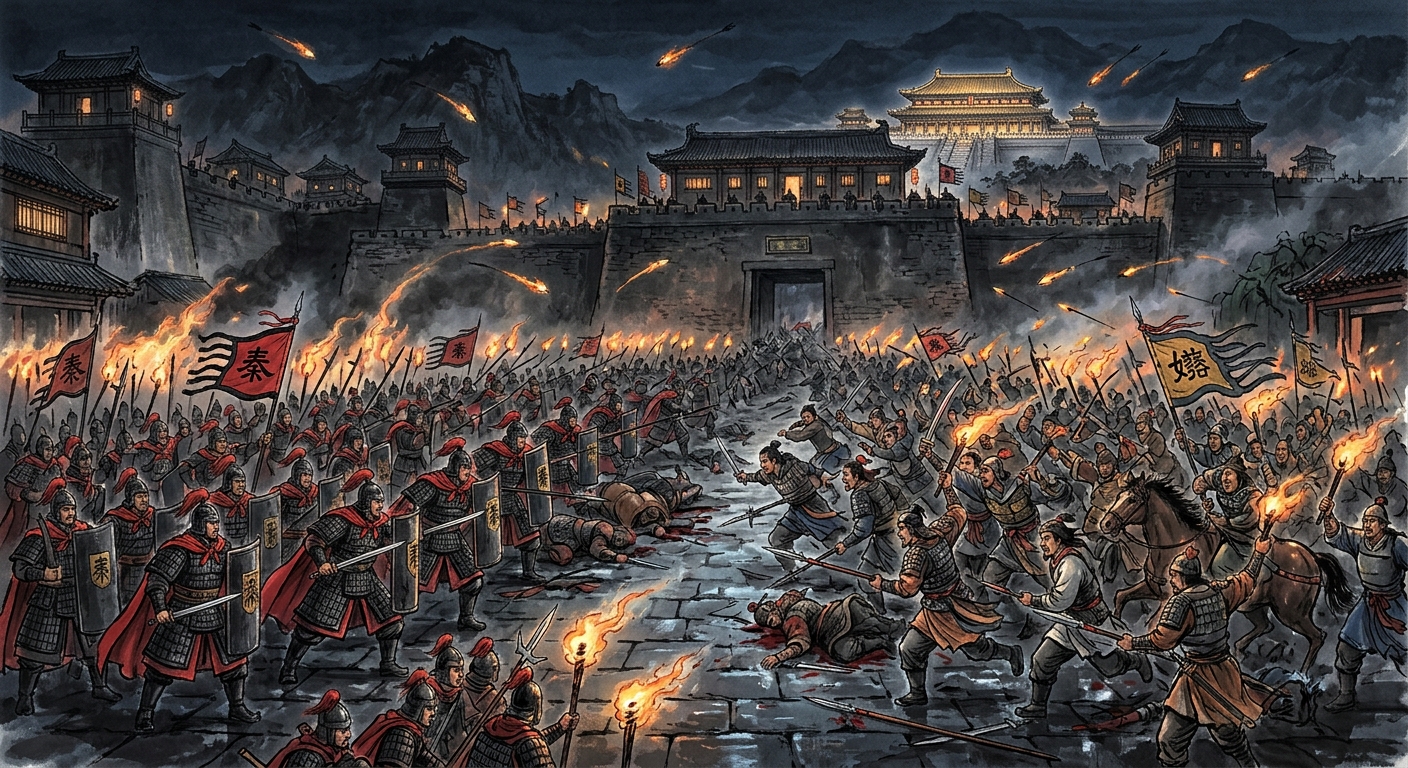
The Biography of Lü Buwei records two colder facts: the two sons the dowager had borne Lao Ai were killed; the dowager herself was banished to Yong, out of Xianyang. 8 Following the case upward led to the chancellor — Lao Ai had been his gift to the palace. Retainers and persuaders argued his case in crowds — his service to the dead king was great — and “the king could not bring himself to punish him.” In the tenth month of the king’s tenth year, Lü Buwei was dismissed — nine characters that sent the man who had wagered on his whole life out of the court. 9
What happened to Lü Buwei is a tragedy in slow motion. Stripped of the chancellorship, he returned to his fief at Luoyang. A year later, envoys and guests of the six states crowded the roads, “come to call on Lord Wenxin” — everyone wanted the fallen minister. The king, hearing of it, feared he would become the seed of a revolt, and sent him a letter:
君何功于秦?秦封君河南,食十万户。
君何亲于秦?号称仲父。
其与家属徙处蜀!
《史记·吕不韦列传》 (Records, Biography of Lü Buwei)
MeaningWhat merit have you toward Qin, that Qin enfeoffed you in Henan with a hundred thousand households? What kinship have you with Qin, that you are styled Second Father? Move with your family to Shu!
Three sentences — first your merit, then your kinship, each one a knife — the man who once said “my gate awaits the greatness of yours” now heard the gate he had magnified close upon him. Lü Buwei judged that the noose was tightening, feared execution, “and drank poison and died.” 5 After his death, his guests buried him secretly on Mount Beimang at Luoyang; the mourners were punished wholesale: the men of Jin expelled, Qin officials above six hundred shi stripped of rank and banished, those below who did not attend exiled — even mourning became a crime. 10
The young king’s first acts tell you who he was: Mao Jiao of Qi warned that banishing his own mother would give the states a reason to abandon Qin — and he went to Yong himself and brought her back to Xianyang. 11 He ordered the expulsion of all foreign officials; Li Si petitioned against it — and he rescinded the order, keeping the man who would draft his blueprint for conquest. 12
Revenge taken, face given, talent kept. In the first year of his personal rule, no one stood between him and “all-under-Heaven.”
Ten Years
The plan for swallowing the six states came from a man of Daliang named Wei Liao. He told the king: with Qin this strong, the other states are like magistrates of counties; what must be feared is their alliance, striking without warning — that is how Zhi, Fuchai and King Min perished. “Do not grudge your treasure: bribe the great ministers of the states to tangle their plans. For no more than three hundred thousand gold, the feudal lords can be had.” The king took his counsel. 13 After living near him, Wei Liao saw through his king, and left behind the only direct physical description of Ying Zheng in the histories:
秦王为人,蜂准,长目,挚鸟膺,豺声,
少恩而虎狼心,居约易出人下,得志亦轻食人。
……诚使秦王得志于天下,天下皆为虏矣。
不可与久游。
《史记·秦始皇本纪》 (Records, Annal of the First Emperor)
MeaningThe King of Qin has a wasp nose, long eyes, the chest of a bird of prey, the voice of a jackal; scant in kindness, with the heart of a wolf or tiger. In hardship he will readily humble himself below others; successful, he will devour them without thought. ...If he attains his ambition over all-under-Heaven, all the world will be his captives. Do not stay long in his company.
Then he tried to flee. The king caught him, pressed him to stay, and made him Wei of Qin — “and in the end used his stratagems”: the bribes and the covert wars against the six states all ran on this “three hundred thousand gold” plan. 13 The death-dates of the six states were scheduled from this budget.
Over the next ten years, the Records mark off the falls of the six states like an annal:
十七年,内史腾攻韩,得韩王安,尽纳其地,以其地为郡,命曰颍川。
十九年……得赵王。
秦王之邯郸,诸尝与王生赵时母家有仇怨,皆坑之。
二十二年,王贲攻魏,引河沟灌大梁,大梁城坏,其王请降,尽取其地。
二十四年,王翦、蒙武攻荆,破荆军,昌平君死,项燕遂自杀。
二十五年,大兴兵,使王贲将,攻燕辽东,得燕王喜。还攻代,虏代王嘉。
二十六年……秦使将军王贲从燕南攻齐,得齐王建。
《史记·秦始皇本纪》 (Records, Annal of the First Emperor)
MeaningIn the seventeenth year (230 BC), Neishi Teng attacked Han, took King An of Han captive, absorbed all his lands, and made them the Yingchuan commandery. In the nineteenth year (228) ... the King of Zhao was taken. The king went to Handan, and all those whose mothers’ families had quarreled with his when he lived in Zhao were buried alive. In the twenty-second year (225), Wang Ben attacked Wei, channeled the river ditches to flood Daliang; the walls collapsed, the king surrendered, and all the land was taken. In the twenty-fourth year (223), Wang Jian and Meng Wu attacked Jing; the Jing army was broken, Lord Changping died, and Xiang Yan killed himself. In the twenty-fifth year (222), a great army was raised, Wang Ben sent against Liaodong in Yan; King Xi of Yan was taken. Attacking Dai next, King Jia of Dai was captured. In the twenty-sixth year (221) ... the Qin general Wang Ben came south from Yan against Qi, and King Jian of Qi was taken.
Ten years, six states, roughly one a year. Buried in the middle is the harshest line in the whole annal: “The king went to Handan, and all those whose mothers’ families had quarreled with his when he lived in Zhao were buried alive.” 14 The humiliations of the hostage years, he repaid with the burial pits. 15
Under the timetable, details multiply. In the war on Zhao, the Qin army faced the famous general Li Mu and could not break through for years — so Qin ran its old trick, gold and slander; the favorite Guo Kai whispered to King Qian of Zhao, Li Mu was killed, and three months later Handan fell. 16 In the twentieth year, a desperate Crown Prince Dan of Yan sent Jing Ke: the farewell at the Yi River, the map of Dukang unrolled to its end, the dagger flashing — the king ran circles around the pillar, drew his sword, and cut the assassin’s leg. The Annal spares it one line — “the king perceived it, and dismembered Ke as a warning” — and after that the war had no suspense: Wang Jian broke the Yan army west of the Yi, took Jicheng the next year, and Crown Prince Dan’s head was sent to Xianyang. 15 In that same year the old Han capital Xinzheng rose in revolt, and the Chu prince of Qin — Lord Changping, the chancellor who had helped put down Lao Ai — was transferred to Ying; a detail that would show its full weight four years later. 17 The campaign against Chu began in defeat: Li Xin pushed deep with two hundred thousand and was beaten back; the king drove to Pinyang himself, apologized to the retired Wang Jian, and begged him out. Wang Jian’s price was “six hundred thousand men, no fewer” — with the entire nation’s army in his hands, “Wang Jian was summoned back, forced from retirement, and sent against Jing”: the King of Jing captured, the Chu army broken, Xiang Yan killed himself. 18 And the last resistance of Chu was to enthrone Lord Changping as king — a prince of Chu, a former chancellor of Qin, the man who had helped suppress Lao Ai, dead at last on his own Chu identity. 17
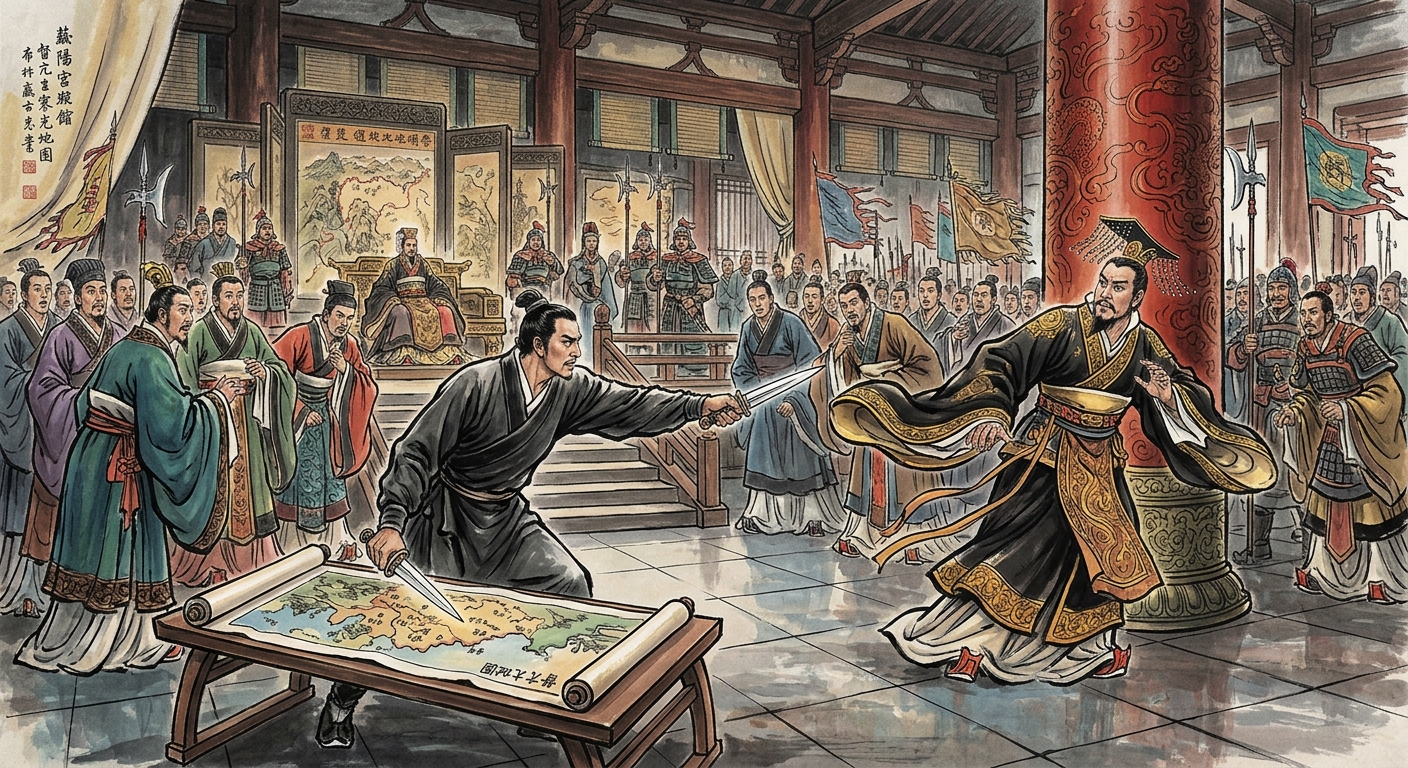
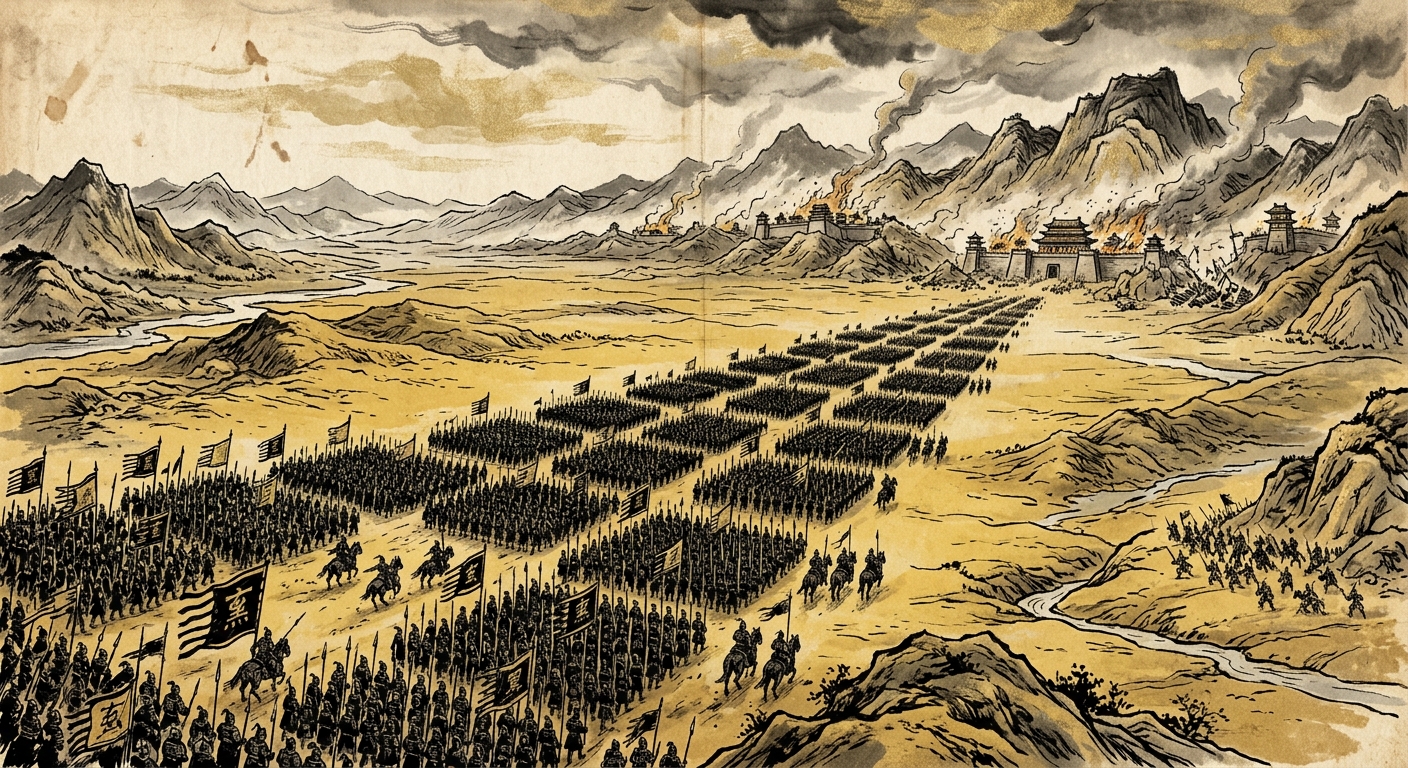
There were no miracles in these ten years. Wang Jian, Wang Ben, two generations of the Meng family, Neishi Teng — Qin’s generals took the field in turn, and the six states fell one by one. The last state was Qi: King Jian of Qi raised not one soldier, opened his gates, and was starved to death in a pine grove at Gong. 19 Five hundred years of the Warring States ended with a bloodless surrender.
The First Emperor
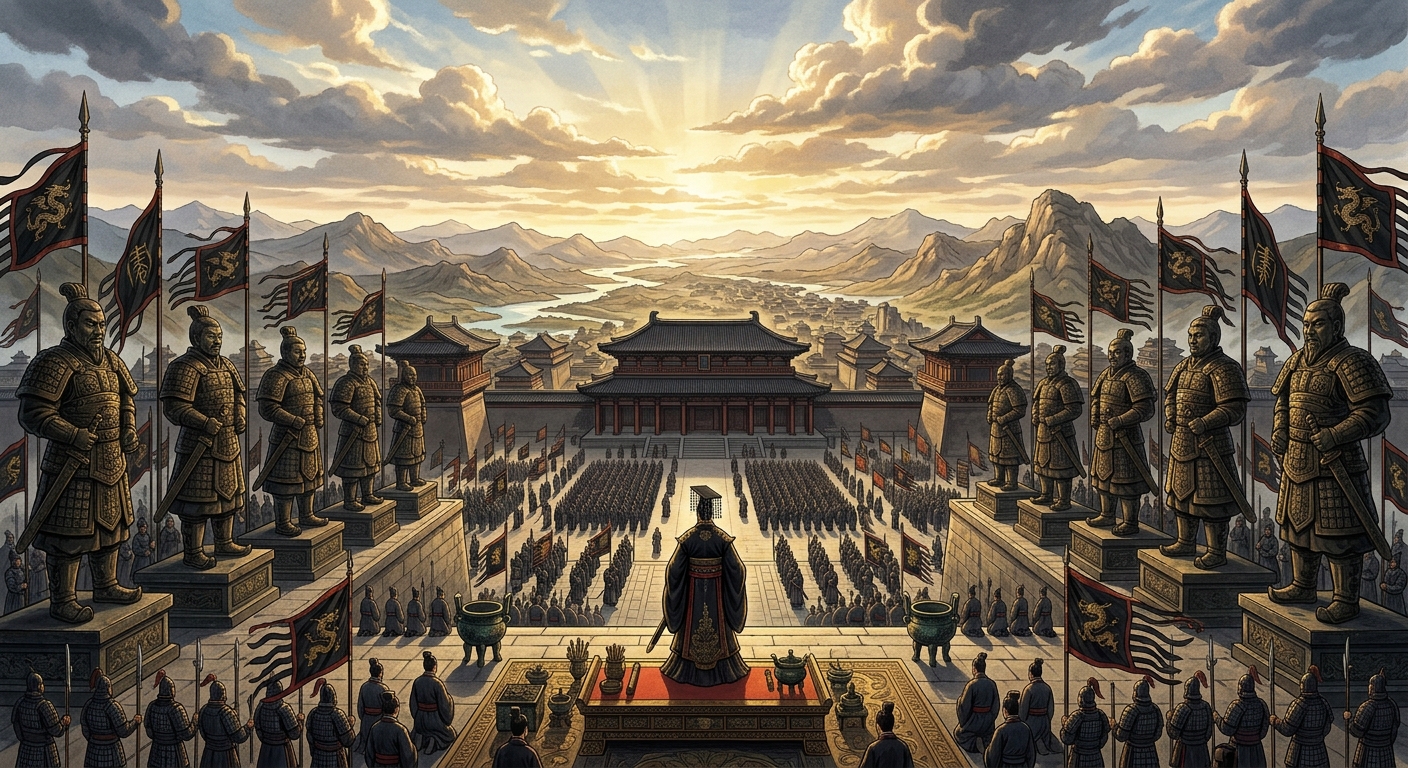
All-under-Heaven newly settled, the first great business was not rewarding anyone. It was renaming.
The ministers debated the imperial title. The chancellor Wang Wan proposed: of old there were the Heavenly Sovereign, the Earthly Sovereign, the Tai Sovereign — the Tai most exalted; let this be the honorific. Ying Zheng’s reply deleted one character and kept another:
王曰:去泰,著皇,采上古帝位号,号曰皇帝。他如议。
制曰:朕闻太古有号毋谥,中古有号,死而以行为谧。
如此,则子议父,臣议君也,甚无谓,朕弗取焉。
自今已来,除谥法。朕为始皇帝。
后世以计数,二世三世至于万世,传之无穷。
《史记·秦始皇本纪》 (Records, Annal of the First Emperor)
MeaningThe king said: strike out "Tai," keep "Huang," and adopt the ancient rank of Di: let the title be Huangdi — Emperor. The rest as proposed. The edict said: I have heard that in highest antiquity there were titles but no posthumous names... Thus sons would discuss fathers and ministers discuss rulers — it is most unmeaning; I do not accept it. From this day, abolish the posthumous-name system. I am the First Emperor. Let my successors be counted: Second Emperor, Third Emperor, to ten thousand generations, without end.
The word “emperor” — huangdi — was his coinage: the huang of the Three Sovereigns joined to the di of the Five Emperors. Its first accompanying decree abolished the posthumous-name system — the custom of letting ministers grade a ruler’s life with one character after death. He abolished it: no one would grade him. 20
He did not know that more than four hundred rulers would eventually sit in that seat; and after “the First,” the next was indeed “the Second.”
Commanderies and Counties
Once the title was settled, the next fight came fast: what to do with the conquered lands.
The chancellor Wang Wan proposed: Yan, Qi and Chu are too far to hold without princes of the blood — enfeoff the king’s sons. The court agreed. Only the commandant of justice Li Si objected — Zhou enfeoffed too many of its own, their descendants grew estranged and attacked each other like enemies, and the Son of Heaven could not stop them. The First Emperor ruled:
始皇曰:天下共苦战斗不休,以有侯王。
赖宗庙,天下初定,又复立国,是树兵也,
而求其宁息,岂不难哉!廷尉议是。
分天下以为三十六郡,郡置守、尉、监。
《史记·秦始皇本纪》 (Records, Annal of the First Emperor)
MeaningThe First Emperor said: all-under-Heaven has suffered endless fighting because of the lords and kings. Relying on the ancestral temple, the world is newly settled — to establish kingdoms again is to plant soldiers. And to seek peace so — is it not hard! The commandant of justice is right. Divide all-under-Heaven into thirty-six commanderies, and in each set a governor, a commander, and an inspector.
Eight hundred years of enfeoffment died in one court debate. Thirty-six commanderies, each with a governor, a commander and an inspector appointed by the center — the skeleton of China’s local government for the next two thousand years was set on this day. Dynasties changed, commandery names changed, and the skeleton — officials of the center governing the local — was never replaced.
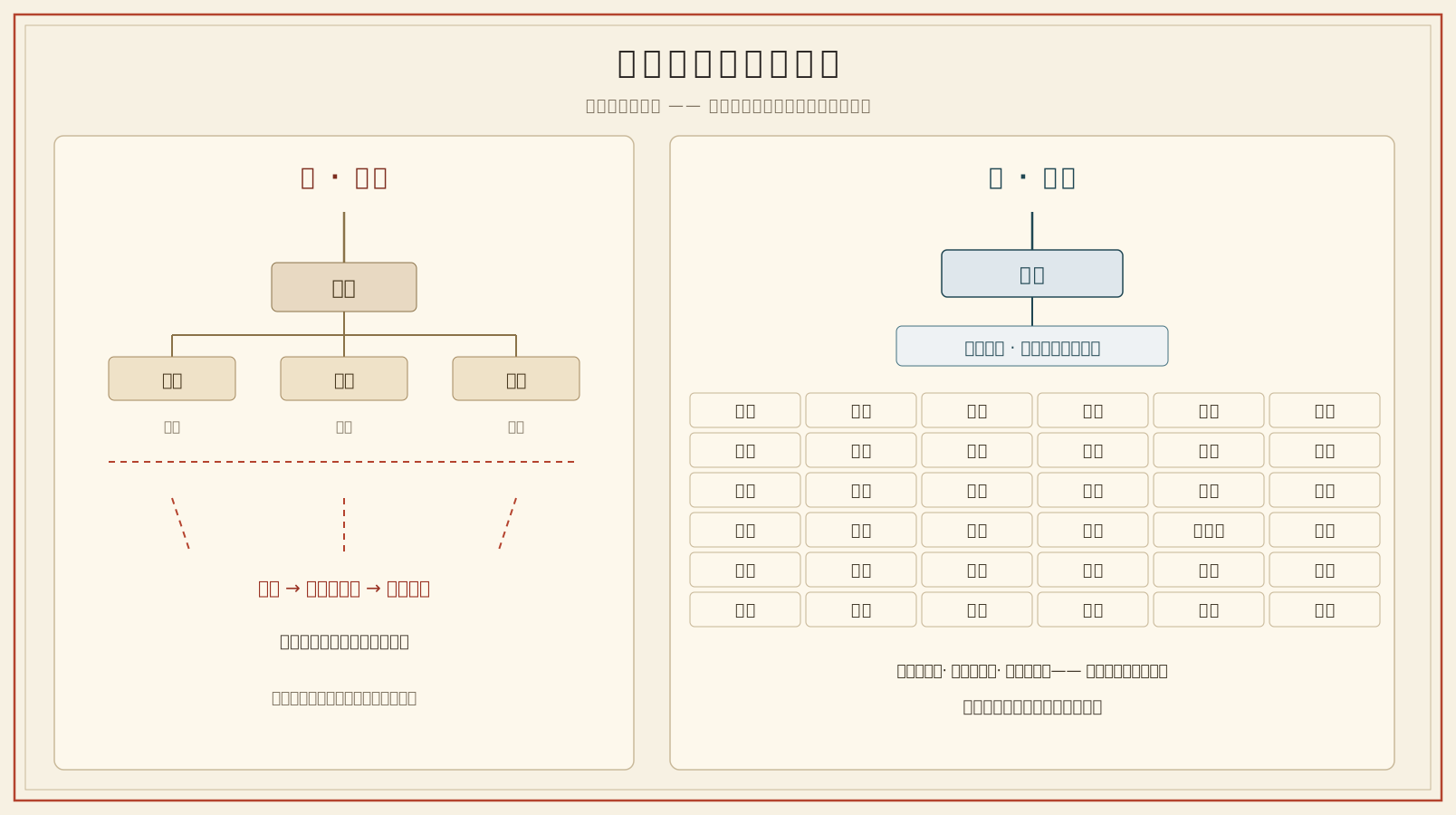
Zhou had spent eight hundred years proving that enfeoffment means war; he spent one court debate deciding never to run the experiment again.
One Standard
Then came a string of decrees so terse they read like a ledger:
收天下兵,聚之咸阳,销以为钟鐻,金人十二,重各千石,置廷宫中。
一法度衡石丈尺。车同轨。书同文字。
更名民曰黔首。
《史记·秦始皇本纪》 (Records, Annal of the First Emperor)
MeaningThe weapons of all-under-Heaven were gathered in Xianyang and melted into bell-stands; twelve bronze colossi were cast, each weighing a thousand dan, and set in the palace. The laws, the weights and measures, the bushel and the foot were made one. The axle-widths of carts were made one. The writing was made one. The people were renamed Qianshou — the Black Heads.
One standard for the measures. One axle-width for the carts. One script for the writing. Fourteen characters, three tasks, separated by full stops, like a work order. This list is what made the later “China” possible — through every later age of division, a common measure and a common script were there to reunite it. 22
He also recolored the world: the five powers cycle in turn — Zhou held the fire power, Qin succeeded it, and so Qin held water: “banners and robes all take black,” the number six ordered the calendar, the Yellow River renamed the River of Power. And Sima Qian copied down the temperament of water as statecraft: “Resolute and harsh, deciding everything by law, cutting and cruel, withholding benevolence, grace and justice — thus according with the tally of water.” So the laws grew urgent, and pardons ceased. 23
The system had no feelings. That is not a metaphor; it is a design specification.
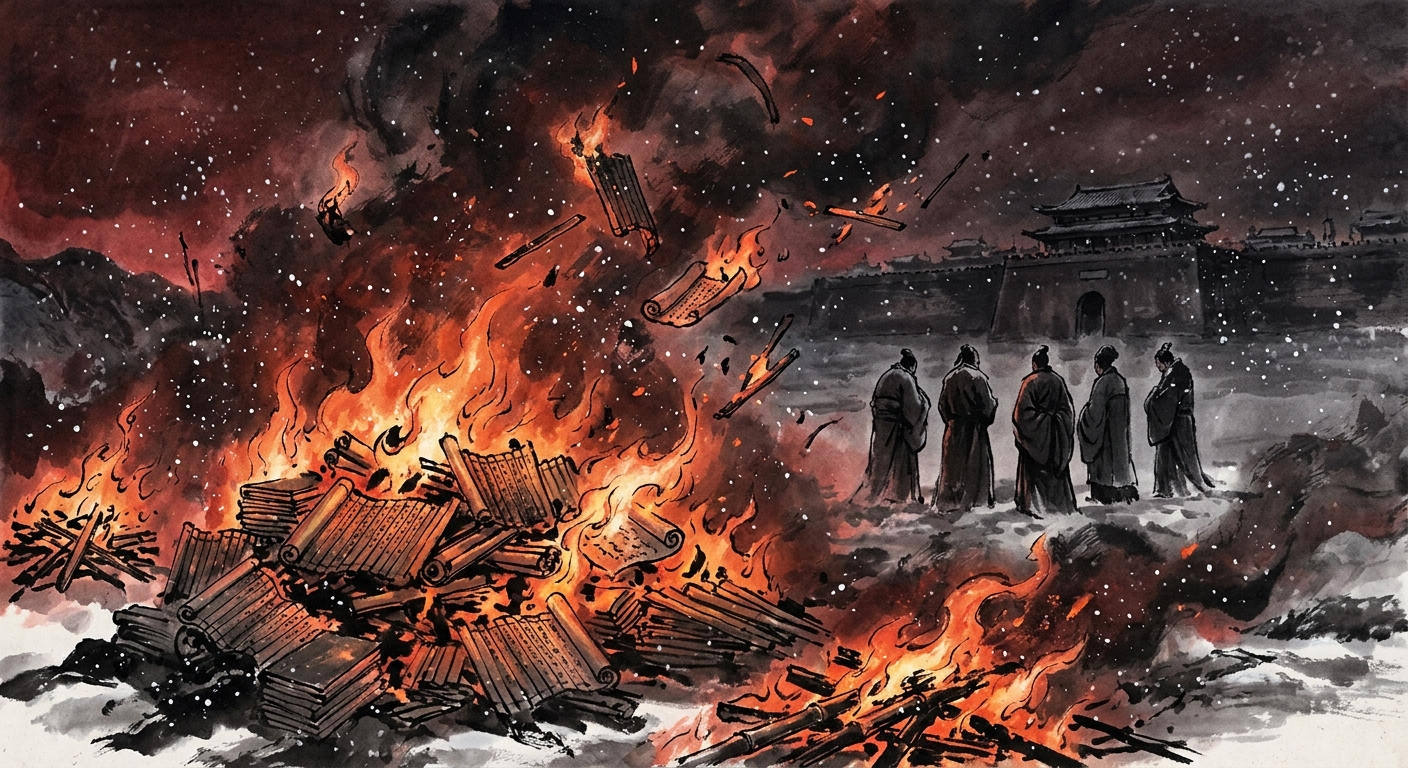
The Burning of the Books
In the eighth year after unification, the system turned on the scholars.
In the thirty-fourth year, wine was poured in the Xianyang palace, and the erudite Chunyu Yue revived the old cause of enfeoffment: Yin and Zhou endured a thousand years because they enfeoffed kinsmen and heroes as branches and shields — “I have never heard of a rule lasting long that did not take the ancients for its model.” Chancellor Li Si rebutted him, and carried it to a memorial:
臣请史官非秦记皆烧之。非博士官所职,
天下敢有藏诗、书、百家语者,悉诣守、尉杂烧之。
有敢偶语诗书者弃市。以古非今者族。
吏见知不举者与同罪。令下三十日不烧,黥为城旦。
所不去者,医药卜筮种树之书。
若有欲学法令者,以吏为师。制曰:可。
《史记·秦始皇本纪》 (Records, Annal of the First Emperor)
MeaningYour servant asks that the records of the historians, all except the annals of Qin, be burned; that all in the empire who dare keep the Songs, the Documents or the words of the hundred schools deliver them to the governors and commanders to be burned together; that those who dare discuss the Songs and Documents in pairs be executed in the marketplace; that those who use antiquity to condemn the present be exterminated with their kin; that officials who know and do not report share their crime; that thirty days after this decree, those who have not burned their books be branded and sent to build the walls; that the books to spare be those of medicine, divination and arboriculture; and that whoever wishes to study the laws take the officials as his teachers. The edict said: Approved.
The next year, the magicians Lu Sheng and Hou Sheng, sent to find the elixir, privately mocked the emperor — “headstrong,” “greedy for power” — and ran. The First Emperor raged, had the scholars interrogated, the scholars denounced one another, and in the end “more than four hundred and sixty transgressors were buried alive at Xianyang.” 24
The burning was the system unifying memory: the past would have exactly one version. The burying was the system answering criticism: from then on, discussing the emperor was itself the crime. “Take the officials for your teachers” folded all learning in the land into the state. Every generation of scholars has carried this memory for two thousand years — it is the most direct source of the two characters “tyrant Qin,” and the deepest stain on Li Si’s life.
The Wall and Epang
In the north, Lu Sheng returned from the sea with a book of charts bearing four characters: “The one who destroys Qin is Hu.” The First Emperor’s answer was to take the word literally —
始皇乃使将军蒙恬发兵三十万人北击胡,略取河南地。
西北斥逐匈奴。自榆中并河以东,属之阴山,
以为三十四县,城河上为塞。
又使蒙恬渡河取高阙、阳山、北假中,筑亭障以逐戎人。
《史记·秦始皇本纪》 (Records, Annal of the First Emperor)
MeaningThe First Emperor sent General Meng Tian north with three hundred thousand men against the Hu, seizing the lands south of the Yellow River, and drove the Xiongnu from the northwest. From Yuzhong along the river eastward to the Yin mountains he set up thirty-four counties, and built walls on the riverbanks as barrier. He then sent Meng Tian across the river to take Gaque, Yangshan and Beijia, building towers and barriers to drive off the Rong.
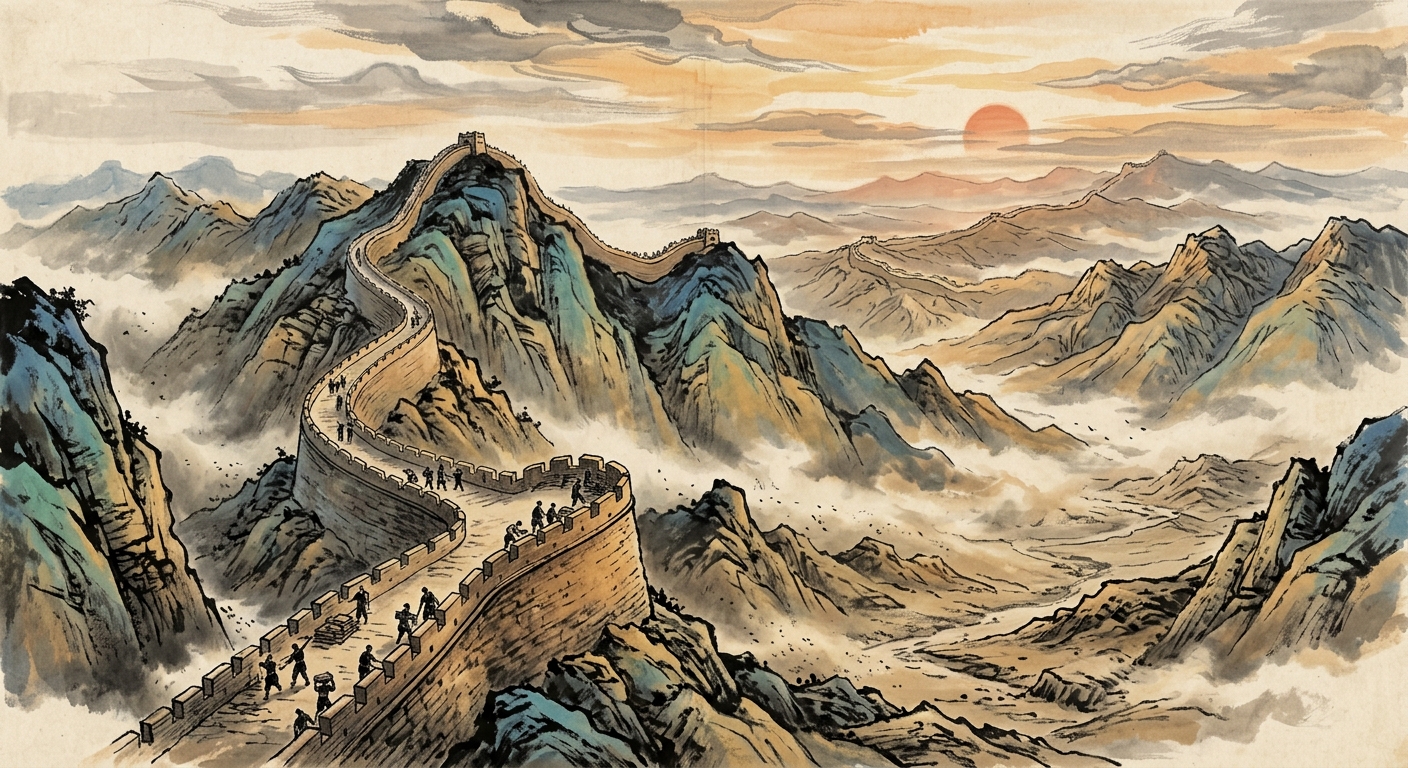
Three hundred thousand men marched north, and the wall began to link up — “even judges who judged unjustly were sent to build the wall,” officials sentenced to the ramparts for bad verdicts. 26 In the south, five hundred thousand men garrisoned the Five Ridges. In Xianyang, the court palace began in the Shanglin park south of the Wei: “First the front hall of Epang — east to west five hundred paces, north to south fifty zhang; above, ten thousand could sit; below, banners of five zhang could be raised.” 27
A world fresh off a hundred years of war was supporting at once the northern wall, the southern ridges, the Epang palace, the speedways and the direct roads. The works became “greatness” — the wall is still China’s most famous line. But Sima Qian kept the ledger of labor precise: the story of Meng Jiangnü is a later invention, 28 and the true history has no names for tears — only rosters of convicts.
Seeking Death’s Opposite
At the summit of power, he began trying to defeat death.
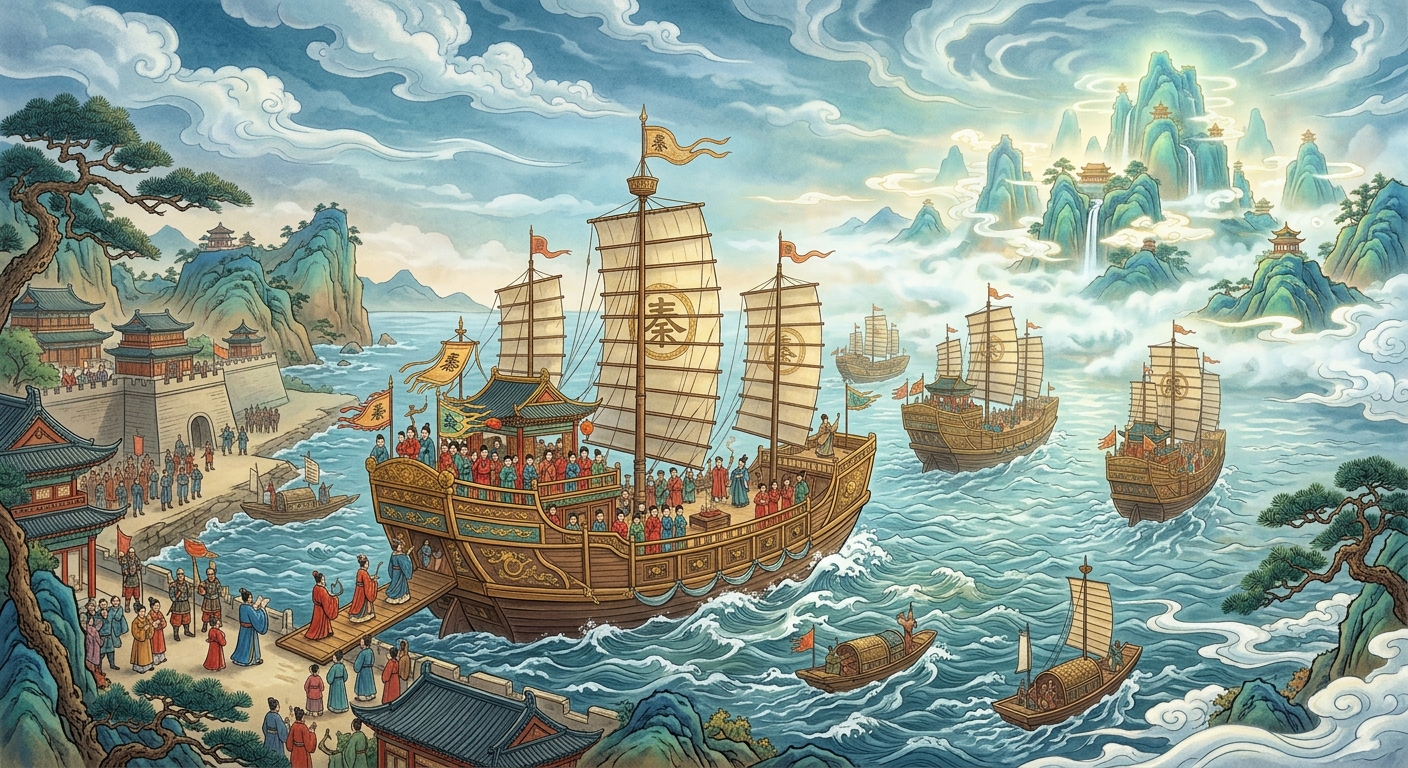
Xu Fu of Qi petitioned that in the sea were three spirit mountains — Penglai, Fangzhang, Yingzhou — where immortals lived; let him purify himself and lead boys and girls to sea to seek them. The emperor “sent Xu Fu with several thousand boys and girls into the sea to seek the immortals.” 29 In the thirty-second year he came in person to Jieshi, “sent Lu Sheng of Yan to seek Xianmen and Gaoshi,” and “sent Han Zhong, Hou Gong and Shi Sheng to seek the drug of deathlessness.” The magicians put to sea batch after batch and came back empty-handed; gold and children sank into the sea without an echo.
No elixir — but a book. Lu Sheng returned from the sea with a chart-and-prophecy volume: “The one who destroys Qin is Hu.” 30 So the emperor sent three hundred thousand north against the Xiongnu — “Hu,” he read as the Hu people. That is why the wall linked up.
Later readers all know: “Hu” meant his own son, Huhai. The cruelest thing about the prophecy is that the money and the men spent on it fed the very “Hu” it named — Meng Tian’s army on the northern border, Fusu far away in Shangjun, and in Xianyang, what remained was Zhao Gao and Huhai.
The man who coined “ten thousand generations” was at the same moment buying immortality with heavy gold. He wanted an empire that lasted forever, and he wanted to live forever himself — both desires were enormous.
Shaqiu
In the thirty-seventh year, the First Emperor began his fifth tour. At Pingyuan Ford he fell ill.
至平原津而病。始皇恶言死,群臣莫敢言死事。
上病益甚,乃为玺书赐公子扶苏曰:与丧会咸阳而葬。
书已封,在中车府令赵高行符玺事所,未授使者。
七月丙寅,始皇崩于沙丘平台。
丞相斯为上崩在外,恐诸公子及天下有变,乃秘之,不发丧。
棺载辒凉车中。
《史记·秦始皇本纪》 (Records, Annal of the First Emperor)
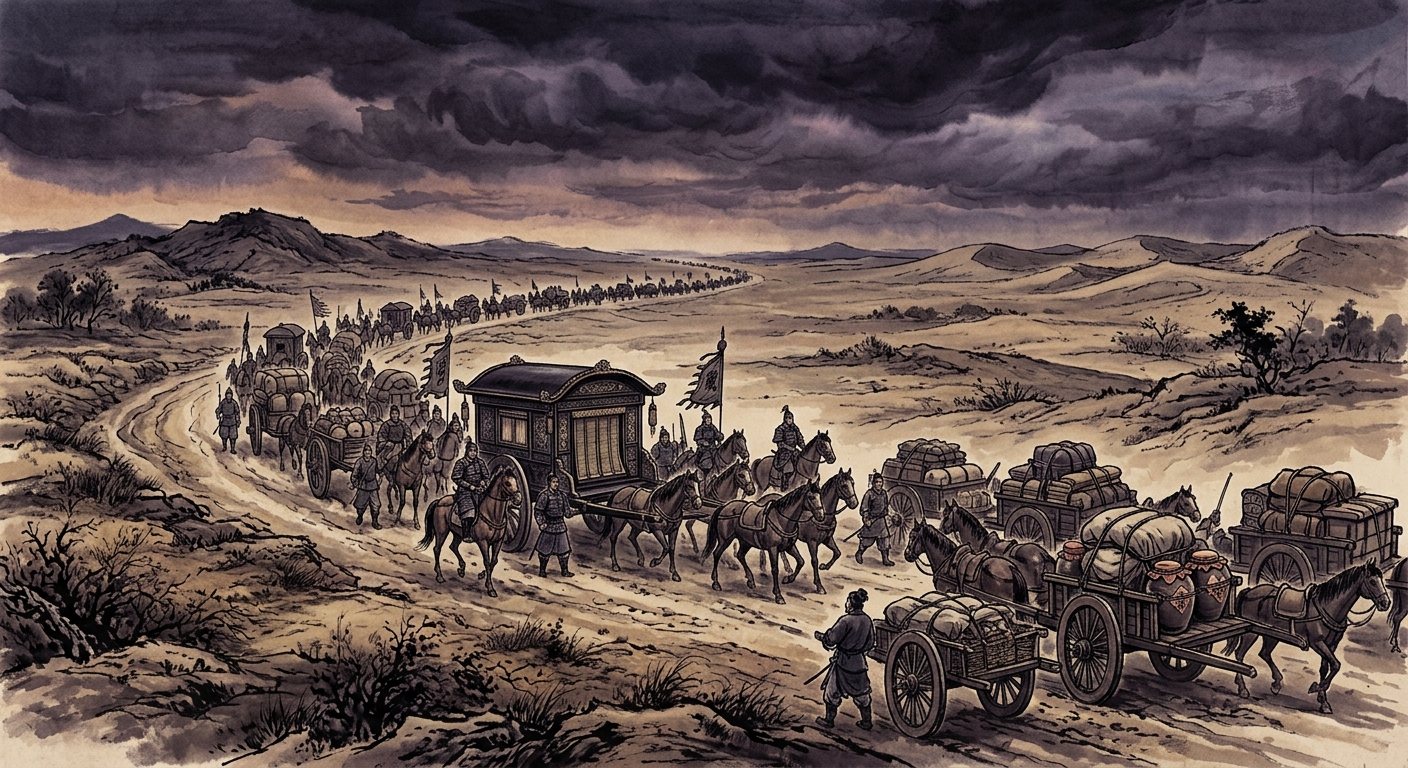
MeaningAt Pingyuan Ford he fell ill. The First Emperor hated any mention of death, and none of the ministers dared raise it. His illness grew worse, and he wrote a sealed letter to Prince Fusu: come to Xianyang for the funeral and the burial. The letter was sealed, and sat with the commandant of the royal carriages, Zhao Gao — never yet given to a messenger. In the seventh month, on the day bing-yin, the First Emperor died at the Shaqiu terrace. Chancellor Li Si, with the sovereign dead away from the capital, feared a rising among the princes or the realm, and kept the death secret. The coffin was carried in the refrigerated traveling carriage.
The letter to Fusu was sealed, but it still sat in Zhao Gao’s hands. The emperor was dead, and Zhao Gao withheld the letter. He understood exactly what it meant: Fusu trusted Meng Tian, and Meng Yi was his mortal enemy — once that letter left, his career, maybe his life, was over.
He went first to Huhai, and opened with a lethal question: “The Sovereign is dead; no decree enfeoffs the princes, but the eldest son alone received a letter. When he arrives he will be emperor — and you, sir, have not an inch of land. What will you do?” Huhai at first kept the rules: “To depose the elder and set up the younger is unrighteous; to disobey the father’s decree for fear of death is unfilial.” Zhao Gao did not argue virtue; he told old stories: Tang and Wu killed their lords and the world called it righteous; the lord of Wei killed his father and Wei praised his virtue — “In great undertakings do not mind small scruples; great virtue does not decline.” “To fix on the small and forget the great brings harm; to hesitate brings regret. Decide and dare to act, and even the spirits will step aside.” Huhai fell silent.
The second was Li Si. Zhao Gao’s five questions struck at everything Li Si cared about:
君侯自料能孰与蒙恬?功高孰与蒙恬?
谋远不失孰与蒙恬?无怨于天下孰与蒙恬?
长子旧而信之孰与蒙恬?
《史记·李斯列传》 (Records, Biography of Li Si)
MeaningJudged against Meng Tian, my lord — your ability? Your merit? Your far-sighted cunning? Your blamelessness in the eyes of the world? The eldest son’s old trust in you?
Li Si admitted: “In all five I am no match for Meng Tian.” Then Zhao Gao showed the card underneath: Qin had never seen a dismissed chancellor or executed minister whose enfeoffment passed to a second generation — every one of them ended in ruin; the eldest son was resolute and martial, and on his accession Meng Tian would surely be chancellor — “you, my lord, will never carry the seal of a marquis home to your village. It is clear.” Li Si looked up to heaven and sighed, weeping: “Ah! Born alone into these chaotic times, with no death to my name, where shall I entrust my life?” And he followed Zhao Gao. 31
The three conspired through the night: they claimed the First Emperor’s testament had been given at Shaqiu, proclaimed Huhai heir; then sealed a new edict with the imperial seal and sent it to Shangjun — in the First Emperor’s voice, counting Fusu’s crimes: more than ten years on the frontier without an inch of success, letters slandering my conduct; unfilial as a son — he is to cut his own throat with the given sword; Meng Tian did not correct him, disloyal as a minister — he is to die, his troops given to the deputy general Wang Li. 32
The envoy reached Shangjun and opened the letter. Fusu wept, went into the inner rooms, and meant to kill himself. Meng Tian stopped him: the Sovereign is away and has named no heir; one envoy comes and you die — how do you know it is not a forgery? Ask again; ask again and then die — it will not be too late. The envoy pressed them again and again. Fusu was humane; he told Meng Tian: “A father ordering a son’s death — to what end ask again?” And he killed himself. Meng Tian refused to die and was bound and sent to Yangzhou — to the end asking: what crime have I committed against Heaven? 33
The envoy returned. Huhai, Li Si and Zhao Gao were overjoyed.
The procession kept touring, from Jingxing to Jiuyuan, a loop of thousands of kilometers back to Xianyang. It was high summer, and “the traveling carriage began to stink” — the emperor’s body was decaying in the carriage, “so an order had the attendants load a dan of salted fish” to cover the smell with salt-fish. 34 Along the road the officials kept reporting as usual, and the replies from inside the carriage came from Zhao Gao.
The man who invented “First Emperor” died on the road, and his body entered the city mixed with the smell of fish. He abolished the posthumous names so that no one would discuss him after death — and the first thing discussed after his death was the corpse that had fooled an empire.
The Deeds and the Faults
He died at Shaqiu; the account must be reckoned from the beginning.
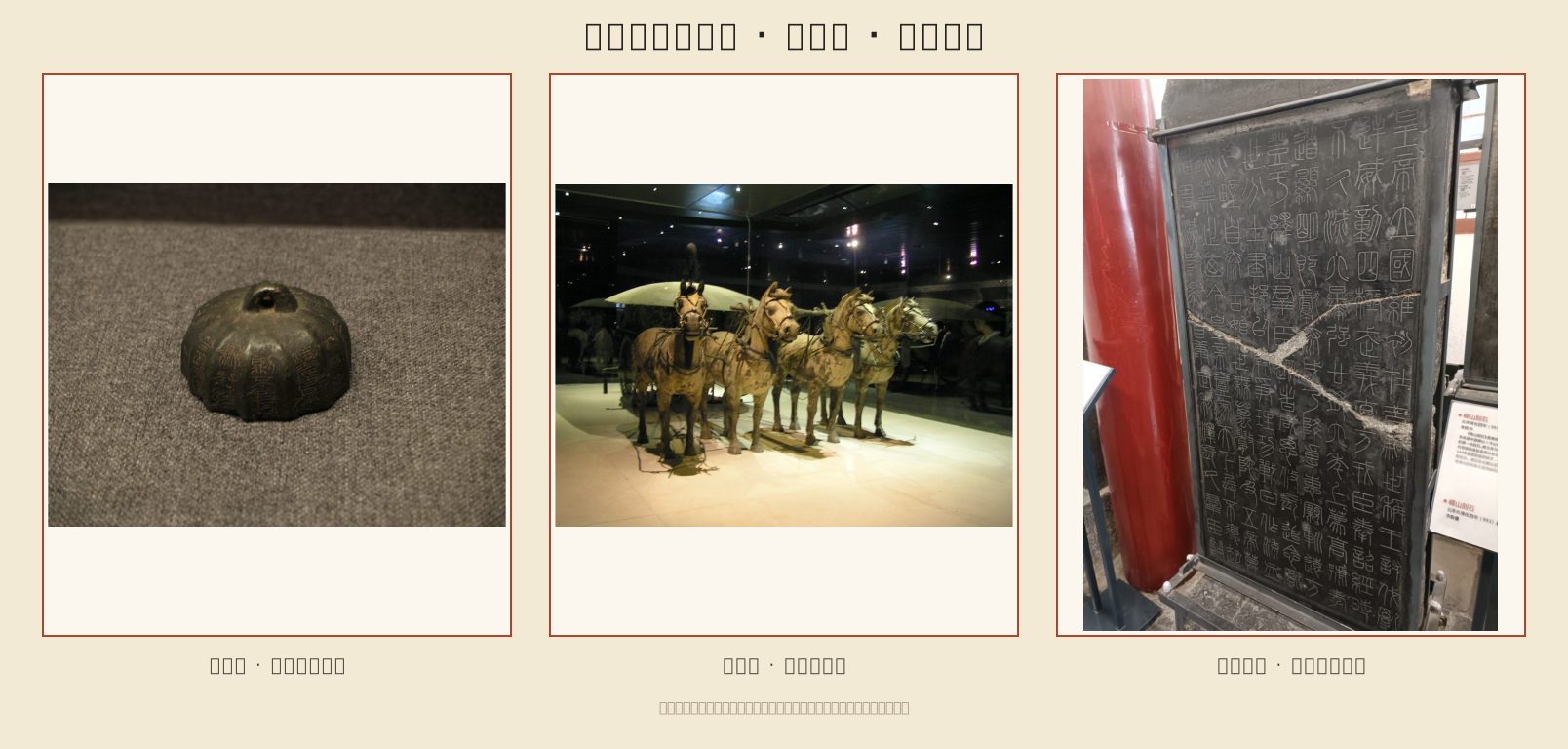
The deeds first. What he left behind, almost every dynasty used: the imperial institution framed supreme power for the next two thousand years; the commandery-county system turned “all-under-Heaven” into something governable — dynasties changed their names and kept Qin’s skeleton; “one measure for all vessels, one script for all writing” let people whose speech was mutually unintelligible share one writing forever; the edict standardizing weights and measures is still engraved on the bronze measures in museums. The northern wall drew the line between farmland and steppe; the southern campaigns brought Lingnan into the map. These are not “heritage,” a soft word — they are foundations still bearing weight today.
Merit needed to speak for itself. In the twenty-eighth year, Ying Zheng climbed Langya on his eastern tour, built a terrace over the sea and stayed three months, “erected a stone and inscribed it, praising Qin’s virtue, making plain his satisfaction.” The stone survives — the fragment in the National Museum of China, and a marker stone at Langya Terrace in Qingdao. The opening of the inscription set the key for his own legacy:
维二十八年,皇帝作始。
端平法度,万物之纪。以明人事,合同父子。
皇帝之功,劝劳本事。上农除末,黔首是富。
器械一量,同书文字。
日月所照,舟舆所载。皆终其命,莫不得意。
《史记·秦始皇本纪》载琅琊刻石 (Records, Annal of the First Emperor, quoting the Langya inscription)
MeaningIn the twenty-eighth year the Emperor began. He made laws and standards even, the tally of all things; he made human affairs clear and father and son at one. The Emperor’s work is to urge the root tasks: honor farming, restrain the trades, enrich the Black Heads. Vessels one measure, writing one script. All the sun and moon shine on, all that boats and carts carry — they end their days, every one, content.
- 劝劳本事
- The stone itself reads "qinlao" (diligent labor); the Records transcribe "quanlao" (urging labor). "Root tasks" refers to farming.
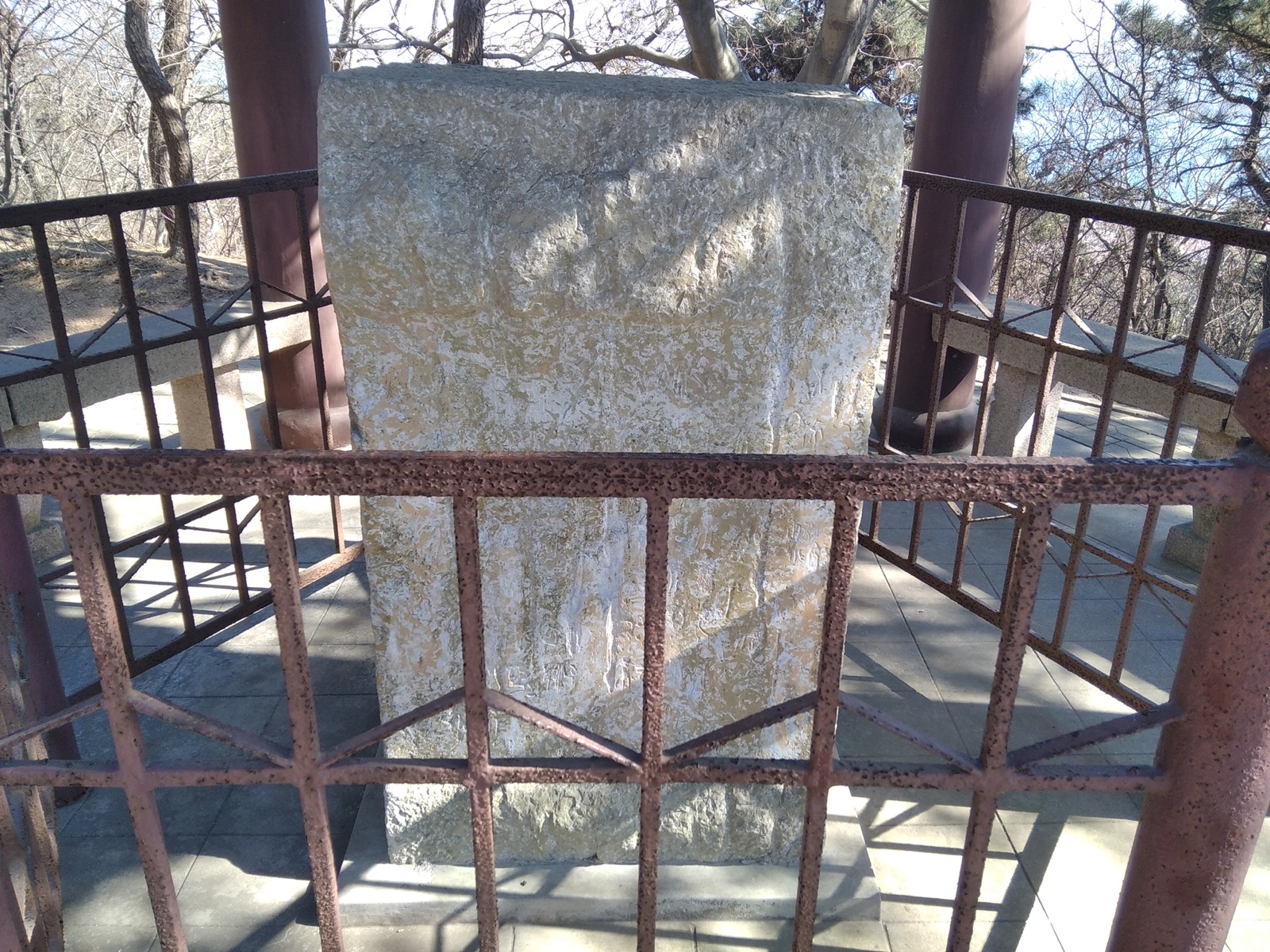
The self-praise exaggerates; the territory was real. After the stone, the empire’s borders really did advance as the inscription claimed: in the north, Meng Tian’s three hundred thousand drove the Xiongnu from the Ordos, thirty-four counties were set along the river, “walls built on the banks as barrier”; in the south, in 214 BC the armies took the Lu Liang lands and set the three commanderies of Guilin, Xiang and Nanhai — the first time a central kingdom’s southern border reached Lingnan. To feed the southern campaign, Jian Lu cut the Lingqu canal, joining the Yangtze and Pearl watersheds — it still irrigates Xing’an in Guangxi today. 35 With the speedways and direct roads, the emperor’s writ could reach, by galloping horse, every parcel of land he claimed.
六合之内,皇帝之土。
西涉流沙,南尽北户。东有东海,北过大夏。
人迹所至,无不臣者。
功盖五帝,泽及牛马。
《史记·秦始皇本纪》载琅琊刻石 (Records, Annal of the First Emperor, quoting the Langya inscription)
MeaningWithin the six directions, all is the Emperor’s land: west to the shifting sands, south to the North-Facing Doors, east to the Eastern Sea, north beyond the Great Xia. Wherever human traces reach, there are none who do not bow. His merit covers the Five Emperors; his grace reaches the oxen and horses.
- 北户
- The far south, where doors open northward to escape the sun — hence the name.
The ledger of institutions and infrastructure has been reckoned above: the title framed supreme power; thirty-six commanderies made the world governable; one script, one axle-gauge, one standard of weights and measures with the banliang coin made this land whole for the first time. Put together, the weight of it is clear: for five hundred and fifty years before him the Zhou kings could not do it, the five hegemons could not, the seven contenders could not — before him, “unifying all-under-Heaven” was an ambition that had never once been realized. 36
The faults next. The first is law: “resolute and harsh, deciding all by law, cutting and cruel, withholding benevolence, grace and justice” — the state was designed as a machine without feelings, light crimes heavily punished, “the long-held unforgiven.” The second is thought: the burning and the burying, told above — what burned was never just bamboo; it was the right of “discussion” itself. The heaviest third is manpower. The Annal records Lishan and Epang:
隐宫徒刑者七十馀万人,
乃分作阿房宫,或作丽山。
发北山石椁,乃写蜀、荆地材皆至。
关中计宫三百,关外四百馀。
《史记·秦始皇本纪》 (Records, Annal of the First Emperor)
MeaningConvicts of the hidden palace, more than seven hundred thousand of them, were divided: some built the Epang palace, some built Mount Li. Stone for coffins was cut in the northern hills; timber was floated down from Shu and Jing. Within the passes there stood three hundred palaces; beyond them, more than four hundred.
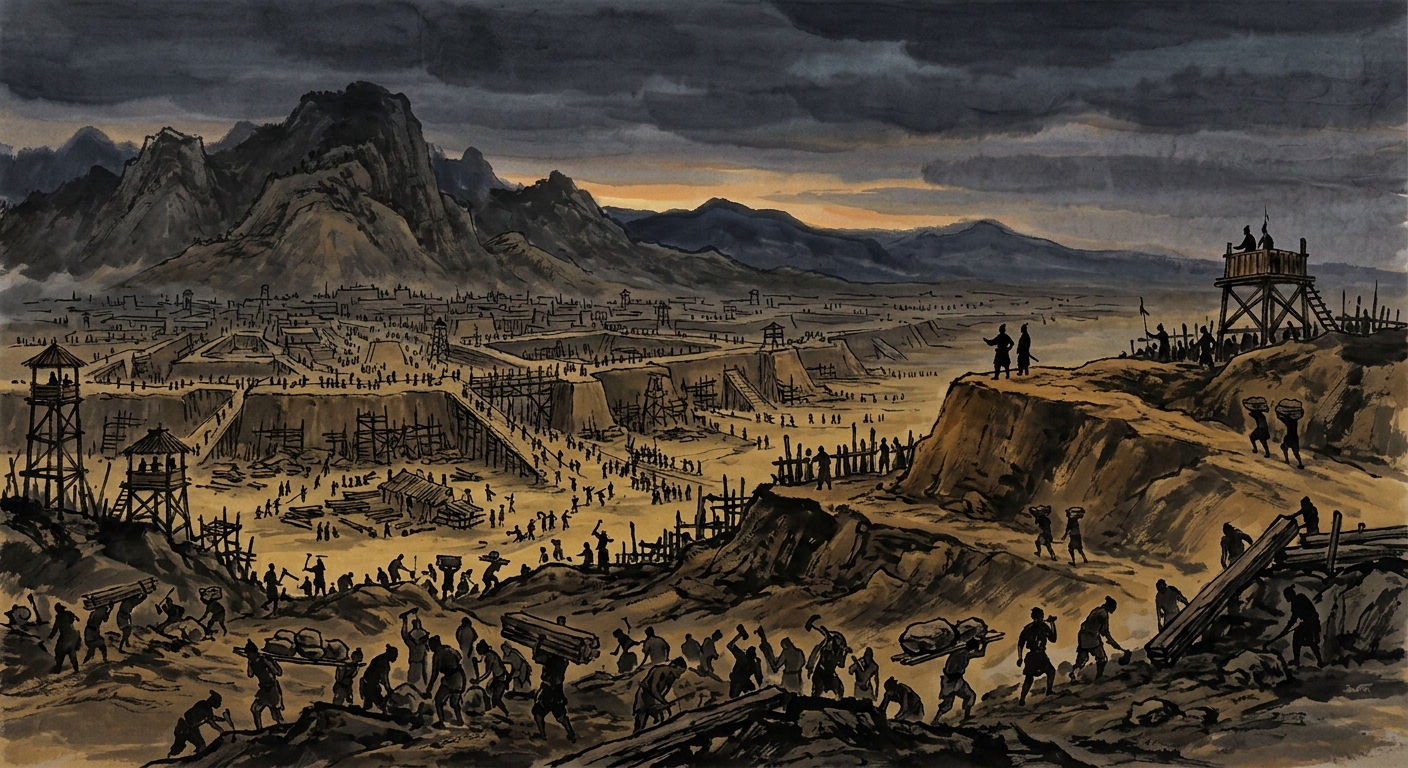
More than seven hundred thousand. Add Meng Tian’s three hundred thousand in the north, the five hundred thousand sent south, the corvée gangs on the speedways — in a country of perhaps twenty million, 37 nearly one person in ten served the state at any given time. The fourth is money: Xu Fu’s thousands of children and oceangoing ships, the alchemists’ budgets — fortunes sank into the sea and bought back not one true word.
And the greatest error grew out of his success: he trusted institutions, and he trusted his own lifespan. Naming an heir — that “middle antiquity” custom — was swept out with the posthumous names. He made no arrangements for after his death, because he did not believe he would die. The emperor died on the road, and within three months the empire’s handle was in Zhao Gao’s fist.
His accusers cite “benevolence unpracticed”; his admirers say “the emperor of all ages” — Li Zhi, at the Ming’s end, wrote in his Cangshu that “the First Emperor was indeed an emperor for the ages,” 38 while roadside scholars recited “tyrant Qin” for two thousand years. Perhaps the fairest verdict is this: he achieved what no one had achieved, and committed what no one had committed — for the first man to do a thing, deeds and faults have no precedents to copy.
Ten Thousand Generations, Fifteen Years
The ten thousand generations he planned lasted two.
In 209 BC, at Dazexiang, Chen Sheng and Wu Guang rose, crying “The world has suffered Qin too long.” Two years later Zhao Gao murdered the Second Emperor and set up Ziying; a year after that Liu Bang entered the passes, and Ziying, in a plain white carriage with a cord at his neck, presented the imperial seals and surrendered beside the Zhi road. Xiang Yu came after, killed Ziying, and burned the Qin palaces — the fire burned three months without dying out. The First Emperor’s thirty-seven-year enterprise: from proclaiming empire to losing it, fourteen and a half years; from founding the kingdom to its fall, fifteen. 39
At the end of this Annal, the Grand Historian quoted Jia Yi’s “Faults of Qin” at length, and pinned the question to one line:
一夫作难而七庙堕,身死人手,为天下笑者,何也?
仁义不施而攻守之势异也。
《史记·秦始皇本纪》引贾谊《过秦论》 (Records, Annal of the First Emperor, quoting Jia Yi’s "Faults of Qin")
MeaningOne common man rose in revolt and the seven ancestral temples fell; the emperor died at another’s hands and became the laughingstock of the world. Why? Because benevolence was unpracticed, and the balance of attack and defense had changed.
And yet this same Qin: the skeleton of thirty-six commanderies was taken over intact by every dynasty after; one writing kept this land reading together though its speech split a thousand ways; the standardization edict is still engraved on the bronze measures in museums. 40 The dynasty died in fifteen years; the institutions it built lived two thousand — how to grade this man became the longest-running argument in Chinese history.
Back to the canyon. In the game, Ying Zheng stands at the fountain, his ultimate falling across half the map — Peerless Among Kings. The official story gives him a caged “monster” for a companion, an education in “the royal house does not solve problems,” and a redemption in which he lifts the mask with his own hand — its writers had plainly read his history, and knew this man spent his life choosing between order and its price, so they wrote him a version that could be redeemed. 41
The true version offers no replay. He believed “action must happen now, in my own hands” — the in-game line that footnotes his whole life most exactly: everything done now, in his own hands — including the things that should not have been done now, or alone.
Every match in the canyon is the follow-up shot of the strike he never took. And that match, in history, has been running for two thousand years.
Notes
-
Honor of Kings official hero page, Ying Zheng, “Hero Story” (pvp.qq.com/web201605/herodetail/110.shtml, accessed 2026-10-18). Xuanyong, the blood clan, the southern wilds and the “monster” belong to the game’s worldview, not to history. Elements like “the Meng general” and “Jixia” in the story are deliberate historical echoes planted by the writers. ↩ ↩2 ↩3 ↩4
-
The same page, “The TA in History” column (accessed 2026-10-18). ↩
-
The battle of Changping was in 260 BC; the Qin general Bai Qi buried alive more than four hundred thousand Zhao surrendered soldiers. See the Records, Biography of Bai Qi and Wang Jian. ↩
-
The “rare commodity” dialogue and “the girl concealed her pregnancy” are from the Biography of Lü Buwei. On the question of Ying Zheng’s paternity Sima Qian preserves both accounts — the Annal states only “the First Emperor of Qin was the son of King Zhuangxiang of Qin.” ↩ ↩2
-
The quotes in this section are from the Records, Biography of Lü Buwei. ↩ ↩2 ↩3 ↩4 ↩5
-
King Xiaowen’s “death on the third day, xinchou” and King Zhuangxiang’s reign are in the Records, Basic Annals of Qin (scroll 5). Xiaowen’s three-day reign was the shortest in Qin history; the cause of King Zhuangxiang’s death is nowhere recorded. ↩
-
That Lao Ai entered the dowager’s palace through a false castration arranged by Lü Buwei is in the Records, Biography of Lü Buwei; the Annal records only “all matters were decided by Lao Ai” and the revolt. ↩
-
“The two sons the dowager bore were killed” and “Lao Ai’s three clans exterminated” are in the Biography of Lü Buwei; the Annal records the chariot-tearing, the beheadings and the four thousand households sent to Shu. ↩
-
After his dismissal Lü Buwei lived at his Henan fief and took poison in 235 BC. See the Records, Biography of Lü Buwei. ↩
-
“Secret burial”: Lü Buwei’s guests buried him at Beimang in Luoyang, and the king punished the mourners. See the Biography of Lü Buwei. ↩
-
Mao Jiao’s full remonstrance is preserved in the Shuoyuan; the Annal records only this one line and the outcome. ↩
-
Li Si’s “Memorial Against the Expulsion” was written here; its famous lines — “Mount Tai does not refuse soil, thus it grows so great” — are in the Records, Biography of Li Si. ↩
-
Wei Liao’s story and his description of the king are in the Annal of the First Emperor. “Wasp nose, long eyes, bird-of-prey chest, jackal voice” is the only direct physical description of Ying Zheng in the histories. ↩ ↩2
-
The line is quoted verbatim from the Annal: “The king went to Handan, and all those whose mothers’ families had quarreled with his when he lived in Zhao were buried alive.” ↩
-
Jing Ke’s attempt on the King of Qin was in 227 BC; the map unrolled, the dagger appeared, the plot failed. See the Records, Biographies of the Assassins. ↩ ↩2
-
Li Mu’s death and the fall of Zhao: Qin ran a scheme of separation, Guo Kai slandered him, the king replaced him with Zhao Cong and Yan Ju; Mu refused the order and was killed. See the Records, Annals of Zhao and the Biography of Bai Qi and Wang Jian. ↩
-
Lord Changping: a Chu prince serving Qin, rose to chancellor, helped Lord Wenwen suppress Lao Ai; in 223 BC Xiang Yan proclaimed him the last king of Chu, and he died in defeat. See the Records, Annal of the First Emperor and the Annals of Chu. ↩ ↩2
-
Li Xin failed with two hundred thousand; the king personally asked Wang Jian, who answered “six hundred thousand men, no fewer.” See the Records, Biography of Bai Qi and Wang Jian. ↩
-
After his surrender, King Jian of Qi was moved to Gong, “placed among pines and cypresses, where he starved to death.” See the Strategies of the Warring States, Qi VI. ↩
-
Posthumous names: after a ruler’s death, ministers chose a single character summarizing his life, praise or blame within it. Abolishing the system abolished posthumous judgment. ↩
-
The commandery-county system first appeared in the Spring and Autumn period; Qin deployed it everywhere and every dynasty kept it — “a hundred dynasties have walked Qin’s government” refers to this skeleton. ↩
-
The unified script standardized on small seal, said to be codified in Li Si’s Cangjie pian, Zhao Gao’s Yuanli pian and Hu Wujing’s Boxue pian; the original unification edict of the twenty-sixth year survives on Qin weights and edict-tablet inscriptions. ↩
-
The five-powers doctrine came from the naturalist Zou Yan. Claiming the water power, favoring black, ordering everything by six — this turned cosmology into state design. ↩
-
The Annal records the burial of “the scholars,” more than four hundred and sixty; the compound phrase “burning the books and burying the scholars” is a later summary. ↩
-
Li Si was later framed by Zhao Gao; in 208 BC he suffered the five punishments and was cut in half at Xianyang market, his three clans exterminated — by the very clause he had drafted. See the Records, Biography of Li Si. ↩
-
The Qin wall was rammed earth, not the brick wall of later ages; remains lie in Inner Mongolia and Gansu. The Records do not mention Meng Jiangnü; the legend took shape in the Tang. ↩
-
The Epang front-hall site lies west of modern Xi’an; the Records give its planned dimensions. Excavation has found no trace of fire; Xiang Yu burned the Qin palaces (Annal of Xiang Yu), whether including Epang is disputed. ↩
-
The Meng Jiangnü legend derives from the Qi Liang story in the Zuozhuan, unrelated to Qin; it drifted onto the wall after the Han. ↩
-
Xu Fu (Fu pronounced fú; Xu福 in the Huainan-Hengshan Biography). Later gazetteers claim he reached Japan; the official histories do not. ↩
-
“The one who destroys Qin is Hu” came from a chart-prophecy volume; the Annal gives it as the direct cause of Meng Tian’s northern campaign. ↩
-
The conspiracy dialogue and the three-way plot are from the Records, Biography of Li Si; the Annal summarizes it and notes “the details are in the Biography of Li Si.” ↩
-
The full text of the forged death edict is recorded in the Records, Biography of Li Si. ↩
-
Meng Tian, bound at Yangzhou, eventually took poison; before dying he blamed his fate on “cutting the veins of the earth.” See the Records, Biography of Meng Tian. ↩
-
A dan of baoyu: here salted fish, not the modern abalone. ↩
-
The Lingqu canal joins the Xiang and Li rivers; the First Emperor ordered it cut by Jian Lu to open the southern grain route. See the Records, Biography of Pingjin-Zhufu and the Huainanzi. It still irrigates Xing’an, Guangxi. ↩
-
The Spring and Autumn and Warring States troubles are usually counted from 770 BC (the move east) to 221 BC (the Qin unification): five hundred and fifty years. ↩
-
No exact census exists for the late Warring States; the common scholarly estimate is about twenty million (cf. Ge Jianxiong, A Population History of China, vol. 1). Service totals are approximations summed from the Annal’s figures. ↩
-
From Li Zhi (Ming), Cangshu, general survey of rulers and ministers. ↩
-
In 209 BC Chen Sheng and Wu Guang rose at Dazexiang; in 207 BC Zhao Gao murdered the Second Emperor and set up Ziying, Liu Bang entered the passes the same year, Ziying surrendered, and Qin fell. ↩
-
The Qin edict-tablets and bronze measures held by the Shaanxi Provincial Museum (from 1961) all bear the twenty-sixth-year edict, matching the text in the Annal. ↩
-
Same as 1. The official story ends with the unmasking — its theme is “facing and redemption”; “a version that could be redeemed” refers to this. ↩